Learning goals
- Use Q = It.
- Rearrange for current or time.
- Calculate charge with seconds and coulombs.
Multiply rate by duration
For a constant electric currentThe amount of electric charge passing a point per unit time, measured in amperes., electric chargeA property of particles responsible for electrical interactions, measured in coulombs. transferred is Q = It. Current I in amperes means coulombs per second, so multiplying by seconds gives coulombs. Use the time during which that current actually flows.
If current changes, a single instantaneous reading does not describe the whole interval. Use the average current for that interval, or add the charge transfers calculated over separate intervals.
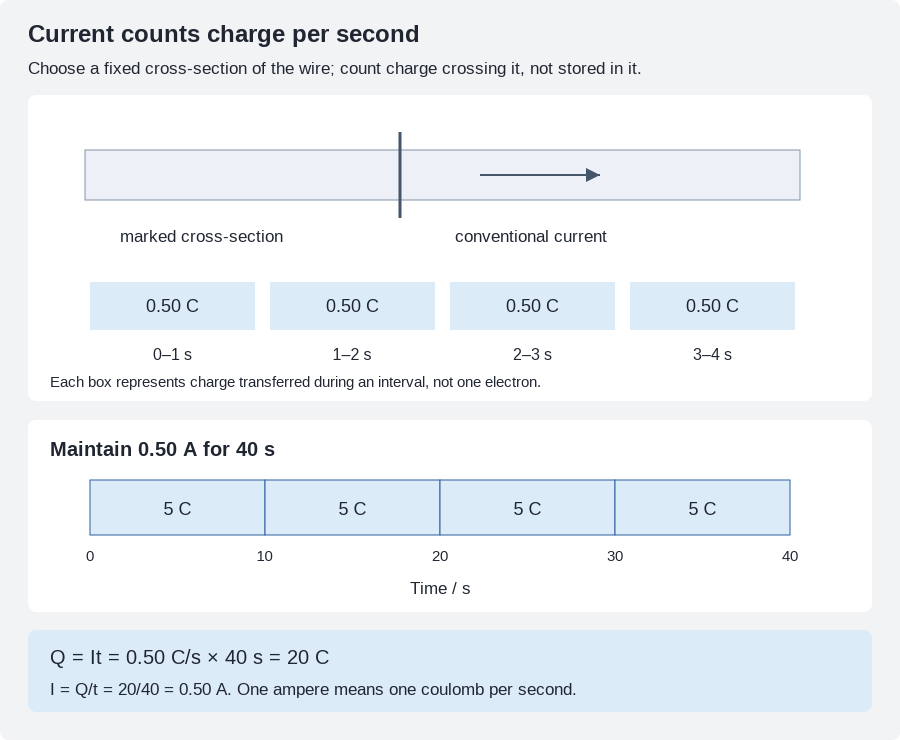
Worked timeline
A 0.50 A electric currentThe amount of electric charge passing a point per unit time, measured in amperes. flows for 40 s. Q = 0.50 × 40 = 20 C. Each ten-second section of the figure contributes 0.50 × 10 = 5 C, and four such sections give 20 C.
For the same duration, doubling current doubles electric chargeA property of particles responsible for electrical interactions, measured in coulombs. transferred. For the same current, doubling the duration also doubles charge. Neither change means that charge has been created; this is charge passing the chosen point.
Rearrange and check units
To find electric currentThe amount of electric charge passing a point per unit time, measured in amperes., I = Q/t: 20 C / 40 s = 0.50 A. To find duration, t = Q/I: 20 C / 0.50 A = 40 s. Convert minutes to seconds before using amperes to obtain coulombs.
For example, 0.50 A for two minutes transfers 0.50 × 120 = 60 C, not 1 C. The quantity counted by Q is electric chargeA property of particles responsible for electrical interactions, measured in coulombs., while electrical energyA conserved quantity transferred between stores by working, heating, electrical processes or radiation, measured in joules. also depends on the potential differenceThe energy transferred per unit charge between two points, measured in volts..
Equations
- Q = I × t
- I = Q ÷ t
- t = Q ÷ I
Common misconceptions
- A larger current transfers more charge per second; it does not necessarily flow for longer.
Connect charge flow to energy transfer
Change steady current, voltage and elapsed time, then compare charge passing a point with energy transferred.
What you see
- Labelled diagrams and numerical outputs describe the same selected state.
How to use it
- Change one control at a time, predict the outcome, then compare the readouts. All controls have keyboard-accessible sliders and step buttons.
- Reset restores every model control to its initial value. Nothing is saved.
What it shows
- Q=It sets the charge passing a point. Voltage is energy transferred per unit charge, so E=QV=IVt and P=IV. Doubling voltage at fixed current doubles energy but leaves charge unchanged. A resistor transfers electrical energy to thermal stores; its temperature also depends on quantities this model does not specify.
Limits of the model
- Current and component voltage are held constant at the selected operating values. Their relationship for a particular real component is not modelled.
- Elapsed time is scrubbed over 60 s. Charge is the amount passing a point, not charge created or consumed in a component. No temperature rise or cooling rate is calculated.
Controls
Q=It=0.5×20=10 C. E=QV=10×6=60 J. P=IV=3 W. At zero elapsed time, no charge has yet passed and no energy has yet transferred, even if the operating power is non-zero.
Predict, change and explain
At 0.5 A and 6 V, predict charge and energy after 20 s. Double only voltage: which graph changes? Then restore voltage and double current. Explain how a component can transfer more energy per coulomb without using up the charge.
Connect the outcome to the Physics
Q=It sets the charge passing a point. Voltage is energy transferred per unit charge, so E=QV=IVt and P=IV. Doubling voltage at fixed current doubles energy but leaves charge unchanged. A resistor transfers electrical energy to thermal stores; its temperature also depends on quantities this model does not specify.