Learning goals
- Define current using charge and time.
- Relate ampere to coulomb per second.
- Distinguish charge flow from voltage.
Count charge crossing a point
electric currentThe amount of electric charge passing a point per unit time, measured in amperes. is the rate of flow of electric chargeA property of particles responsible for electrical interactions, measured in coulombs. through a chosen cross-section. If charge Q passes in time t, the average current is I = Q/t. One ampere means one coulomb per second: 1 A = 1 C/s.
This is not the total charge present in a wire. A metal wire already contains electronA negatively charged subatomic particle found outside an atom’s nucleus. and positive ionAn atom or group of atoms with a net charge because electrons have been gained or lost., even when no net current flows. Current describes the transfer past a point over time.
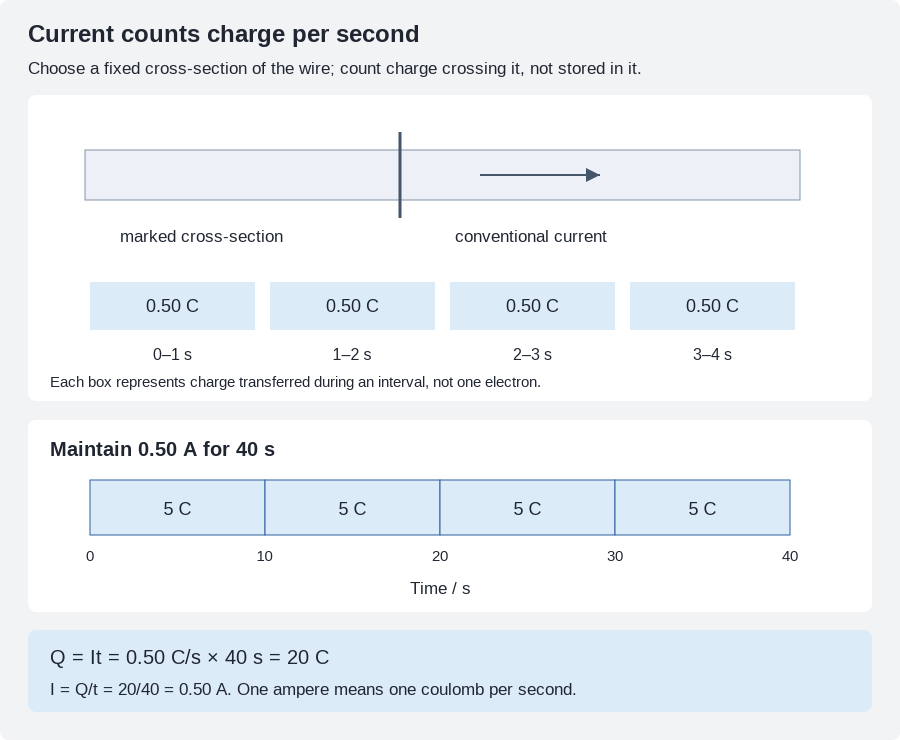
Read the interval model
In the figure, 0.50 C passes the marked point in each successive one-second interval. The electric currentThe amount of electric charge passing a point per unit time, measured in amperes. is therefore 0.50 C/s = 0.50 A. Over four seconds, 2.0 C passes, giving the same average: 2.0/4.0 = 0.50 A.
Each box accounts for a quantity of electric chargeA property of particles responsible for electrical interactions, measured in coulombs., not a single electronA negatively charged subatomic particle found outside an atom’s nucleus.. For the longer 40 s interval, 20 C passes at this steady current. A longer measuring interval accumulates more charge without changing the rate.
Current, voltage and direction
potential differenceThe energy transferred per unit charge between two points, measured in volts. describes energyA conserved quantity transferred between stores by working, heating, electrical processes or radiation, measured in joules. per electric chargeA property of particles responsible for electrical interactions, measured in coulombs. and can exist across an open gap without a continuous electric currentThe amount of electric charge passing a point per unit time, measured in amperes.. Closing a suitable path allows current. conventional currentThe direction positive charge would flow, opposite to electron movement in a metal. direction is the direction positive charge would flow; in a metal it is opposite to electronA negatively charged subatomic particle found outside an atom’s nucleus. drift. The next page uses the same quantities to calculate total charge.
Equations
- current = charge ÷ time
Common misconceptions
- Current is not the amount of charge stored in a component.
Connect charge flow to energy transfer
Change steady current, voltage and elapsed time, then compare charge passing a point with energy transferred.
What you see
- Labelled diagrams and numerical outputs describe the same selected state.
How to use it
- Change one control at a time, predict the outcome, then compare the readouts. All controls have keyboard-accessible sliders and step buttons.
- Reset restores every model control to its initial value. Nothing is saved.
What it shows
- Q=It sets the charge passing a point. Voltage is energy transferred per unit charge, so E=QV=IVt and P=IV. Doubling voltage at fixed current doubles energy but leaves charge unchanged. A resistor transfers electrical energy to thermal stores; its temperature also depends on quantities this model does not specify.
Limits of the model
- Current and component voltage are held constant at the selected operating values. Their relationship for a particular real component is not modelled.
- Elapsed time is scrubbed over 60 s. Charge is the amount passing a point, not charge created or consumed in a component. No temperature rise or cooling rate is calculated.
Controls
Q=It=0.5×20=10 C. E=QV=10×6=60 J. P=IV=3 W. At zero elapsed time, no charge has yet passed and no energy has yet transferred, even if the operating power is non-zero.
Predict, change and explain
At 0.5 A and 6 V, predict charge and energy after 20 s. Double only voltage: which graph changes? Then restore voltage and double current. Explain how a component can transfer more energy per coulomb without using up the charge.
Connect the outcome to the Physics
Q=It sets the charge passing a point. Voltage is energy transferred per unit charge, so E=QV=IVt and P=IV. Doubling voltage at fixed current doubles energy but leaves charge unchanged. A resistor transfers electrical energy to thermal stores; its temperature also depends on quantities this model does not specify.