Learning goals
- Predict force directions for charge pairs.
- Identify equal and opposite interaction forces.
- Explain why attraction alone cannot identify a charge.
Apply the charge rule
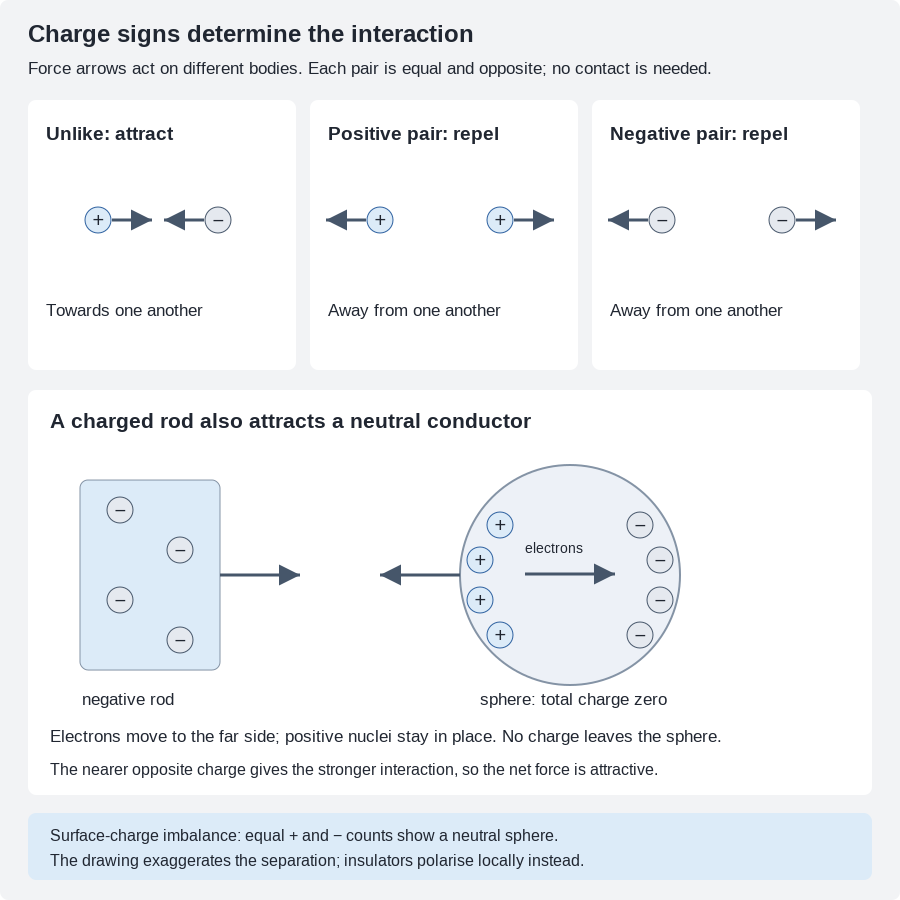
A positive and a negative charged object attract. Two positive objects repel, and two negative objects repel. These electrostatic forceThe attraction between unlike charges or repulsion between like charges. act without contact. For the simple separated objects in the figure, draw each forceA push or pull arising from an interaction between objects, measured in newtons. along the line joining them.
Each object exerts a force on the other. The two forces are equal in magnitude and opposite in direction, even if the objects have different massThe quantity measuring an object’s inertia, expressed in kilograms. or electric chargeA property of particles responsible for electrical interactions, measured in coulombs. magnitudes. They act on different objects, so they do not cancel when finding the force on one object. Different masses may give different accelerationThe change in velocity per unit time, measured in metres per second squared..
Use observations carefully
If a rod repels a known positively charged light sphere, the rod is also positive. If it repels a known negative sphere, it is negative. Keep the objects separated during the test so contact does not redistribute electric chargeA property of particles responsible for electrical interactions, measured in coulombs..
Attraction is less decisive: a positive object can attract a negative object or a neutral one. The lower panel shows how a negative rod attracts a neutral conductorA material containing mobile charged particles that carry an electric current. after its electronA negatively charged subatomic particle found outside an atom’s nucleus. redistribute. Do not infer an opposite net charge from attraction alone.
Limits of the sketch
The arrows indicate the direction and paired equality of forceA push or pull arising from an interaction between objects, measured in newtons., not a comparison of strength between the three separate examples. Actual force depends on electric chargeA property of particles responsible for electrical interactions, measured in coulombs., separation and geometry. A full force diagram may also need weightThe gravitational force acting on an object, equal to its mass multiplied by gravitational field strength., support or thread tensionThe pulling force transmitted through a stretched string, rope or similar object.; these are omitted to focus on electrostatics.
Equations
Common misconceptions
- Neutral objects can be attracted; attraction does not establish opposite net charge.