Learning goals
- Explain both signs using electrons.
- Account for charge before and after contact.
- Apply conservation of charge to an isolated pair.
Neutral does not mean empty of charge
A neutral object has equal total positive and negative electric chargeA property of particles responsible for electrical interactions, measured in coulombs.. Positive protonA positively charged nuclear particle with a mass approximately equal to that of a neutron. remain bound in nucleusThe dense central region of an atom containing protons and neutrons, except hydrogen-1 which has no neutron. during ordinary electrostatic charging. electronA negatively charged subatomic particle found outside an atom’s nucleus. can transfer between materials when their surfaces contact and separate.
An object that loses electrons has a deficit of negative charge and becomes positive. An object that gains electrons has an excess and becomes negative. The positive object has not acquired extra protons.
Read the charge accounting
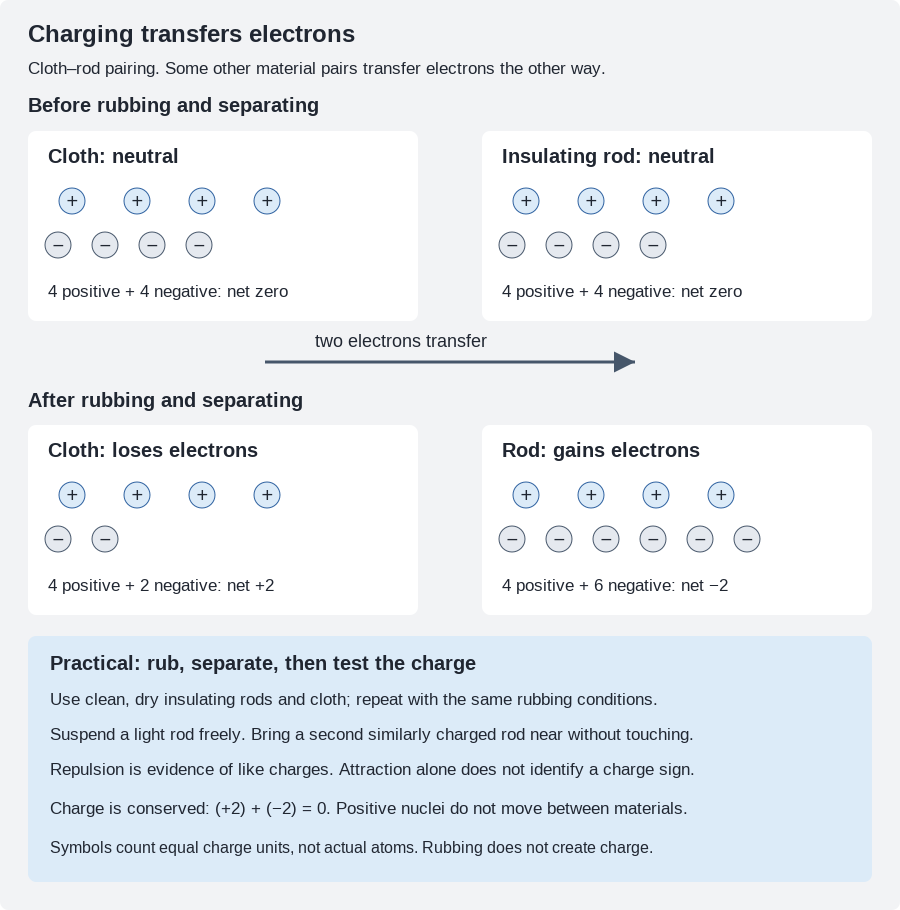
Each material in the figure starts with four positive and four negative symbols. These symbols represent equal units of electric chargeA property of particles responsible for electrical interactions, measured in coulombs., not a literal count of all particles. Two electronA negatively charged subatomic particle found outside an atom’s nucleus. transfer from cloth to rod. The cloth then has four positive and two negative units: net +2. The rod has four positive and six negative units: net −2.
The total remains (+2) + (−2) = 0, as it was initially. The count of positive units on each material is unchanged and the combined negative count remains eight. Equal and opposite charging follows for an initially neutral isolated pair; contact with other objects or Earth changes the system boundary.
Reverse and test the reasoning
If electronA negatively charged subatomic particle found outside an atom’s nucleus. transfer in the opposite direction, the signs reverse. For an object that starts positive, gaining some electrons can first reduce its positive electric chargeA property of particles responsible for electrical interactions, measured in coulombs.; it becomes negative only after the gain exceeds the original deficit.
Charge in an insulatorA material in which charge does not move freely, so it conducts very little current. may remain near the contact region. A net charge describes the total imbalance and does not mean every atomAn electrically neutral particle with a small positive nucleus surrounded by electrons. on the object has acquired that sign.
Equations
Common misconceptions
- Electrons are transferred; ordinary frictional charging does not transport positive nuclei from one material to the other.