Learning goals
- Carry out and interpret a charging-by-friction investigation.
- Control conditions in a comparison.
- Distinguish evidence of charging from evidence of charge sign.
Purpose and method
Investigate whether rubbing different insulating materials produces electrostatic forceThe attraction between unlike charges or repulsion between like charges.. Use clean, dry insulating rods, suitable cloths, a light rod suspended horizontally on insulating thread, and small paper pieces. Start with an uncharged comparison rod and note the behaviour before rubbing.
Rub one rod with a cloth, separate them, then bring the rubbed area close to the paper without touching it. Record attraction. Rub a second rod of the same material with the same cloth material and bring it near the suspended rubbed rod without contact. Record attraction or repulsion. Repeat with another material pairing.
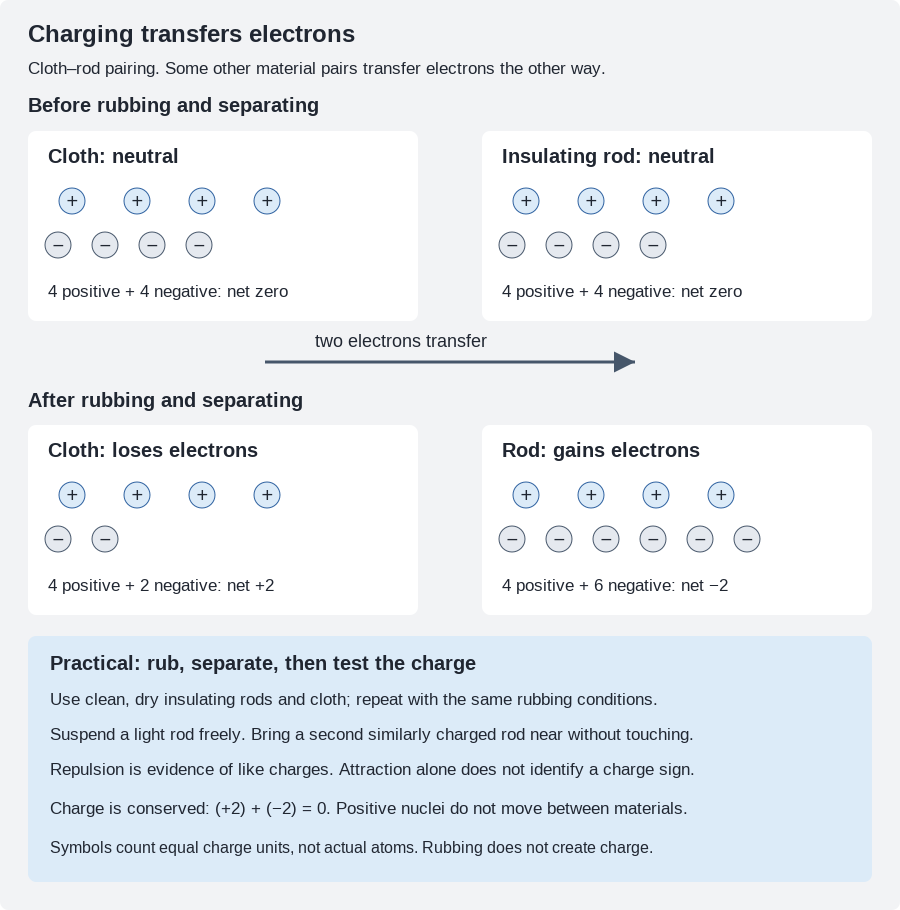
Control and record
For a fair comparison keep rod dimensions, rubbed area, number of strokes, observation distanceThe length of a path travelled, without regard to direction. and delay after rubbing similar. Use a fresh uncharged comparison or a teacher-approved neutralisation method between trials; merely waiting does not guarantee an insulatorA material in which charge does not move freely, so it conducts very little current. is discharged. Repeat each pairing at least three times and record a table of materials, conditions and observed motion.
Avoid draughts and give the suspended rod time to settle. Moisture can allow electric chargeA property of particles responsible for electrical interactions, measured in coulombs. to leak away, so dry surfaces usually give clearer results. Keep the demonstration away from sensitive electronics and flammable vapours.
What the results establish
Rubbing promotes contact and separation between surfaces, transferring electronA negatively charged subatomic particle found outside an atom’s nucleus.. The figure illustrates one direction of transfer, but the sign depends on the material pairing and surface conditions. electric chargeA property of particles responsible for electrical interactions, measured in coulombs. is transferred, not created.
Attraction of neutral paper is consistent with polarisation and does not identify the rod's sign. Repulsion between two rods provides evidence that both carry like charges. To assign positive or negative, compare with a reliably known charge using repulsion. Neither paper attraction nor the amount of motion directly measures charge in coulombs.
Equations
Common misconceptions
- Attraction alone does not prove that two objects have opposite net charges; one may be neutral.