Learning goals
- Identify common conductors and insulators.
- Relate charge mobility to material choice.
- Explain why isolation matters in electrostatic experiments.
Mobile charge makes a conductor
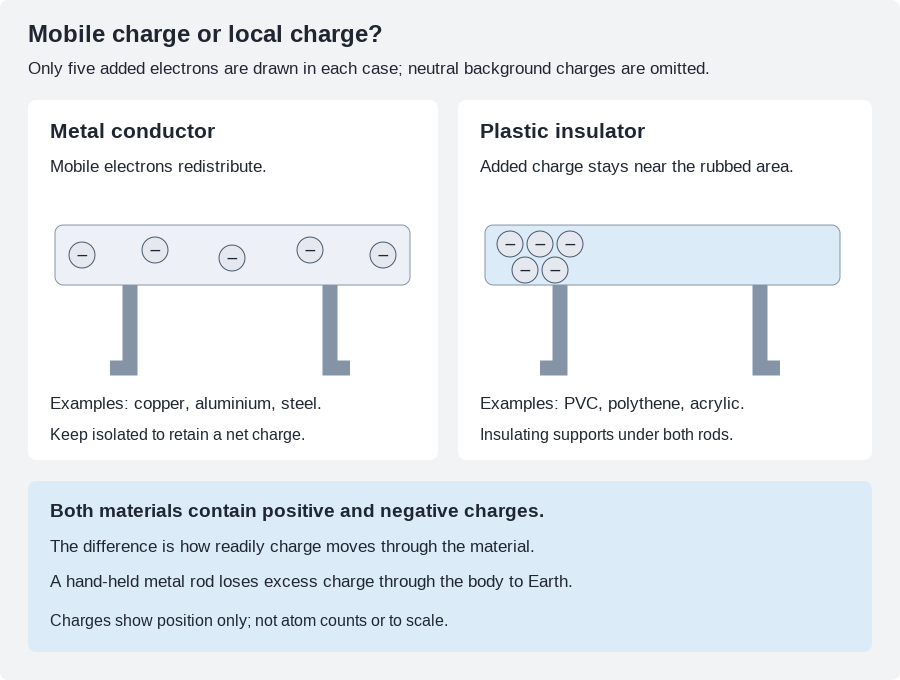
Copper, aluminium and steel are conductorA material containing mobile charged particles that carry an electric current.. These metals contain mobile electronA negatively charged subatomic particle found outside an atom’s nucleus. that can move through the material. A potential differenceThe energy transferred per unit charge between two points, measured in volts. can drive these electrons around a complete circuit. Excess electric chargeA property of particles responsible for electrical interactions, measured in coulombs. placed on an isolated metal object can redistribute over its surface.
PVC, polythene and acrylic are plastics and good insulatorA material in which charge does not move freely, so it conducts very little current. in ordinary classroom conditions. Electrons are bound within their atomAn electrically neutral particle with a small positive nucleus surrounded by electrons. or molecules and cannot move freely across the whole material. Added charge can remain near the region that was rubbed. Insulators still contain both positive and negative charges.
Interpreting the comparison
The figure puts the same five excess electronA negatively charged subatomic particle found outside an atom’s nucleus. symbols on each rod. They spread across the metal but remain concentrated on the plastic. Neutral background electric chargeA property of particles responsible for electrical interactions, measured in coulombs. are omitted: the drawing does not imply that a metal consists only of electrons or that a plastic contains no other charges.
Both rods have insulating supports. A metal rod held directly in a hand can exchange charge through the body with Earth, making retained charge difficult to demonstrate. This is not evidence that metals cannot be charged; an isolated metal can carry net charge.
Choosing and testing materials
A cable uses a conducting metal core for the electric currentThe amount of electric charge passing a point per unit time, measured in amperes. and an insulating plastic coating to restrict unwanted current paths. In a teacher-approved low-voltage continuity circuit, a test material completing a gap may allow a measurable current. An unlit lamp only shows the current is below its visible threshold, not mathematically zero.
Material behaviour depends on conditions: damp or contaminated surfaces can leak electric chargeA property of particles responsible for electrical interactions, measured in coulombs.. Keep those conditions comparable when comparing materials.
Equations
Common misconceptions
- An insulator contains charge; its charge is not freely mobile through the whole material.