Learning goals
- Explain induced attraction without net charging.
- Distinguish electron mobility in metals and insulators.
- Explain electron flow during earthing.
A negative rod beside a neutral metal sphere
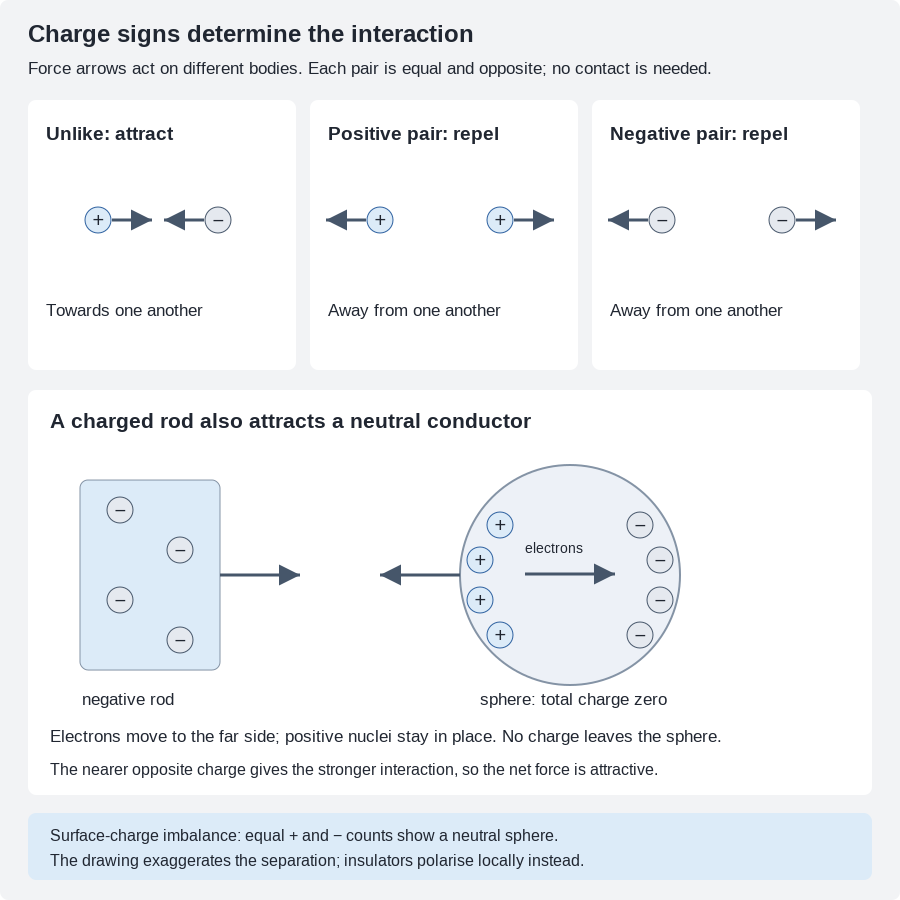
Bring a negatively charged insulating rod near an isolated neutral metal sphere without touching. Mobile electronA negatively charged subatomic particle found outside an atom’s nucleus. in the sphere are repelled towards the far side. The near side has a deficit of electrons and is relatively positive; the far side has an excess and is negative. Positive nucleusThe dense central region of an atom containing protons and neutrons, except hydrogen-1 which has no neutron. remain in place.
No electrons enter or leave the isolated sphere, so its total electric chargeA property of particles responsible for electrical interactions, measured in coulombs. remains zero. The nearer positive region is attracted more strongly than the more distant negative region is repelled, producing a net attraction. The drawing exaggerates the separation and represents surface-charge imbalance, not all the sphere's particles.
Reverse the rod or remove it
A positive rod attracts electronA negatively charged subatomic particle found outside an atom’s nucleus. towards the near side of the sphere. That near side becomes relatively negative, so the sphere is again attracted. Remove the rod and the electrons redistribute: induced separation alone does not leave the initially neutral sphere with net electric chargeA property of particles responsible for electrical interactions, measured in coulombs..
In an insulatorA material in which charge does not move freely, so it conducts very little current., electrons cannot travel freely across the whole object. Bound positive and negative charge distributions can shift slightly relative to one another, or molecular dipoles can align. This polarisation helps explain attraction of neutral paper by a charged rod.
Connection to Earth
A conducting connection to Earth allows electronA negatively charged subatomic particle found outside an atom’s nucleus. exchange. With no nearby charged object inducing separation, a negatively charged metal object can lose excess electrons to Earth; a positively charged object can receive electrons. Earth acts as a very large electric chargeA property of particles responsible for electrical interactions, measured in coulombs. reservoir, with little change in its potential.
Distinguish redistribution within an object from transfer across its boundary. Only the latter changes its net charge. This distinction also explains why touching a conductorA material containing mobile charged particles that carry an electric current. can discharge it and why an insulating support helps it retain charge.
Equations
Common misconceptions
- Induced charge separation in an isolated neutral object is not the same as giving it a net charge.