Learning goals
- Explain the full charging-to-ignition sequence.
- Distinguish bonding from earthing.
- Relate conducting paths to reduced potential differences.
From charge separation to a spark
Contact and separation during fuel movement can transfer electric chargeA property of particles responsible for electrical interactions, measured in coulombs. between fuel and surfaces. If charge cannot flow away readily, it can accumulate. An aircraft or tanker can then be at a different electric potential from nearby equipment.
A sufficiently large potential differenceThe energy transferred per unit charge between two points, measured in volts. across an air gap can ionise the air, providing a conducting path. A sudden discharge through that path is a spark. Its energyA conserved quantity transferred between stores by working, heating, electrical processes or radiation, measured in joules. can ignite a suitable flammable fuel–air mixture, so a small spark can have serious consequences even without an open flame.
Bonding and earthing have different roles
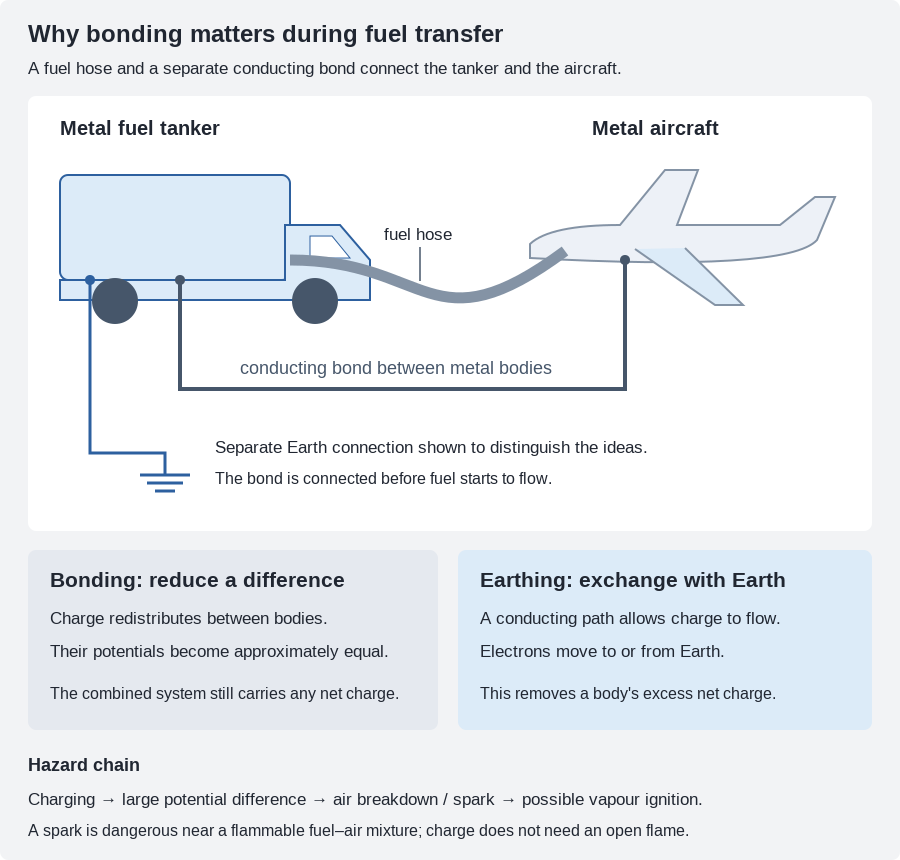
Bonding connects conducting bodies together. electronA negatively charged subatomic particle found outside an atom’s nucleus. redistribute through the bond so the bodies approach the same potential, reducing the potential differenceThe energy transferred per unit charge between two points, measured in volts. that could drive a spark between them. The combined bonded system can still have a net electric chargeA property of particles responsible for electrical interactions, measured in coulombs..
earthingConnecting an object to Earth so that charge flows to or from it until their potentials equalise. connects a conductorA material containing mobile charged particles that carry an electric current. to Earth and allows charge exchange with a much larger reservoir. Electrons may flow to Earth from a negative object or from Earth to a positive one, reducing excess net charge. Bonding is therefore not automatically the same as earthing.
Interpret the application
The figure separately identifies a fuel hose, a conducting bond and an Earth connection. Do not assume that a visible hose alone establishes a reliable electrical connection. Real fuelling uses approved equipment and procedures for its particular installation; the drawing explains the physics rather than giving an operational procedure.
Insulation can prevent electric currentThe amount of electric charge passing a point per unit time, measured in amperes. in a normal circuit but may allow static electric chargeA property of particles responsible for electrical interactions, measured in coulombs. to accumulate. Whether a material is desirable depends on the purpose: a conducting route can be protective when controlled charge redistribution is needed.
Equations
Common misconceptions
- Bonding equalises potentials between bodies; it need not remove the combined system's net charge.