Learning goals
- Explain the photocopier charging, toner transfer and fixing sequence.
- Predict the deflection of a charged droplet.
- State the limits of the illustrated printing models.
Photocopying: make and transfer a charge pattern
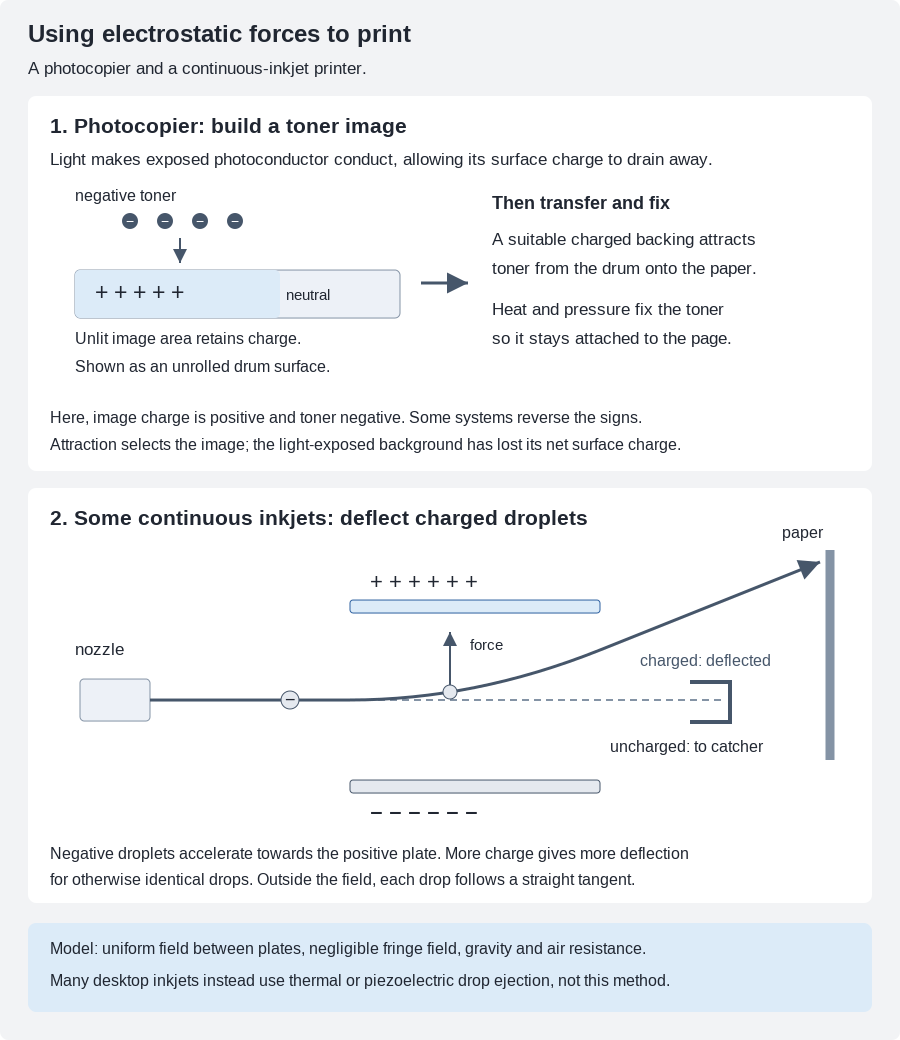
A photoconductive drum is given a surface electric chargeA property of particles responsible for electrical interactions, measured in coulombs.. Light from the original makes exposed regions conduct, allowing their charge to drain away. In the illustrated traditional model, dark image regions retain positive charge while the illuminated background loses it.
Negatively charged toner is attracted to the positive image regions. A suitably charged backing behind the paper then attracts the toner onto the paper. Heated rollers apply pressureThe normal force exerted per unit area, measured in pascals. and fuseA safety device with a wire that melts when excessive current heats it, breaking the circuit. the toner so it remains attached. The drum is cleaned and reset for another image.
Here, dark image regions retain positive charge and attract negative toner. Real systems can reverse the signs, and many digital systems use a different arrangement in which toner develops light-exposed regions. The central principle is controlled electric forceA push or pull arising from an interaction between objects, measured in newtons. acting on charged toner, not one universal sign convention.
Continuous inkjet: steer drops with charge
Some continuous inkjet systems electric chargeA property of particles responsible for electrical interactions, measured in coulombs. selected droplets as a jet breaks into drops. Between deflection electrodes, a negative droplet feels a forceA push or pull arising from an interaction between objects, measured in newtons. towards the positive electrode. It accelerates sideways while continuing forwards; otherwise identical drops with more charge are deflected further.
The figure shows an ideal uniform fieldA field with the same magnitude and direction at every point in a region. between two plates. A charged droplet follows a curved path there, then a straight tangentA straight line with the same local gradient as a curve at the point where it touches. after leaving the field. An uncharged drop has no electric deflection in this model and goes to a catcher for reuse. Timing the charge and moving the target builds a printed pattern.
Use the model within its limits
The diagram neglects air resistanceA drag force exerted by air on an object moving relative to it., gravityThe attractive interaction between objects with mass. and fringe fields to isolate the electric forceA push or pull arising from an interaction between objects, measured in newtons.. Reversing the electric chargeA property of particles responsible for electrical interactions, measured in coulombs. reverses the electric force for the same field.
Many desktop inkjets eject drops using thermal or piezoelectric mechanisms instead. Do not apply the continuous-inkjet description to every printer. In both illustrated electrostatic applications, explain the charged object, the force direction and the resulting useful motion.
Equations
Common misconceptions
- Electrostatic deflection is used by some continuous inkjet systems, not every inkjet printer.