Learning goals
- Define voltage using energy and charge.
- Use the unit equivalence V = J/C.
- Relate voltage to energy transfer.
Energy transferred per coulomb
The potential differenceThe energy transferred per unit charge between two points, measured in volts. across a component is the energyA conserved quantity transferred between stores by working, heating, electrical processes or radiation, measured in joules. transferred per unit electric chargeA property of particles responsible for electrical interactions, measured in coulombs. passing through it: V = E/Q. One volt means one joule per coulomb. Voltage compares two points, so it must be stated across a component or between specified points.
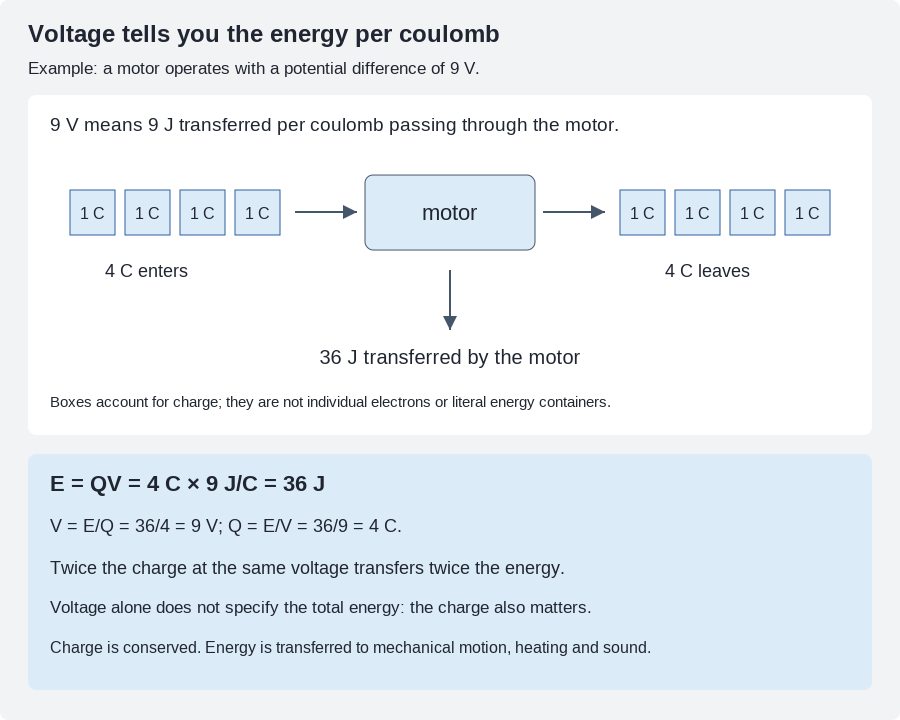
A 9 V motor transfers 9 J of electrical energy for each coulomb passing through it. That does not mean its total energy transfer is always 9 J; the total also depends on how much charge passes.
Use the accounting model
The figure groups 4 C into four symbolic one-coulomb boxes. Each accounts for a 9 J transfer through the motor, giving 36 J altogether. The same 4 C leaves: energyA conserved quantity transferred between stores by working, heating, electrical processes or radiation, measured in joules. transfer does not consume electric chargeA property of particles responsible for electrical interactions, measured in coulombs..
The boxes are a bookkeeping device, not literal containers attached to individual electronA negatively charged subatomic particle found outside an atom’s nucleus.. The motor transfers energy into mechanical motion and other pathways such as heating and soundA mechanical wave produced by vibrations and transmitted through a material medium..
Distinguish voltage from current and power
electric currentThe amount of electric charge passing a point per unit time, measured in amperes. describes coulombs per second. potential differenceThe energy transferred per unit charge between two points, measured in volts. describes joules per coulomb. Multiplying them gives joules per second, or powerThe energy transferred or work done per unit time, measured in watts.. Knowing voltage alone cannot tell you the current or the total energyA conserved quantity transferred between stores by working, heating, electrical processes or radiation, measured in joules. transferred.
A voltmeterAn instrument connected in parallel to measure potential difference. goes across two points to measure their potential difference. An ammeterAn instrument connected in series to measure electric current. goes in series to measure electric chargeA property of particles responsible for electrical interactions, measured in coulombs. flow; exchanging these connection arrangements is not equivalent.
Equations
- voltage = energy transferred ÷ charge
- 1 V = 1 J/C
Common misconceptions
- Voltage is not the same as total energy; the amount of charge also matters.
Connect charge flow to energy transfer
Change steady current, voltage and elapsed time, then compare charge passing a point with energy transferred.
What you see
- Labelled diagrams and numerical outputs describe the same selected state.
How to use it
- Change one control at a time, predict the outcome, then compare the readouts. All controls have keyboard-accessible sliders and step buttons.
- Reset restores every model control to its initial value. Nothing is saved.
What it shows
- Q=It sets the charge passing a point. Voltage is energy transferred per unit charge, so E=QV=IVt and P=IV. Doubling voltage at fixed current doubles energy but leaves charge unchanged. A resistor transfers electrical energy to thermal stores; its temperature also depends on quantities this model does not specify.
Limits of the model
- Current and component voltage are held constant at the selected operating values. Their relationship for a particular real component is not modelled.
- Elapsed time is scrubbed over 60 s. Charge is the amount passing a point, not charge created or consumed in a component. No temperature rise or cooling rate is calculated.
Controls
Q=It=0.5×20=10 C. E=QV=10×6=60 J. P=IV=3 W. At zero elapsed time, no charge has yet passed and no energy has yet transferred, even if the operating power is non-zero.
Predict, change and explain
At 0.5 A and 6 V, predict charge and energy after 20 s. Double only voltage: which graph changes? Then restore voltage and double current. Explain how a component can transfer more energy per coulomb without using up the charge.
Connect the outcome to the Physics
Q=It sets the charge passing a point. Voltage is energy transferred per unit charge, so E=QV=IVt and P=IV. Doubling voltage at fixed current doubles energy but leaves charge unchanged. A resistor transfers electrical energy to thermal stores; its temperature also depends on quantities this model does not specify.