Learning goals
- Use E = QV.
- Rearrange for charge or voltage.
- Check joule and coulomb units.
From energy per charge to total energy
potential differenceThe energy transferred per unit charge between two points, measured in volts. V is energyA conserved quantity transferred between stores by working, heating, electrical processes or radiation, measured in joules. per coulomb, so multiplying it by electric chargeA property of particles responsible for electrical interactions, measured in coulombs. Q gives energy transferred: E = QV. Use charge in coulombs and voltage in volts to obtain joules. The voltage must be the potential difference across the component involved.
The equation uses the same constant voltage for the stated charge transfer. If the voltage varies significantly, calculate suitable portions separately or use an appropriately charge-weighted average.
Worked example and rearrangements
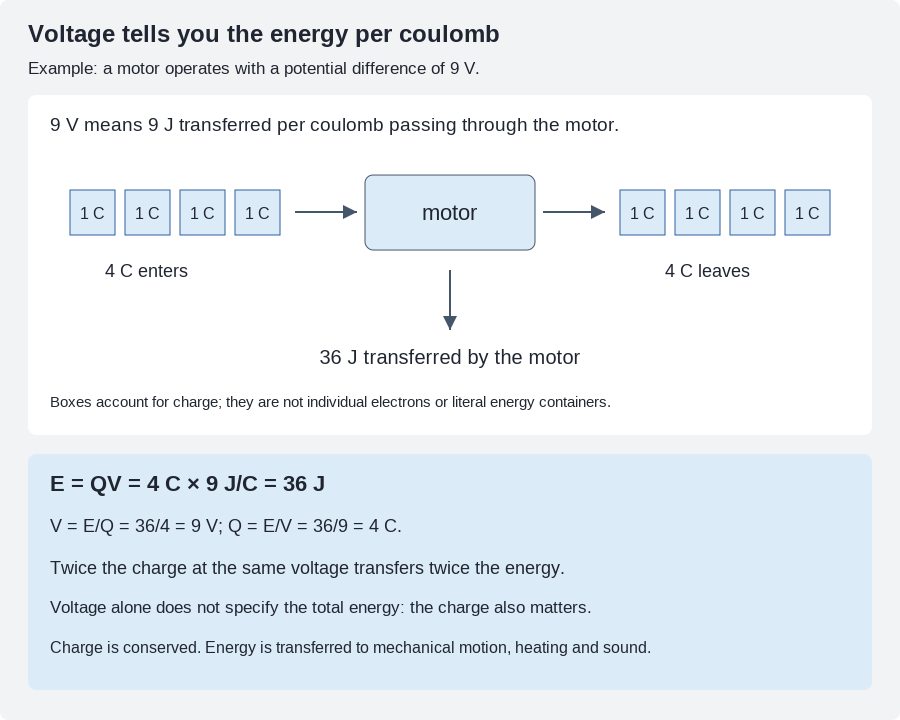
For 4 C through a motor at 9 V, E = 4 × 9 = 36 J. The units cancel as C × J/C = J. Rearranging gives Q = E/V = 36/9 = 4 C and V = E/Q = 36/4 = 9 V.
At the same 9 V, 8 C transfers 72 J: doubling electric chargeA property of particles responsible for electrical interactions, measured in coulombs. doubles energyA conserved quantity transferred between stores by working, heating, electrical processes or radiation, measured in joules.. At the same 4 C, a 6 V potential differenceThe energy transferred per unit charge between two points, measured in volts. transfers 24 J. Explain which quantity is held constant before making a proportional prediction.
Link with current and time
For a constant electric currentThe amount of electric charge passing a point per unit time, measured in amperes., Q = It. Substituting this into E = QV gives E = IVt, connecting the energyA conserved quantity transferred between stores by working, heating, electrical processes or radiation, measured in joules. and electric chargeA property of particles responsible for electrical interactions, measured in coulombs. descriptions of the same process.
The motor’s electrical input is not necessarily all useful mechanical output. Some energy may be transferred by heating or soundA mechanical wave produced by vibrations and transmitted through a material medium., but the total electrical transfer is still determined by QV.
Equations
- E = Q × V
- Q = E ÷ V
- V = E ÷ Q
Common misconceptions
- The voltage is energy per coulomb, not the total energy transferred.
Connect charge flow to energy transfer
Change steady current, voltage and elapsed time, then compare charge passing a point with energy transferred.
What you see
- Labelled diagrams and numerical outputs describe the same selected state.
How to use it
- Change one control at a time, predict the outcome, then compare the readouts. All controls have keyboard-accessible sliders and step buttons.
- Reset restores every model control to its initial value. Nothing is saved.
What it shows
- Q=It sets the charge passing a point. Voltage is energy transferred per unit charge, so E=QV=IVt and P=IV. Doubling voltage at fixed current doubles energy but leaves charge unchanged. A resistor transfers electrical energy to thermal stores; its temperature also depends on quantities this model does not specify.
Limits of the model
- Current and component voltage are held constant at the selected operating values. Their relationship for a particular real component is not modelled.
- Elapsed time is scrubbed over 60 s. Charge is the amount passing a point, not charge created or consumed in a component. No temperature rise or cooling rate is calculated.
Controls
Q=It=0.5×20=10 C. E=QV=10×6=60 J. P=IV=3 W. At zero elapsed time, no charge has yet passed and no energy has yet transferred, even if the operating power is non-zero.
Predict, change and explain
At 0.5 A and 6 V, predict charge and energy after 20 s. Double only voltage: which graph changes? Then restore voltage and double current. Explain how a component can transfer more energy per coulomb without using up the charge.
Connect the outcome to the Physics
Q=It sets the charge passing a point. Voltage is energy transferred per unit charge, so E=QV=IVt and P=IV. Doubling voltage at fixed current doubles energy but leaves charge unchanged. A resistor transfers electrical energy to thermal stores; its temperature also depends on quantities this model does not specify.