Reasoning about forces and motion
Connect a stated change to its physical cause, test an explanation and identify the conditions a model needs.
Specification 1.6, 1.7, 1.8, 1.13, 1.17, 1.19, 1.20, 1.21, 1.22, 1.23, 1.26P, 1.27P, 1.28P, 1.29P, 1.30P, 1.32P
Ratings, marks and Maths and Logic completion stay in this browser on this device. Written answers are temporary and are never recorded or transmitted. Reset clears only Physics practice progress, including Maths and Logic completion.
Answers and choices are temporary. Only started/completed flags are saved on this device. Practice can be retried or revealed; the check counts each question’s first answer. These are original practice tasks, not official exam questions.
Starting here
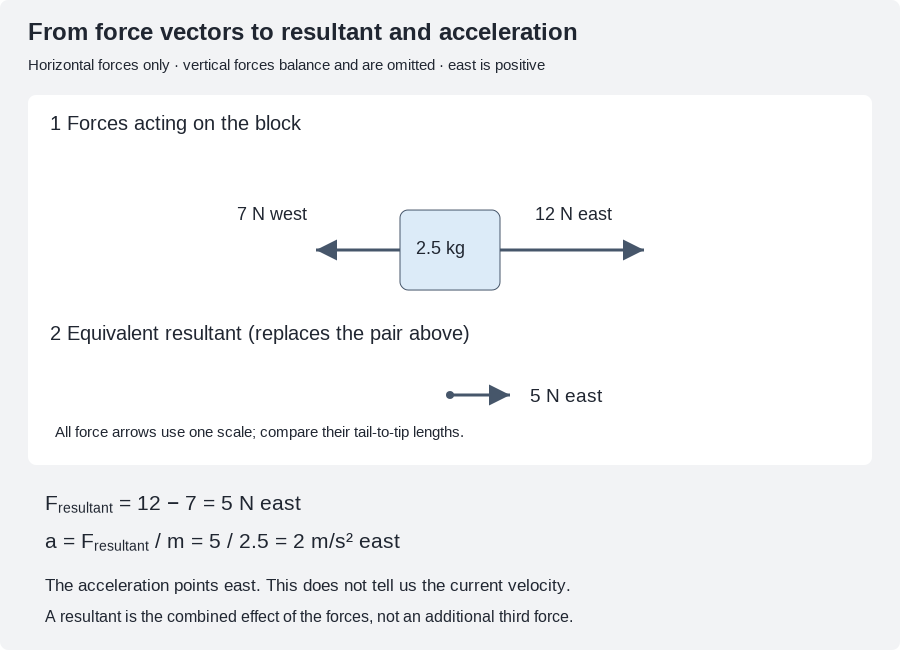
A sound explanation starts with the stated conditions, identifies the relevant principle and follows its consequences. A force result tells you about acceleration; it does not by itself tell you the current velocity. The figure combines the forces to find an eastward acceleration; the object’s current velocity is not specified.
Distinguish an observation from a proposed cause. Keep other variables fixed before deciding that one change caused a result. When using a model, state the conditions that make its relationship applicable.
Key ideas
- Resultant force changes velocity; balanced forces mean zero acceleration, not necessarily rest.
- Newton’s third-law forces act on different objects. Forces balancing on one object are a different pair.
- A chain of reasoning names each physical link rather than repeating the question.
Worked example
A trolley moves right at constant speed under a rightward pull and leftward friction. A student says the pull must be larger because the trolley moves right. Assess the claim.
- Observation. Constant velocity means acceleration is zero.
- Principle. Fresultant=ma, so the horizontal resultant is zero.
- Consequence. The rightward pull equals the leftward friction. Rightward velocity does not require a rightward resultant.
Answer: The claim confuses velocity with acceleration. Equal opposing forces can act while the trolley keeps moving.
Activities
Opens when you finish the stage above.
Build the skill
Opens when you finish the stage above.
Check
Opens when you finish the stage above.