Learning goals
- Recognise proportional force and extension.
- Identify the limit of proportionality on a graph (beyond the specification).
- Distinguish proportionality from elasticity.
Recognise the initial proportional region
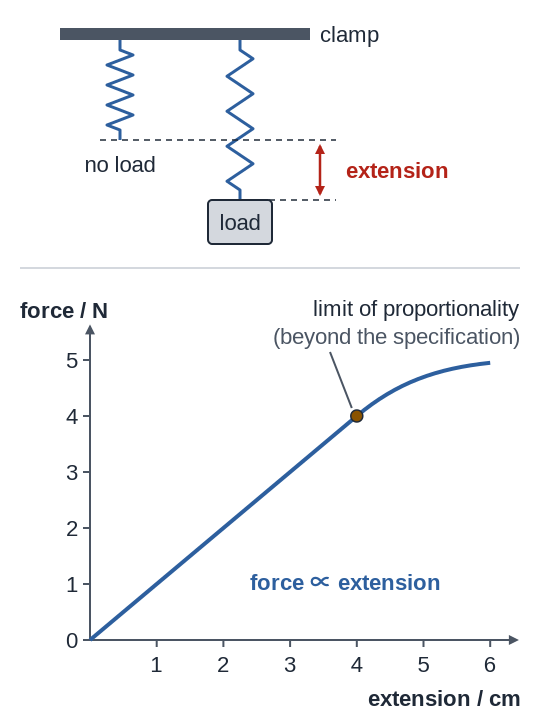
Hooke’s lawThe extension of a spring is directly proportional to the applied force up to its limit of proportionality. describes forceA push or pull arising from an interaction between objects, measured in newtons. proportional to extensionThe increase in length of an object relative to its original unstretched length. in the initial linear region. On a force-against-extension graph, this is a straight line through the origin. Doubling force doubles extension while that relationship holds.
Use extension, the increase from original length, rather than total loaded length. A graph against total length would not generally pass through the origin.
Read evidence from a graph
Compare several plotted points rather than assuming proportionality from one measurement. In a proportional region, equal forceA push or pull arising from an interaction between objects, measured in newtons. increases produce equal extensionThe increase in length of an object relative to its original unstretched length. increases. The gradientThe change in the vertical-axis quantity divided by the corresponding change in the horizontal-axis quantity. of force against extension is the stiffness of the specimen (beyond the specification): a steeper line requires a larger force for the same extension.
The point where the graph stops being a straight line is called the limit of proportionalityThe point beyond which extension no longer increases in direct proportion to the applied force. (beyond the specification). The curved continuation in the figure is schematic; its exact shape depends on the specimen.
Keep proportionality separate from recovery
A material can stop obeying the proportional relationship yet recover its original length after unloading. Conversely, permanent extensionThe increase in length of an object relative to its original unstretched length. is established by comparing unloaded lengths, not simply noticing a curved loading graph.
Rubber bands often have a nonlinear loading curve. Do not apply the spring’s initial straight-line relationship to every material or extrapolate it beyond the region supported by measurements.
Equations
- force ∝ extension in the linear region
Common misconceptions
- A spring can still return to its original length after leaving the proportional region; proportionality and elastic behaviour are different ideas.