Learning goals
- Define elastic behaviour.
- Compare elastic and permanent deformation.
- Use a force–extension graph as evidence.
Define elastic recovery
A material behaves elastically when it recovers its original shape after deforming forceA push or pull arising from an interaction between objects, measured in newtons. are removed. Deformation can mean stretching, compressionA region of a longitudinal wave where particles are closer together and pressure is higher. or bending. Elastic describes recovery, not how easily the object changes shape.
Use before-and-after evidence
Measure the original unloaded length, apply a safe load, then remove it and measure again after settling. Returning to the original length within measurement uncertaintyThe estimated range around a measured value within which the true value is expected to lie. supports elastic behaviourRecovery of an object’s original shape and size after the deforming force is removed. for that loading.
If the final unloaded length is larger, a permanent extensionThe increase in length of an object relative to its original unstretched length. remains: the material has undergone permanent deformation. The elastic limitThe greatest load or deformation from which an object returns fully to its original shape after unloading. (beyond the specification) is the greatest load from which the material still recovers fully. Beyond it, removing the forceA push or pull arising from an interaction between objects, measured in newtons. leaves a permanent extension, called plastic deformationA change in shape or size that remains after the deforming forces are removed. (beyond the specification). Repeat trials must account for any permanent change.
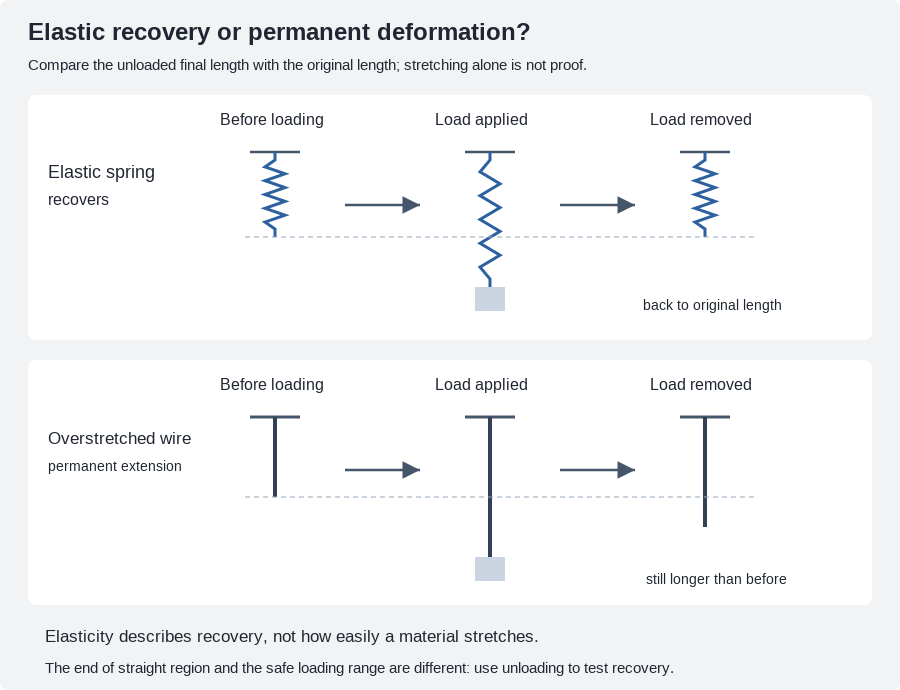
Interpret the comparison figure
The spring returns to its original unloaded length; the overstretched wire remains longer. Compare like states: loaded and unloaded lengths are expected to differ, even for elastic behaviourRecovery of an object’s original shape and size after the deforming force is removed..
A curved loading graph alone does not establish permanent deformation. The limit of proportionalityThe point beyond which extension no longer increases in direct proportion to the applied force. concerns the straight-line forceA push or pull arising from an interaction between objects, measured in newtons.–extensionThe increase in length of an object relative to its original unstretched length. relationship, while the elastic limitThe greatest load or deformation from which an object returns fully to its original shape after unloading. concerns recovery (both beyond the specification). The two boundaries need not coincide.
Equations
Common misconceptions
- Elastic does not mean “easy to stretch”; it describes recovery after the force is removed.