Learning goals
- Define scalar and vector quantities.
- Classify common Physics quantities.
- Represent a vector with an arrow.
Magnitude and direction
A scalarA physical quantity described by magnitude alone. has magnitude only: massThe quantity measuring an object’s inertia, expressed in kilograms., time, distanceThe length of a path travelled, without regard to direction., speedThe distance travelled per unit time, without specifying direction., energyA conserved quantity transferred between stores by working, heating, electrical processes or radiation, measured in joules., electric chargeA property of particles responsible for electrical interactions, measured in coulombs., powerThe energy transferred or work done per unit time, measured in watts. and temperatureA measure of how hot a system is, related to the average kinetic energy of its particles. are scalars. Magnitude gives the size of a quantity, stated with a number and unit. A vectorA physical quantity described by both magnitude and direction. has magnitude and direction: displacementThe straight-line change in position from a starting point, with a specified direction., velocityThe rate of change of displacement, including the direction of motion., accelerationThe change in velocity per unit time, measured in metres per second squared., forceA push or pull arising from an interaction between objects, measured in newtons., momentumThe product of an object’s mass and velocity, measured in kilogram metres per second. and weightThe gravitational force acting on an object, equal to its mass multiplied by gravitational field strength. are vectors. Weight is the gravitational force on an object, so its direction matters. A velocity of 5 m/s east differs from 5 m/s west, although the speeds agree.
Classify the quantity itself, rather than looking for a compass direction in the wording. Charge is scalar even when it is negative: its sign distinguishes types of charge, rather than a direction in space. A temperature below 0 °C is also scalar. Power describes the rate of energy transfer and has no spatial direction. A force remains a vector even if a question gives only its magnitude.
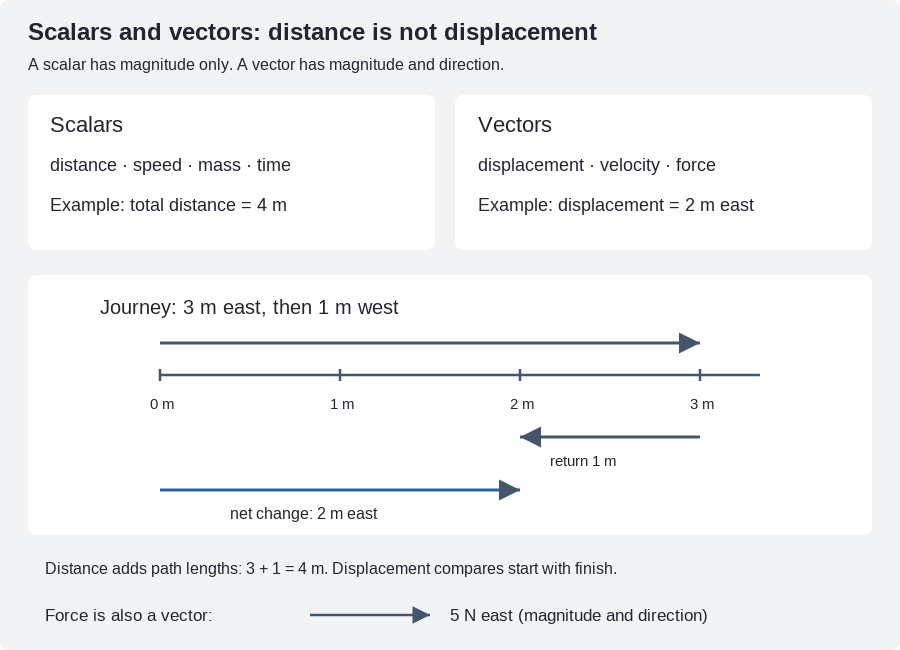
Distance compared with displacement
Travelling 3 m east then 1 m west gives distanceThe length of a path travelled, without regard to direction. 3 + 1 = 4 m. displacementThe straight-line change in position from a starting point, with a specified direction. is the change from the starting position, 3 − 1 = 2 m east. Returning all the way to the start would give zero displacement but a nonzero distance.
In 2 s, the illustrated 4 m journey would have average speedThe ratio of total path length to the entire elapsed time of a journey. 2 m/s and average velocityThe rate of change of displacement, including the direction of motion. 1 m/s east. These answer different questions, so choose the quantity requested.
Represent a vector
An arrow points in the vectorA physical quantity described by both magnitude and direction. direction. Its length can represent magnitude using a stated scale, while a label supplies quantity and unit. For motion along a line, choosing east as positive allows westward vectors to be written with negative signs. A negative velocityThe rate of change of displacement, including the direction of motion. records direction; it does not give a negative speedThe distance travelled per unit time, without specifying direction..
Equations
Common misconceptions
- Speed and velocity are not interchangeable: velocity includes direction.
- A larger vector is not shown by a thicker arrow; use a longer arrow or a stated scale.
Connect resultant force, motion and graph area
Change mass and opposing forces, then connect acceleration, velocity and distance to the same model.
What you see
- Labelled diagrams and numerical outputs describe the same selected state.
How to use it
- Change one control at a time, predict the outcome, then compare the readouts. All controls have keyboard-accessible sliders and step buttons.
- Reset restores every model control to its initial value. Nothing is saved.
What it shows
- Fresultant=ma fixes acceleration, the gradient of the velocity–time graph. Signed area gives displacement. Distance adds the magnitudes of the areas, so it can exceed the magnitude of displacement after a reversal.
Limits of the model
- One-dimensional motion with right positive, constant mass and constant horizontal forces. Vertical forces balance.
- The forces remain applied for five seconds; there is no speed-dependent resistance. Time is controlled with the slider, not wall-clock playback.
Controls
Areas below zero contribute negative displacement but positive distance. Equal forces preserve the initial velocity; they do not necessarily stop the trolley.
Predict, change and explain
Set equal forces and a non-zero initial velocity. Predict the graph and displacement. Then make the resultant oppose the initial velocity: find when the trolley stops and reverses. Compare distance with displacement.
Connect the outcome to the Physics
Fresultant=ma fixes acceleration, the gradient of the velocity–time graph. Signed area gives displacement. Distance adds the magnitudes of the areas, so it can exceed the magnitude of displacement after a reversal.