Learning goals
- Recognise common force types.
- Classify contact and non-contact forces.
- Name the interaction producing a force.
Contact interactions
normal reactionA contact force exerted perpendicular to a surface supporting an object. acts perpendicular to a supporting surface. A table pushes upwards on a resting book. tensionThe pulling force transmitted through a stretched string, rope or similar object. is a pulling forceA push or pull arising from an interaction between objects, measured in newtons. transmitted by a stretched rope or string. frictionA force opposing relative sliding or the tendency to slide between contacting surfaces. acts between contacting surfaces; dragA force exerted by a fluid that opposes an object’s motion relative to the fluid. such as air resistanceA drag force exerted by air on an object moving relative to it. results from interaction with a fluid.
A stretched spring exerts an elastic force. Name the physical interaction rather than labelling every upwards arrow simply “upthrustThe upward resultant force a fluid exerts on an immersed object because pressure increases with depth.” or every forwards arrow “push”. Upthrust is the upward force exerted by a fluid on an immersed object.
Forces across a gap
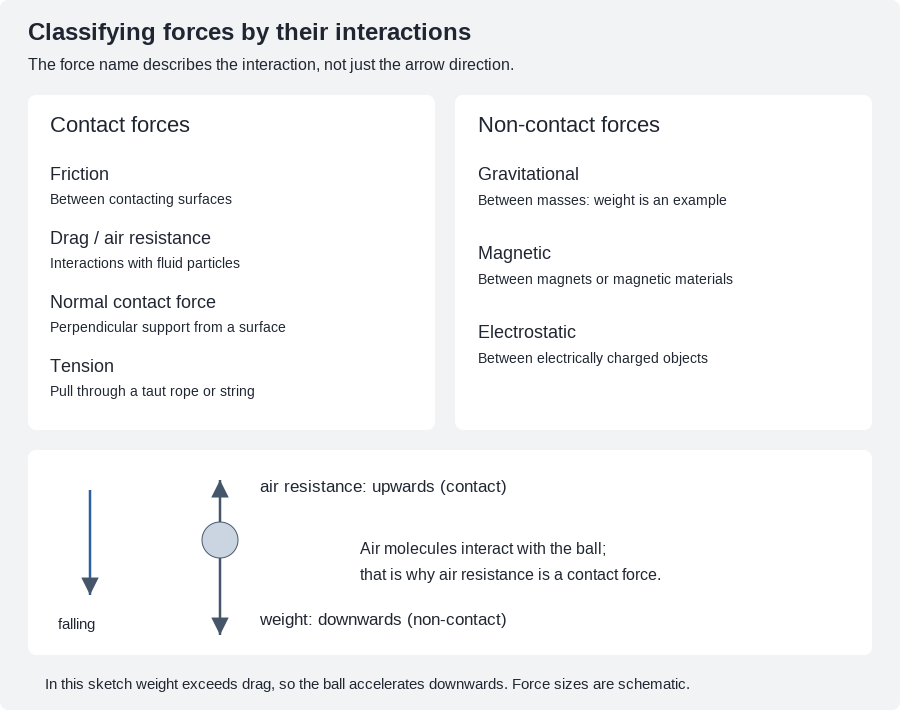
Gravitational, magnetic and electrostatic forceThe attraction between unlike charges or repulsion between like charges. can act without the bodies touching. weightThe gravitational force acting on an object, equal to its mass multiplied by gravitational field strength. is the gravitational forceA push or pull arising from an interaction between objects, measured in newtons. exerted on a massThe quantity measuring an object’s inertia, expressed in kilograms.. A magnet attracts suitable magnetic material; charged objects attract or repel electrically.
air resistanceA drag force exerted by air on an object moving relative to it. is a contact forceAn interaction requiring objects to touch, such as friction or a normal reaction. even though the air is invisible: air molecules interact with the surface. A falling ball can have both downward weight and upward air resistance; the forces arise from different interactions.
Choose a force diagram
Select one body, then name each external object interacting with it. For a book on a table, draw Earth’s weightThe gravitational force acting on an object, equal to its mass multiplied by gravitational field strength. forceA push or pull arising from an interaction between objects, measured in newtons. down and the table’s normal reactionA contact force exerted perpendicular to a surface supporting an object. up. The book’s force on the table belongs on a separate diagram of the table. This keeps forces on different bodies from being incorrectly added.
Equations
Common misconceptions
- Weight is gravitational force; mass is not a force.
- Air resistance is a contact force because air molecules collide with the object.