Learning goals
- Describe changes caused by forces.
- Identify interacting bodies in a force situation.
- Distinguish contact and non-contact examples.
An interaction between bodies
A forceA push or pull arising from an interaction between objects, measured in newtons. is a push or pull exerted by one body on another. Identify both bodies: a foot pushes a ball, a string pulls a trolley, or Earth attracts a falling object. The effect depends on all the forces acting on the selected body.
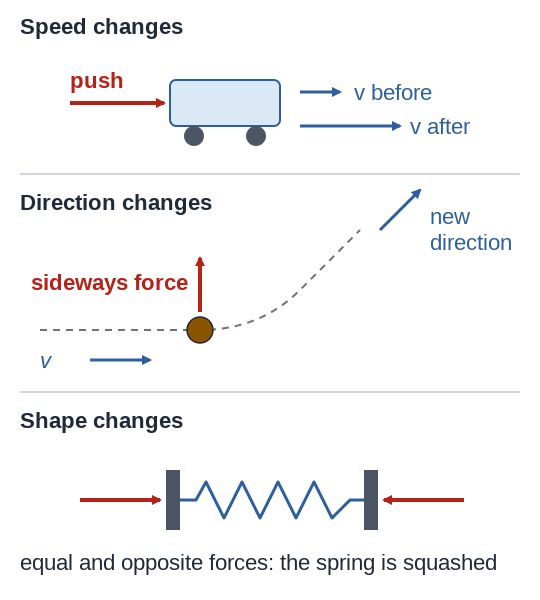
Speed, direction and shape
An unbalanced forceA push or pull arising from an interaction between objects, measured in newtons. can increase or decrease speedThe distance travelled per unit time, without specifying direction.. A sideways force can change direction even when speed stays constant, as when a moving ball is deflected. Both changes are changes in velocityThe rate of change of displacement, including the direction of motion..
Forces can also deform an object. Two hands compressing a spring can change its shape while its centre stays still. Equal opposite forces acting on the same object can balance its overall motion while still deforming it.
Explain continued motion
A moving object does not require a forward resultant forceThe single force that has the same combined effect as all the forces acting on an object. to maintain constant velocityThe rate of change of displacement, including the direction of motion.. A bicycle slows without pedalling because resistive forceA push or pull arising from an interaction between objects, measured in newtons. act; pedalling can supply a driving force that balances them. A zero resultant means no change in velocity, rather than no motion or no forces.
Equations
Common misconceptions
- A force is not required to keep an object moving at constant velocity.
- Deformation is also an effect of force, even when there is no visible movement.