Learning goals
- Explain why force is a vector.
- Draw force arrows with a stated convention.
- Predict how opposite forces combine.
Both size and direction matter
forceA push or pull arising from an interaction between objects, measured in newtons. is a vectorA physical quantity described by both magnitude and direction.. A 5 N force east and a 5 N force west can have opposite effects on the same object. A complete force description therefore gives magnitude in newtons and direction.
Draw forces on the selected body
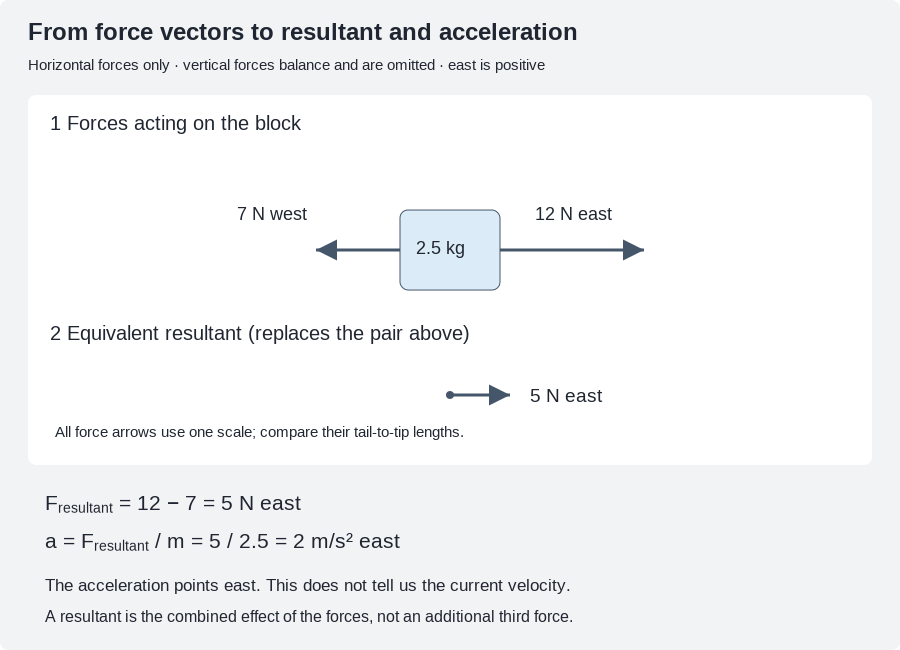
Draw each forceA push or pull arising from an interaction between objects, measured in newtons. arrow acting on the chosen object, pointing in the force direction. Label its magnitude and interaction. If using a scale, longer arrows represent larger forces; arrow thickness has no physical meaning.
In the figure a 2.5 kg block experiences 12 N east and 7 N west. The separate equivalent diagram shows the resultant 5 N east. It replaces the pair for calculating accelerationThe change in velocity per unit time, measured in metres per second squared.; it is not a third force to add to them.
Interpret the resultant
accelerationThe change in velocity per unit time, measured in metres per second squared. points in the resultant direction. This need not be the electric currentThe amount of electric charge passing a point per unit time, measured in amperes. direction of motion: an eastward resultant would slow a block initially moving west until it stopped and could reverse. A forceA push or pull arising from an interaction between objects, measured in newtons. diagram alone does not specify the object’s velocityThe rate of change of displacement, including the direction of motion..
Equations
Common misconceptions
- The arrow direction is part of the force description, not just a diagram style.
Connect resultant force, motion and graph area
Change mass and opposing forces, then connect acceleration, velocity and distance to the same model.
What you see
- Labelled diagrams and numerical outputs describe the same selected state.
How to use it
- Change one control at a time, predict the outcome, then compare the readouts. All controls have keyboard-accessible sliders and step buttons.
- Reset restores every model control to its initial value. Nothing is saved.
What it shows
- Fresultant=ma fixes acceleration, the gradient of the velocity–time graph. Signed area gives displacement. Distance adds the magnitudes of the areas, so it can exceed the magnitude of displacement after a reversal.
Limits of the model
- One-dimensional motion with right positive, constant mass and constant horizontal forces. Vertical forces balance.
- The forces remain applied for five seconds; there is no speed-dependent resistance. Time is controlled with the slider, not wall-clock playback.
Controls
Areas below zero contribute negative displacement but positive distance. Equal forces preserve the initial velocity; they do not necessarily stop the trolley.
Predict, change and explain
Set equal forces and a non-zero initial velocity. Predict the graph and displacement. Then make the resultant oppose the initial velocity: find when the trolley stops and reverses. Compare distance with displacement.
Connect the outcome to the Physics
Fresultant=ma fixes acceleration, the gradient of the velocity–time graph. Signed area gives displacement. Distance adds the magnitudes of the areas, so it can exceed the magnitude of displacement after a reversal.