Learning goals
- Identify a pivot and a force line of action.
- Measure the perpendicular moment arm.
- Calculate a moment and state its turning sense.
Turning effect and line of action
A pivotA fixed point or axis about which an object turns. is the point about which an object can turn. A forceA push or pull arising from an interaction between objects, measured in newtons. can cause a clockwise or anticlockwise turning effect about that point. The momentThe turning effect of a force about a point, equal to force multiplied by perpendicular distance from that point to its line of action. equals the force multiplied by the perpendicular distanceThe shortest distance from a point to a line, measured at a right angle to that line. from the pivot to the line of actionThe straight line along which a force acts, extended through its point of application. of the force.
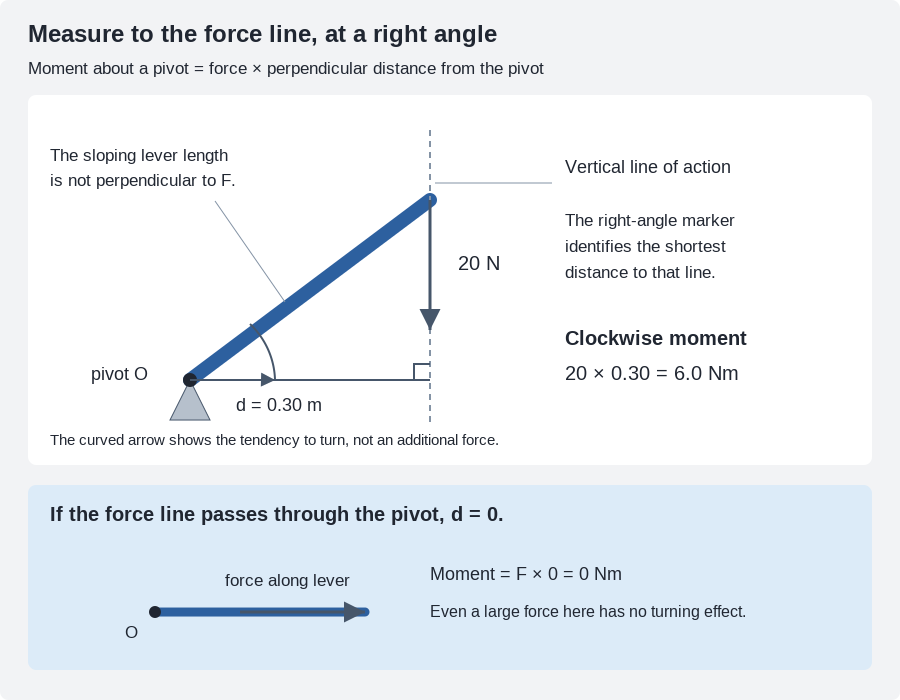
Extend the force arrow as a straight line. Draw the shortest line from the pivot to that line: it meets it at a right angle. This perpendicular separation is the moment arm d. The sloping length of a lever is not generally d.
Worked example: a tilted lever
The figure shows a vertical downward forceA push or pull arising from an interaction between objects, measured in newtons. of 20 N. Its vertical line of actionThe straight line along which a force acts, extended through its point of application. is 0.30 m horizontally from the pivotA fixed point or axis about which an object turns.. momentThe turning effect of a force about a point, equal to force multiplied by perpendicular distance from that point to its line of action. = 20 × 0.30 = 6.0 Nm, clockwise. Use metres: 30 cm must first be divided by 100.
If the same force acts with twice the perpendicular distanceThe shortest distance from a point to a line, measured at a right angle to that line., its moment doubles. For the same required turning effect, a longer perpendicular lever arm lets you use a smaller force; this explains a long spanner or a door handle far from the hinges.
The zero-distance case
If the forceA push or pull arising from an interaction between objects, measured in newtons. line passes through the pivotA fixed point or axis about which an object turns., d = 0 and the momentThe turning effect of a force about a point, equal to force multiplied by perpendicular distance from that point to its line of action. is zero, however large the force. A force along a straight lever through its pivot cannot turn it about that pivot.
A moment is reported in newton metres, Nm, with a clockwise or anticlockwise sense. Although work also involves force and distanceThe length of a path travelled, without regard to direction., a moment is a turning effect, not an amount of energyA conserved quantity transferred between stores by working, heating, electrical processes or radiation, measured in joules..
Equations
- moment = Fd; force F in N, perpendicular distance d in m, moment in Nm
Common misconceptions
- Use the perpendicular distance to the force line, not automatically the distance to the point where the force is applied.
- A large force can have zero moment if its line passes through the pivot.
Balance forces and turning effects
Use perpendicular distances to compare moments and identify the force needed for vertical balance.
What you see
- Labelled diagrams and numerical outputs describe the same selected state.
How to use it
- Change one control at a time, predict the outcome, then compare the readouts. All controls have keyboard-accessible sliders and step buttons.
- Reset restores every model control to its initial value. Nothing is saved.
What it shows
- Moment=force×perpendicular distance. Equal clockwise and anticlockwise moments remove the turning tendency. Vertical equilibrium additionally requires an upward support equal to the sum of the downward loads.
Limits of the model
- A light horizontal beam has negligible weight, two downward loads and an ideal pivot. Distances shown are perpendicular to the vertical force lines.
- The drawing shows the initial horizontal position and turning tendency, not an equilibrium shape or a simulation of angular motion.
Controls
The support acts through the pivot, so its moment about that pivot is zero. Its shown value balances the vertical forces in this initial snapshot. For full equilibrium, the two moments must also balance.
Predict, change and explain
Balance a 4 N left load at 0.5 m with a right load at 0.25 m. Predict the right force and pivot support. Then double only one distance and explain the new turning tendency.
Connect the outcome to the Physics
Moment=force×perpendicular distance. Equal clockwise and anticlockwise moments remove the turning tendency. Vertical equilibrium additionally requires an upward support equal to the sum of the downward loads.