Learning goals
- Identify both bodies in a third-law pair.
- Distinguish an interaction pair from balanced forces.
- Explain why equal forces can produce unequal accelerations.
Name who acts on whom
If body A exerts a forceA push or pull arising from an interaction between objects, measured in newtons. on body B, body B simultaneously exerts a force of equal magnitude and opposite direction on body A. Both forces belong to the same interaction, such as contact, gravityThe attractive interaction between objects with mass. or electrostatics. Neither waits for the other to happen.
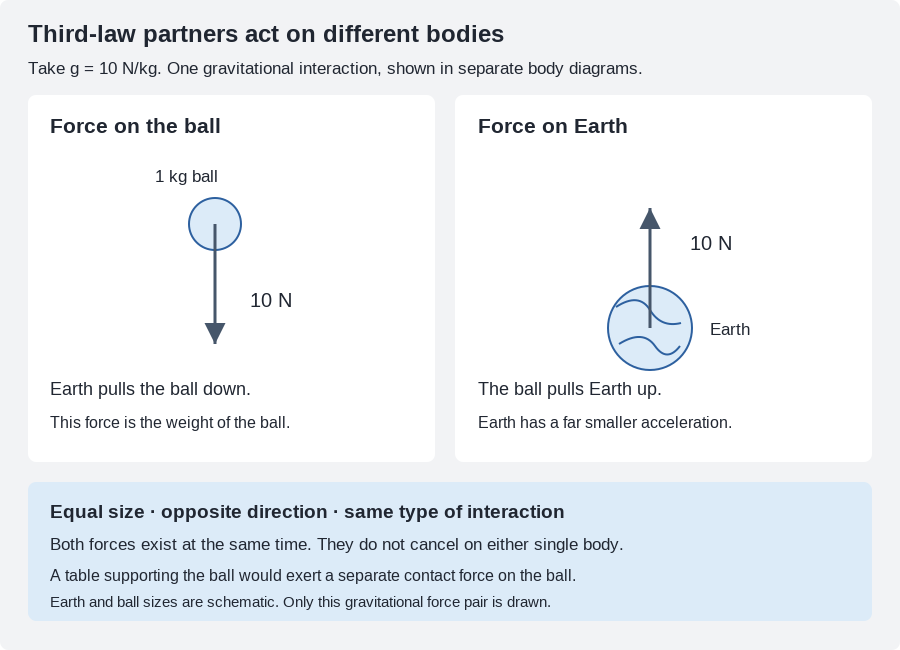
Describe both the source and the recipient: “Earth pulls on the ball” pairs with “the ball pulls on Earth”. In the figure each gravitational force has magnitude 10 N. Earth accelerates far less because its massThe quantity measuring an object’s inertia, expressed in kilograms. is enormously greater; a = F/m.
Why the pair does not cancel on one body
A free-body diagram includes only forceA push or pull arising from an interaction between objects, measured in newtons. acting on the selected body. The gravitational force on Earth belongs on the Earth diagram, not on the ball diagram. Therefore the two partners do not cancel when finding the resultant on the ball.
If the ball rests on a table, its downward weightThe gravitational force acting on an object, equal to its mass multiplied by gravitational field strength. and upward normal reactionA contact force exerted perpendicular to a surface supporting an object. can balance. Those two forces both act on the ball and are different interactions, so they are not third-law partners. The partner of the table pushing the ball up is the ball pushing the table down.
Apply the rule to movement
During walking push-off, the foot pushes the ground backwards and the ground pushes the foot forwards through frictionA force opposing relative sliding or the tendency to slide between contacting surfaces.. These equal opposite forceA push or pull arising from an interaction between objects, measured in newtons. act on different bodies. The forward force on the walker can accelerate the walker.
In a collision between a heavy and a light trolley, the forces they exert on one another are equal at each instant. The lighter trolley has the larger accelerationThe change in velocity per unit time, measured in metres per second squared. magnitude if those are their only unbalanced forces.
Equations
Common misconceptions
- Equal and opposite forces are not necessarily a third-law pair; check the bodies and interaction.
- The more massive object does not exert a larger force on its collision partner.