Learning goals
- Calculate average resultant force from momentum change and time.
- Interpret a momentum–time gradient.
- Handle stopping and rebound signs.
From momentum change to force
The change in momentumThe product of an object’s mass and velocity, measured in kilogram metres per second. is final momentum minus initial momentum, Δp = mv − mu for a constant massThe quantity measuring an object’s inertia, expressed in kilograms.. Dividing by the time interval Δt gives the average resultant forceThe single force that has the same combined effect as all the forces acting on an object.. The units kg m/s divided by s are kg m/s², equivalent to newtons.
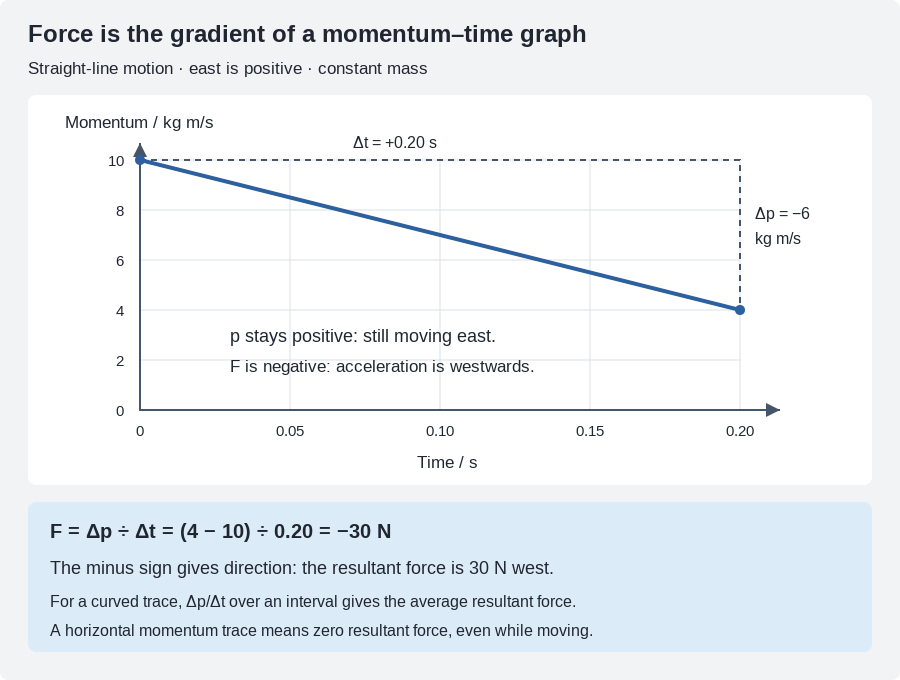
A straight momentum–time graph has a constant gradientThe change in the vertical-axis quantity divided by the corresponding change in the horizontal-axis quantity. and therefore constant resultant force. For a curved graph, the slope between two endpoints gives the average forceA push or pull arising from an interaction between objects, measured in newtons. over that interval; the tangentA straight line with the same local gradient as a curve at the point where it touches. gives the force at an instant. A horizontal trace means constant momentum and zero resultant force.
Worked graph example
Take east as positive. momentumThe product of an object’s mass and velocity, measured in kilogram metres per second. falls from +10 kg m/s to +4 kg m/s in 0.20 s. The change is 4 − 10 = −6 kg m/s, so F = −6/0.20 = −30 N. The forceA push or pull arising from an interaction between objects, measured in newtons. is 30 N westwards.
Momentum remains positive throughout, so the object continues moving east while slowing. A negative force does not automatically mean negative velocityThe rate of change of displacement, including the direction of motion..
Rebounds need signed velocities
A 0.20 kg ball approaches a wall at +5 m/s and rebounds at −3 m/s. Its momentumThe product of an object’s mass and velocity, measured in kilogram metres per second. change is (0.20 × −3) − (0.20 × 5) = −0.60 − 1.00 = −1.60 kg m/s. If contact lasts 0.040 s, the average forceA push or pull arising from an interaction between objects, measured in newtons. is −1.60/0.040 = −40 N.
Subtracting the two speedThe distance travelled per unit time, without specifying direction. would miss the reversal. Force × time equals momentum change; for a varying force, use the average force over the stated interval.
Equations
- F_average = Δp/Δt = (mv − mu)/Δt
- F_average Δt = Δp
Common misconceptions
- Force is a rate of change of momentum, not momentum itself.
- A finite-interval calculation gives average force when the force varies.