Learning goals
- Choose the objects included in a momentum system.
- Use conservation to calculate mass, velocity or momentum.
- Explain why kinetic energy can decrease while momentum is conserved.
Choose a system and a sign convention
A system is the set of objects you include, such as both trolleys in a collision. forceA push or pull arising from an interaction between objects, measured in newtons. between those objects are internal: they transfer momentumThe product of an object’s mass and velocity, measured in kilogram metres per second. between the objects. If the resultant external force is zero, the total momentum stays constant. In a short collision, external forces such as frictionA force opposing relative sliding or the tendency to slide between contacting surfaces. may have a negligible effect on total momentum during the short interaction.
Choose one direction as positive. Add each signed massThe quantity measuring an object’s inertia, expressed in kilograms. × velocityThe rate of change of displacement, including the direction of motion. before the event, then equate that total to the signed total afterwards. An object at rest contributes zero momentum.
Worked example: trolleys that stick together
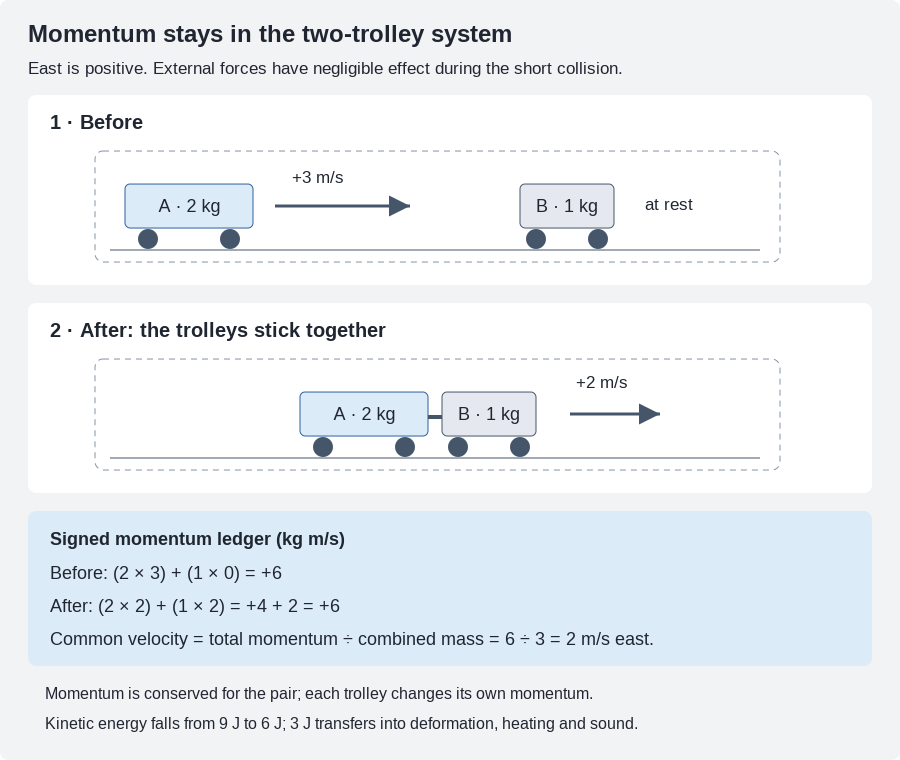
A 2 kg trolley moves east at 3 m/s and a 1 kg trolley is stationary. Before collision, total momentumThe product of an object’s mass and velocity, measured in kilogram metres per second. is (2 × 3) + (1 × 0) = +6 kg m/s. They stick together, so both must have the same final velocityThe rate of change of displacement, including the direction of motion. v.
Afterwards the combined massThe quantity measuring an object’s inertia, expressed in kilograms. is 3 kg, so 3v = 6 and v = +2 m/s, east. Checking separately gives (2 × 2) + (1 × 2) = +6 kg m/s. Trolley A loses 2 kg m/s and B gains 2 kg m/s.
Other unknowns and an energy check
If the stationary trolley massThe quantity measuring an object’s inertia, expressed in kilograms. were unknown but the common final velocityThe rate of change of displacement, including the direction of motion. were measured as 2 m/s, 6 = (2 + m) × 2. Divide by 2, then subtract 2: m = 1 kg. Always check that a calculated mass is positive and that velocity signs match your chosen direction.
The initial kinetic energyThe energy associated with motion, equal to half the mass multiplied by speed squared for a moving object. here is ½ × 2 × 3² = 9 J; afterwards it is ½ × 3 × 2² = 6 J. The remaining 3 J transfers to deformation, heating and soundA mechanical wave produced by vibrations and transmitted through a material medium.. Total energyA conserved quantity transferred between stores by working, heating, electrical processes or radiation, measured in joules. is conserved, but kinetic energy is not conserved in this inelastic collision.
Equations
- total signed momentum before = total signed momentum after
- m₁u₁ + m₂u₂ = m₁v₁ + m₂v₂
Common misconceptions
- Momentum is conserved for the whole isolated system, not necessarily for each object.
- Conservation of momentum does not require conservation of kinetic energy.
Predict the motion after trolleys stick
Use signed system momentum to predict a shared velocity and distinguish momentum from kinetic energy.
What you see
- Labelled diagrams and numerical outputs describe the same selected state.
How to use it
- Change one control at a time, predict the outcome, then compare the readouts. All controls have keyboard-accessible sliders and step buttons.
- Reset restores every model control to its initial value. Nothing is saved.
What it shows
- Total signed momentum is conserved for the two-trolley system. After sticking, their combined mass has one velocity. Kinetic energy decreases as energy transfers to other stores; momentum conservation does not require kinetic energy conservation.
Limits of the model
- Two trolleys on one straight track meet and stick. External horizontal forces have negligible effect during the collision.
- The left trolley moves right; the right trolley moves left or starts at rest, so they approach. Before/after drawings are snapshots, not a timed animation.
Controls
Shared velocity=total momentum÷combined mass=4÷3=1.33 m/s. A negative result means leftwards. Equal and opposite incoming momenta can give zero shared velocity even though both trolleys were moving.
Predict, change and explain
Find a pair of incoming momenta that cancel. Predict the shared velocity before reading it. Then keep velocities fixed and double one mass. Compare total momentum and kinetic energy before and after.
Connect the outcome to the Physics
Total signed momentum is conserved for the two-trolley system. After sticking, their combined mass has one velocity. Kinetic energy decreases as energy transfers to other stores; momentum conservation does not require kinetic energy conservation.