Learning goals
- Explain safety features using momentum change and stopping time.
- Calculate and compare average impact forces.
- Distinguish average force from peak force and contact pressure.
The person still has to stop
A moving occupant has momentumThe product of an object’s mass and velocity, measured in kilogram metres per second.. During a collision the vehicle may slow rapidly, but the occupant continues forwards unless a forceA push or pull arising from an interaction between objects, measured in newtons. changes their momentum. A restraint must bring the occupant towards the new velocityThe rate of change of displacement, including the direction of motion. of the vehicle. For the same initial and final velocities and the same massThe quantity measuring an object’s inertia, expressed in kilograms., the momentum change is fixed.
Average resultant forceThe single force that has the same combined effect as all the forces acting on an object. equals change in momentum divided by the time taken. Increasing the stopping time spreads the same change over a longer interval and reduces the average force. It does not remove the momentum change.
Worked comparison
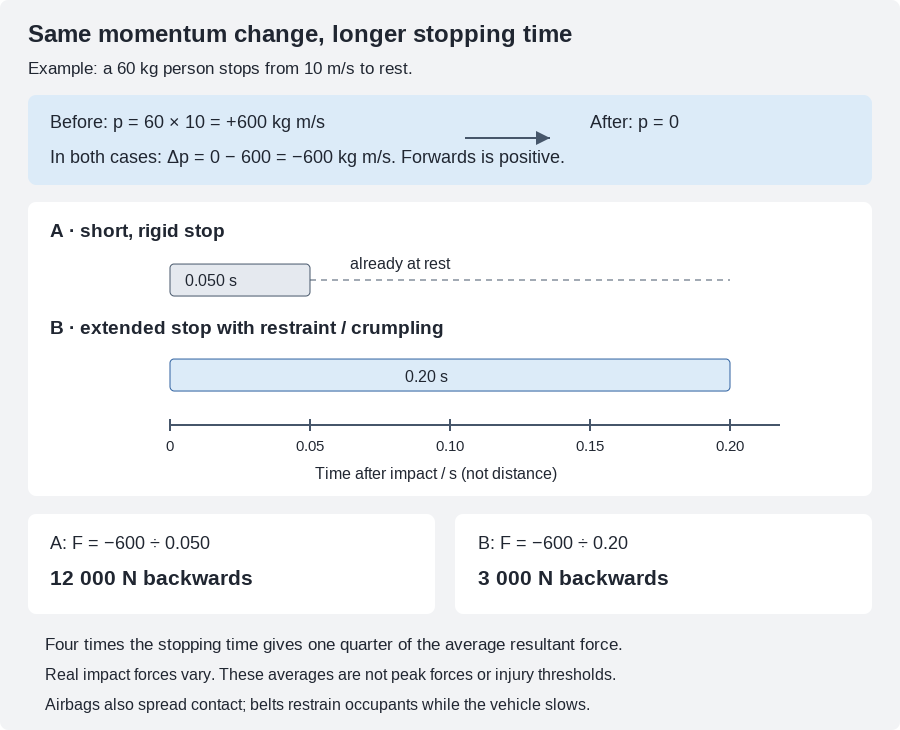
Consider an 60 kg person moving forwards at 10 m/s and brought to rest. Initial momentumThe product of an object’s mass and velocity, measured in kilogram metres per second. is 60 × 10 = 600 kg m/s. Final momentum is zero, so Δp = 0 − 600 = −600 kg m/s.
Stopping in 0.050 s gives F = −600/0.050 = −12 000 N. Stopping in 0.20 s gives F = −600/0.20 = −3 000 N. Four times the duration gives one quarter of the average forceA push or pull arising from an interaction between objects, measured in newtons.. Both forces act backwards. The timeline bars in the figure show time, not distanceThe length of a path travelled, without regard to direction. travelled.
Connect the model to a safety feature
Crumple zones deform and extend the vehicle stopping time. Seat belts restrain occupants so they slow with the vehicle; controlled stretching can increase their stopping time. Airbags cushion contact and spread the forceA push or pull arising from an interaction between objects, measured in newtons. over a larger area. A helmet lining deforms to extend the stopping time of the head.
Spreading a force over a larger area reduces pressureThe normal force exerted per unit area, measured in pascals., a separate benefit from reducing force through longer stopping time. Real impact forces vary, so an average does not specify the peak force or guarantee an injury outcome.
Equations
- average resultant force = change in momentum / stopping time
Common misconceptions
- Safety features do not make the required momentum change disappear.
- A longer impact stopping time is not the same quantity as a longer driver reaction time.