Learning goals
- Define centre of gravity and draw the weight through it.
- Explain the suspension method for a thin lamina.
- Use the weight line to reason about balance and tipping.
Representing the whole weight by one force
gravityThe attractive interaction between objects with mass. acts on all parts of an object. In a uniform gravitational fieldA region in which a mass experiences a gravitational force., their combined effect can be represented by one downward weightThe gravitational force acting on an object, equal to its mass multiplied by gravitational field strength. forceA push or pull arising from an interaction between objects, measured in newtons. acting through the centre of gravityThe point through which an object’s total weight is represented as acting., G. A uniform symmetrical object has G at its geometric centre. Uneven massThe quantity measuring an object’s inertia, expressed in kilograms. distribution shifts G towards the heavier region.
G need not lie inside the material: for example, the centre of gravity of a uniform ring is in its central hole. It is a point used to locate the resultant weight, not a separate particle.
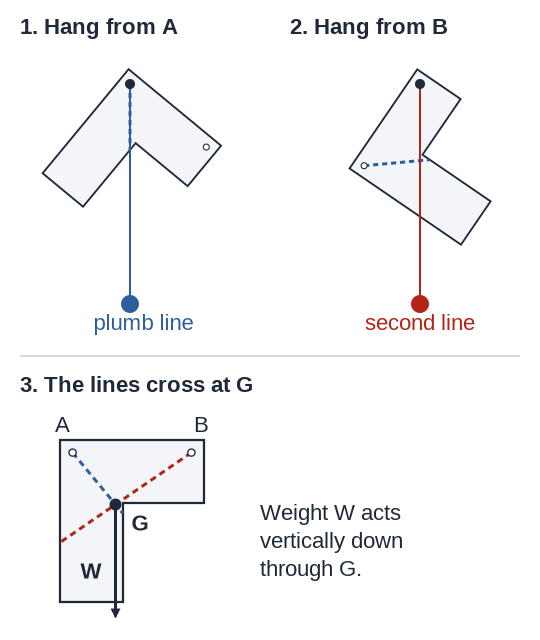
Finding G for an irregular lamina
Use a thin stiff sheet, a secure pin and a plumb line. Suspend the lamina freely from a small hole near its edge, with the plumb line hanging from the same pin. Let both settle. Mark the vertical string line on the lamina, viewing straight on to reduce parallax.
Repeat from a different hole and draw another vertical. The two marked lines intersect at G. A third suspension should give a line through the same point; a small intersection region indicates measurement uncertaintyThe estimated range around a measured value within which the true value is expected to lie.. Ensure the sheet is not rubbing against the support and the plumb bob hangs clear.
Why the method works
The freely suspended object turns until G lies below the suspension point. Its downward weightThe gravitational force acting on an object, equal to its mass multiplied by gravitational field strength. then has zero momentThe turning effect of a force about a point, equal to force multiplied by perpendicular distance from that point to its line of action. about the pin. Each suspension therefore identifies a line containing G. The figure shows the same shape rotated, not two different pieces.
For a body resting on a base, a weight line outside the base gives a turning effect about an edge and can cause tipping. A lower centre of gravityThe point through which an object’s total weight is represented as acting. and a wider base usually make a body harder to tip.
Equations
Common misconceptions
- The centre of gravity is not always the geometric centre or inside the material.
- Weight acts down through G, not along the sloping outline of the object.