Learning goals
- Identify weight and air resistance on a falling object.
- Explain changing resultant force during a fall.
- Describe terminal velocity.
Release and initial acceleration
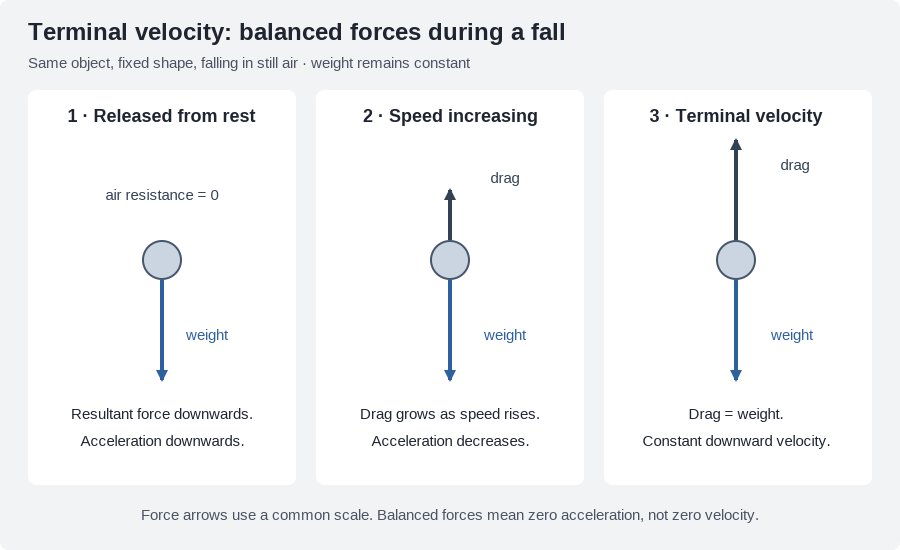
For an object released from rest in still air, downward weightThe gravitational force acting on an object, equal to its mass multiplied by gravitational field strength. initially exceeds upward air resistanceA drag force exerted by air on an object moving relative to it.. The downward resultant causes downward accelerationThe change in velocity per unit time, measured in metres per second squared.. Weight remains approximately constant near Earth’s surface.
Increasing drag reduces acceleration
As downward speedThe distance travelled per unit time, without specifying direction. grows, upward air resistanceA drag force exerted by air on an object moving relative to it. grows. The resultant weightThe gravitational force acting on an object, equal to its mass multiplied by gravitational field strength. minus dragA force exerted by a fluid that opposes an object’s motion relative to the fluid. becomes smaller, so downward accelerationThe change in velocity per unit time, measured in metres per second squared. decreases. The object is still speeding up, but gains less speed each second.
When drag equals weight, resultant forceThe single force that has the same combined effect as all the forces acting on an object. and acceleration are zero. The object continues falling at a constant terminal velocityA constant velocity reached when resistive forces balance the driving force so that the resultant force is zero.. Balanced forceA push or pull arising from an interaction between objects, measured in newtons. maintain that velocityThe rate of change of displacement, including the direction of motion.; they do not require rest.
Limits and changed conditions
The three illustrated stages show constant weightThe gravitational force acting on an object, equal to its mass multiplied by gravitational field strength. arrows and increasing dragA force exerted by a fluid that opposes an object’s motion relative to the fluid. arrows, finally equal in size. They depict successive states of one falling body, not forceA push or pull arising from an interaction between objects, measured in newtons. on three bodies simultaneously.
Changing exposed area or shape changes the speedThe distance travelled per unit time, without specifying direction. at which drag balances weight. An opened parachute can produce drag greater than weight and slow a fall before a lower terminal speed is reached. In a vacuum, air resistanceA drag force exerted by air on an object moving relative to it. is absent: this drag-balance explanation of terminal velocityA constant velocity reached when resistive forces balance the driving force so that the resultant force is zero. does not apply.
Equations
Common misconceptions
- Terminal velocity is not zero velocity; it is constant velocity.
- Air resistance is not constant during the whole fall.