Learning goals
- Define thinking and braking distance.
- Use the stopping-distance sum.
- Separate reaction effects from braking effects.
Two stages of stopping
thinking distanceThe distance a vehicle travels during the driver’s reaction time before braking starts. is travelled while the driver reacts. braking distanceThe distance a vehicle travels from the start of braking until it stops. is travelled after the brakes are applied until the vehicle stops. Their sum is the total stopping distanceThe total distance travelled during the driver’s reaction time and while braking to rest.. During reaction the car is still moving: if its speedThe distance travelled per unit time, without specifying direction. is approximately constant, thinking distance equals speed multiplied by reaction timeThe interval between a stimulus and the start of a response.. Once braking begins, the speed decreases until it reaches zero.
Worked example
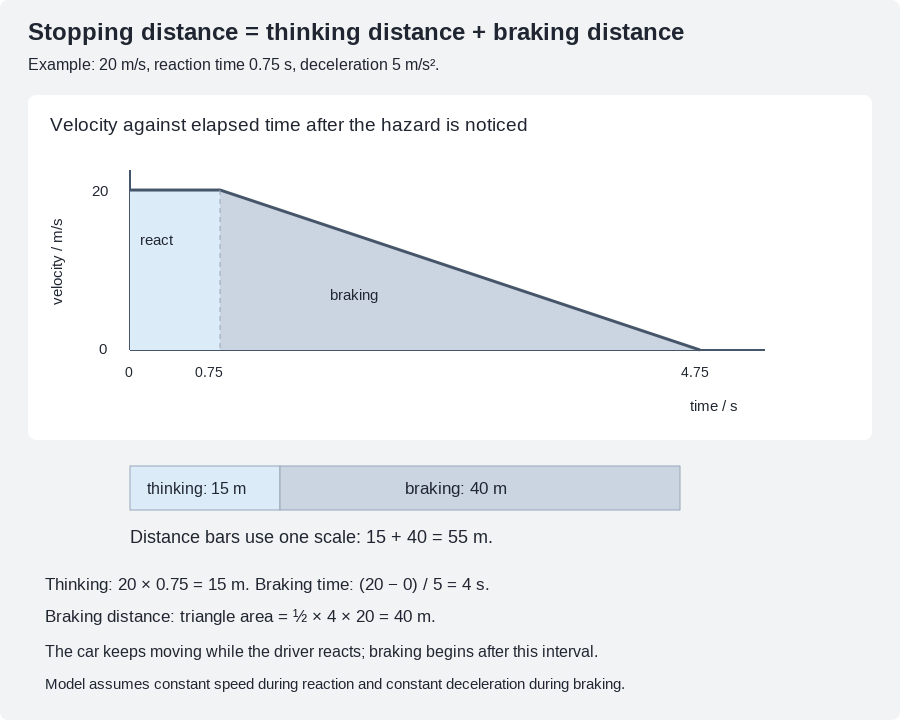
In the figure a car moves at 20 m/s during a 0.75 s reaction interval, so thinking distanceThe distance a vehicle travels during the driver’s reaction time before braking starts. is 20 × 0.75 = 15 m. A constant decelerationA decrease in the speed of an object over time. of 5 m/s² then reduces its speedThe distance travelled per unit time, without specifying direction. to zero in 4 s. The area of the triangular braking section of the velocityThe rate of change of displacement, including the direction of motion.–time graph is ½ × 4 × 20 = 40 m. Total stopping distanceThe total distance travelled during the driver’s reaction time and while braking to rest. is therefore 15 + 40 = 55 m.
Read the boundaries carefully
reaction timeThe interval between a stimulus and the start of a response. runs from noticing a hazard to applying the brakes. Braking time begins when the brakes act and ends at rest. During reaction, the model assumes unchanged speedThe distance travelled per unit time, without specifying direction.; during braking, it assumes constant decelerationA decrease in the speed of an object over time..
On the velocityThe rate of change of displacement, including the direction of motion.–time graph, thinking distanceThe distance a vehicle travels during the driver’s reaction time before braking starts. is a rectangle and braking distanceThe distance a vehicle travels from the start of braking until it stops. a triangle. Their areas add because the vehicle continues in one direction. Real road conditions and braking forceA push or pull arising from an interaction between objects, measured in newtons. vary.
Equations
- thinking distance = speed × reaction time
- stopping distance = thinking distance + braking distance
Common misconceptions
- Thinking distance is not the distance travelled while the brakes are working.
Separate thinking and braking distance
Predict how speed, reaction time, mass and braking force affect the two parts of stopping distance.
What you see
- Labelled diagrams and numerical outputs describe the same selected state.
How to use it
- Change one control at a time, predict the outcome, then compare the readouts. All controls have keyboard-accessible sliders and step buttons.
- Reset restores every model control to its initial value. Nothing is saved.
What it shows
- Thinking distance is speed×reaction time. During uniform braking, time to stop is speed divided by the deceleration F/m. Average speed during this interval is half the initial speed. Thus thinking distance doubles but braking distance quadruples when speed doubles under these conditions.
Limits of the model
- Straight level road, constant speed during reaction, then one constant opposing resultant force until rest.
- No other resistance or braking delay; the chosen force does not change with speed. This is not a road-safety stopping-distance calculator.
Controls
At these settings: thinking=20×0.7=14 m. Braking distance=average braking speed×braking time=10×4=40 m. Calculations use unrounded values.
Predict, change and explain
Double speed from 10 to 20 m/s without changing the other controls. Compare the two distances. Restore speed, then double reaction time. Finally compare two masses at the same braking force.
Connect the outcome to the Physics
Thinking distance is speed×reaction time. During uniform braking, time to stop is speed divided by the deceleration F/m. Average speed during this interval is half the initial speed. Thus thinking distance doubles but braking distance quadruples when speed doubles under these conditions.