Learning goals
- Distinguish mass from weight.
- Use W = mg with correct units.
- Explain why weight changes between gravitational fields.
Mass and weight measure different things
massThe quantity measuring an object’s inertia, expressed in kilograms. describes the amount of matter and resistanceThe ratio of potential difference across a component to the current through it, measured in ohms. to accelerationThe change in velocity per unit time, measured in metres per second squared., measured in kilograms. weightThe gravitational force acting on an object, equal to its mass multiplied by gravitational field strength. is the gravitational forceA push or pull arising from an interaction between objects, measured in newtons. on the body, measured in newtons, directed towards the attracting body. Moving an unchanged object to another planetA large body orbiting a star that is rounded by its own gravity and has cleared its orbital neighbourhood. changes its weight, not its mass.
Gravitational field strength
The field strength g is forceA push or pull arising from an interaction between objects, measured in newtons. per unit massThe quantity measuring an object’s inertia, expressed in kilograms. in N/kg. A value of 10 N/kg means each kilogram experiences 10 N of weightThe gravitational force acting on an object, equal to its mass multiplied by gravitational field strength.. Therefore W = mg. Use the value stated in a question rather than silently substituting a different rounded value.
Worked comparison
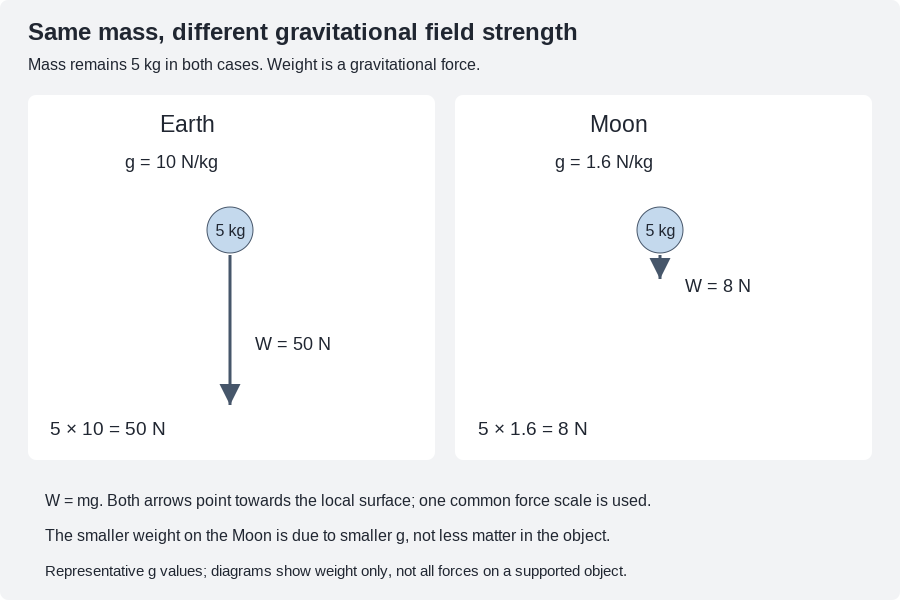
For a 5 kg object on Earth with g = 10 N/kg, W = 5 × 10 = 50 N downwards. On the moonA natural satellite orbiting a planet or other non-stellar body., g = 1.6 N/kg gives W = 5 × 1.6 = 8 N. Both massThe quantity measuring an object’s inertia, expressed in kilograms. remain 5 kg.
Rearranging gives m = W/g. A 20 N weightThe gravitational force acting on an object, equal to its mass multiplied by gravitational field strength. in a 10 N/kg field corresponds to 2.0 kg. A forceA push or pull arising from an interaction between objects, measured in newtons. meter measures weight; an electronic balance may display a mass inferred from the local gravitational force.
Equations
- W = m × g
Common misconceptions
- A person’s mass does not become smaller on the Moon; their weight does.