Learning goals
- Use force, mass and acceleration in calculations.
- Explain how mass affects acceleration for a fixed force.
- Check units and direction.
Use the unbalanced force
For constant massThe quantity measuring an object’s inertia, expressed in kilograms., resultant forceThe single force that has the same combined effect as all the forces acting on an object. F equals mass m multiplied by accelerationThe change in velocity per unit time, measured in metres per second squared. a. Use kilograms, newtons and m/s². Acceleration is the rate of change of velocityThe rate of change of displacement, including the direction of motion. and points in the resultant direction.
For a fixed mass, doubling the resultant doubles acceleration. For a fixed resultant, doubling mass halves acceleration. A zero resultant gives zero acceleration; the velocity can still be nonzero.
Worked example from the force diagram
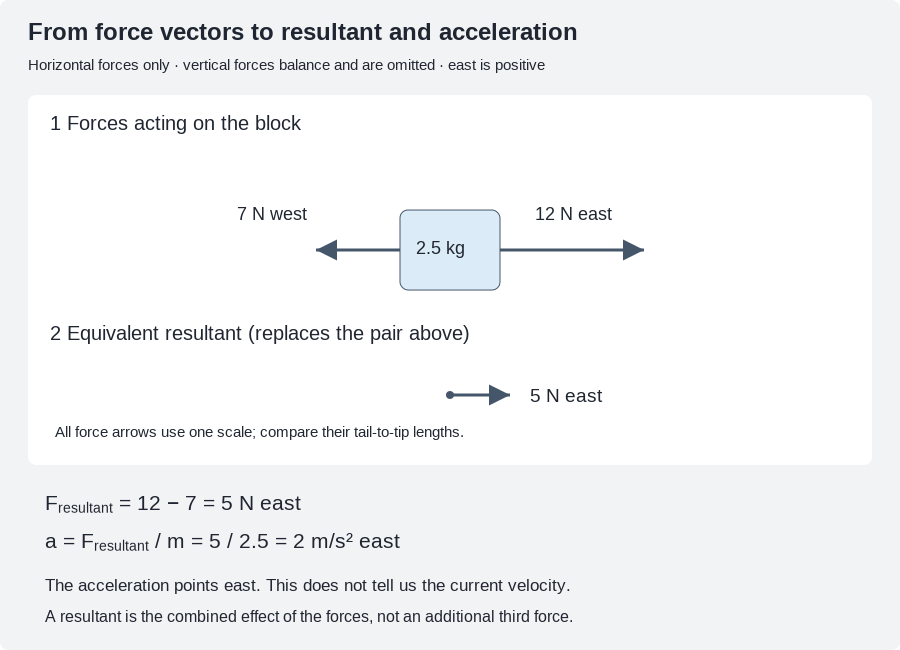
The 2.5 kg block has forceA push or pull arising from an interaction between objects, measured in newtons. 12 N east and 7 N west. First calculate the resultant: 12 − 7 = 5 N east. Then a = F/m = 5/2.5 = 2 m/s² east.
Using 12 N alone would ignore the opposing force. The resultant arrow in the equivalent diagram represents the same combined effect and is not an extra force.
Rearrange and interpret
From F = ma, divide by a to find m = F/a, or by m to find a = F/m. A 3 kg trolley requiring accelerationThe change in velocity per unit time, measured in metres per second squared. 4 m/s² needs resultant 3 × 4 = 12 N.
If it also has 2 N resistanceThe ratio of potential difference across a component to the current through it, measured in ohms. opposite its acceleration, the driving forceA push or pull arising from an interaction between objects, measured in newtons. must be 14 N to leave a 12 N resultant. State what each force refers to and check the sign convention before substitution.
Equations
- F = m × a
Common misconceptions
- Use the resultant force, not one force selected from the diagram.
- Mass is measured in kilograms; weight is a separate force measured in newtons.
Connect resultant force, motion and graph area
Change mass and opposing forces, then connect acceleration, velocity and distance to the same model.
What you see
- Labelled diagrams and numerical outputs describe the same selected state.
How to use it
- Change one control at a time, predict the outcome, then compare the readouts. All controls have keyboard-accessible sliders and step buttons.
- Reset restores every model control to its initial value. Nothing is saved.
What it shows
- Fresultant=ma fixes acceleration, the gradient of the velocity–time graph. Signed area gives displacement. Distance adds the magnitudes of the areas, so it can exceed the magnitude of displacement after a reversal.
Limits of the model
- One-dimensional motion with right positive, constant mass and constant horizontal forces. Vertical forces balance.
- The forces remain applied for five seconds; there is no speed-dependent resistance. Time is controlled with the slider, not wall-clock playback.
Controls
Areas below zero contribute negative displacement but positive distance. Equal forces preserve the initial velocity; they do not necessarily stop the trolley.
Predict, change and explain
Set equal forces and a non-zero initial velocity. Predict the graph and displacement. Then make the resultant oppose the initial velocity: find when the trolley stops and reverses. Compare distance with displacement.
Connect the outcome to the Physics
Fresultant=ma fixes acceleration, the gradient of the velocity–time graph. Signed area gives displacement. Distance adds the magnitudes of the areas, so it can exceed the magnitude of displacement after a reversal.