Learning goals
- Describe friction as an opposing force.
- Identify factors that change friction qualitatively.
- Draw friction in a free-body diagram.
Relative motion at a contact
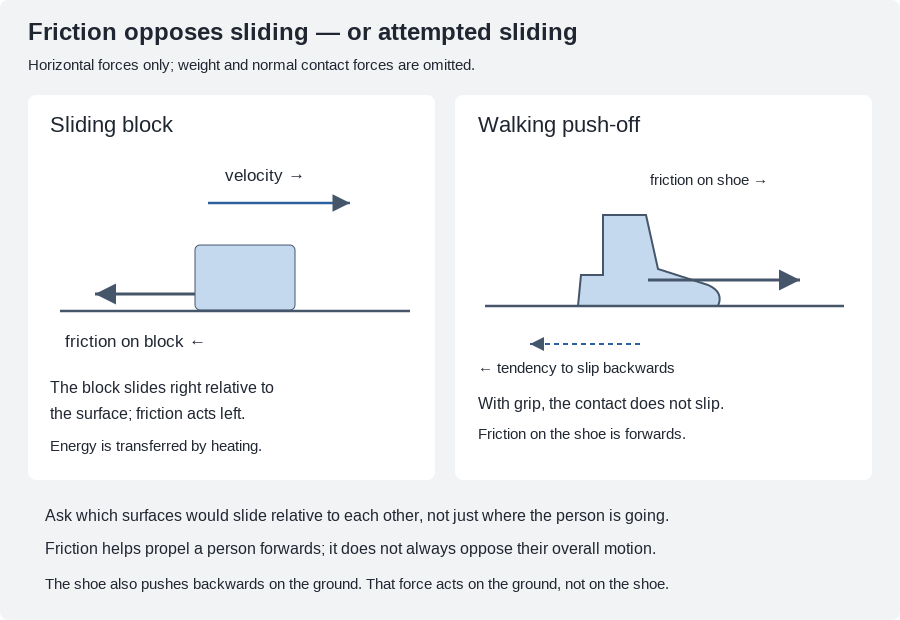
frictionA force opposing relative sliding or the tendency to slide between contacting surfaces. opposes relative sliding, or the tendency to slide, between contacting surfaces. Friction that stops surfaces starting to slide is called static friction (beyond the specification). A block sliding right on a stationary floor experiences friction left. The floor experiences the opposite friction forceA push or pull arising from an interaction between objects, measured in newtons. from the block.
Sliding friction transfers energyA conserved quantity transferred between stores by working, heating, electrical processes or radiation, measured in joules. into the internal stores of the surfaces, often warming them. Lubrication can reduce unwanted friction; rough grips can help prevent slipping.
Why friction can help movement
During walking push-off, a shoe tends to slip backwards relative to the ground. frictionA force opposing relative sliding or the tendency to slide between contacting surfaces. from the ground acts forwards on the shoe and helps accelerate the walker. It opposes the tendency to slip, even though it acts in the direction the person moves.
A tyre can likewise obtain grip through friction. Do not choose the friction direction from the vehicle’s overall motion alone: identify the surfaces and their relative slipping or tendency to slip.
Fluid resistance
air resistanceA drag force exerted by air on an object moving relative to it. and water resistanceThe ratio of potential difference across a component to the current through it, measured in ohms. are dragA force exerted by a fluid that opposes an object’s motion relative to the fluid. forceA push or pull arising from an interaction between objects, measured in newtons. opposing motion relative to the fluid. Drag generally increases as relative speedThe distance travelled per unit time, without specifying direction. increases and also depends on shape and exposed area. A falling object in still air has upward drag and downward weightThe gravitational force acting on an object, equal to its mass multiplied by gravitational field strength.. These can balance without the object stopping.
Equations
Common misconceptions
- Do not assume friction always opposes the overall motion of an object. Identify the relative sliding or tendency to slide at the contact; friction opposes that.