Learning goals
- Define acceleration using change in velocity and time.
- Calculate acceleration with signed or stated velocity changes.
- Interpret the unit m/s² physically.
Velocity changes with time
velocityThe rate of change of displacement, including the direction of motion. includes direction. accelerationThe change in velocity per unit time, measured in metres per second squared. measures how quickly velocity changes: subtract initial velocity u from final velocity v, then divide by the elapsed time t. Use a consistent positive direction throughout.
The unit m/s² means a change of one metre per second each second. A finite-interval calculation gives average acceleration; if the acceleration is constant, that value applies throughout the interval.
Worked example: equal changes each second
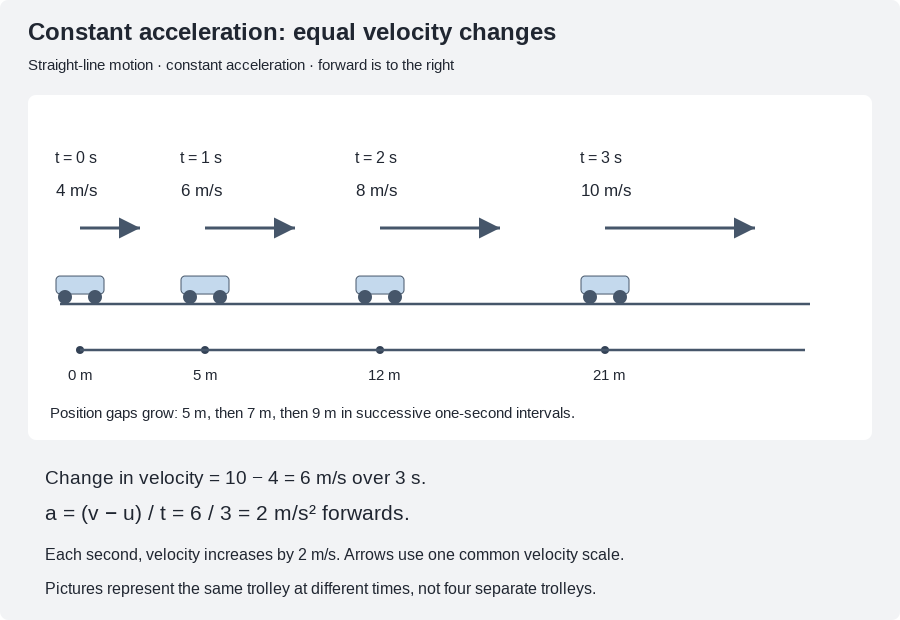
The illustrated trolley has velocityThe rate of change of displacement, including the direction of motion. 4, 6, 8 and 10 m/s forwards at 0, 1, 2 and 3 s. Over the full interval, a = (10 − 4)/3 = 2 m/s² forwards. Each one-second interval gives the same value.
The trolley travels progressively farther in each second because it is getting faster. Its positions are 0, 5, 12 and 21 m, giving successive distanceThe length of a path travelled, without regard to direction. 5, 7 and 9 m. Equal time intervals do not imply equal distances when velocity changes.
Signs and slowing down
Taking forwards as positive, slowing from +10 to +4 m/s in 3 s gives a = (4 − 10)/3 = −2 m/s². The accelerationThe change in velocity per unit time, measured in metres per second squared. is backwards while the trolley still moves forwards.
Negative acceleration does not always mean slowing. A change from −4 to −10 m/s in 3 s also gives −2 m/s², but the speedThe distance travelled per unit time, without specifying direction. increases from 4 to 10 m/s backwards. Acceleration opposite to velocityThe rate of change of displacement, including the direction of motion. reduces speed; acceleration in the same direction increases it.
Equations
- a = (v − u)/t; a in m/s², u and v in m/s, t in s
- v = u + at for constant acceleration (beyond the specification)
Common misconceptions
- An object can accelerate while slowing down; acceleration is about velocity change, not only speeding up.
- Acceleration is not velocity divided by distance.
Connect resultant force, motion and graph area
Change mass and opposing forces, then connect acceleration, velocity and distance to the same model.
What you see
- Labelled diagrams and numerical outputs describe the same selected state.
How to use it
- Change one control at a time, predict the outcome, then compare the readouts. All controls have keyboard-accessible sliders and step buttons.
- Reset restores every model control to its initial value. Nothing is saved.
What it shows
- Fresultant=ma fixes acceleration, the gradient of the velocity–time graph. Signed area gives displacement. Distance adds the magnitudes of the areas, so it can exceed the magnitude of displacement after a reversal.
Limits of the model
- One-dimensional motion with right positive, constant mass and constant horizontal forces. Vertical forces balance.
- The forces remain applied for five seconds; there is no speed-dependent resistance. Time is controlled with the slider, not wall-clock playback.
Controls
Areas below zero contribute negative displacement but positive distance. Equal forces preserve the initial velocity; they do not necessarily stop the trolley.
Predict, change and explain
Set equal forces and a non-zero initial velocity. Predict the graph and displacement. Then make the resultant oppose the initial velocity: find when the trolley stops and reverses. Compare distance with displacement.
Connect the outcome to the Physics
Fresultant=ma fixes acceleration, the gradient of the velocity–time graph. Signed area gives displacement. Distance adds the magnitudes of the areas, so it can exceed the magnitude of displacement after a reversal.