
What you need to know
- 6.14Core Practical 14: effect of different antibioticA substance that kills bacteria or stops them growing, without harming human cells. Antibiotics do not work on viruses. on bacteria.
Preparation for supervised school work. Teachers approve organism, discs and disposal. Fictional millimetres are teaching data. CP9 used plant extracts; this practical uses antibiotic discs. Not a prescription.
By the end, you should be able to…
- Name independent and dependent variables for disc diffusionThe net movement of molecules from a region of higher concentration to a region of lower concentration. It is passive..
- Include a control disc (sterile water) and 25 °C incubation.
- Evaluate zone size without claiming a best medicine.
Build your understanding
What you are comparing
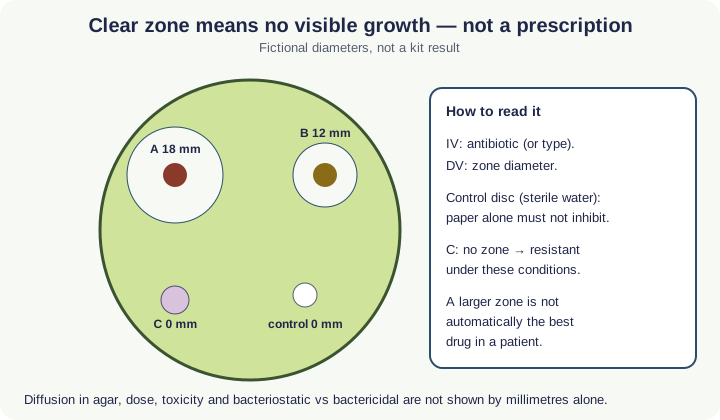
Aim: the effect of different antibioticA substance that kills bacteria or stops them growing, without harming human cells. Antibiotics do not work on viruses. on bacteria. Independent variable: antibiotic type (or concentration if that is the design). Dependent variable: diameter of the clear zone of inhibitionThe clear area around an antibiotic disc on a bacterial lawn, where bacteria have not grown.. The control disc (soaked only in sterile water) must show no zone: it shows that the paper disc alone does not inhibit growth, so any zone is caused by the antibiotic.
Use the non-pathogenic speciesA group of organisms that can interbreed to produce fertile offspring. issued. Spread an even lawn so zones have a clear edge. Place discs with flamed forceps and do not slide them. Fictional results such as control disc 0 mm, A 18 mm, B 12 mm, C 0 mm are for discussing sensitivity versus resistance — not yours to copy.
Aseptic and 25 °C, again
Aseptic lawn, as in 6A 4 and CP9: sterile spreader, lid as a shield, no sniffing later. Invert plates so condensationA reaction that joins two molecules with a covalent bond and releases a molecule of water. does not drip. Tape lightly, not sealed, so aerobes get oxygen. Incubate at about 25 °C, not 37 °C, to reduce selection of human pathogens. autoclaveA machine that sterilises equipment and media with steam under pressure, at about 121 °C. waste.
Measure diameter through the disc, consistently including or excluding the disc and stating which. Record 0 when there is no clear agar beyond the disc; otherwise include the 6 mm disc. An irregular zone can be two perpendicular diameters averaged. Area is an alternative if the question asks.
What a millimetre is not
A larger zone means that antibiotic inhibited that lawn more under these conditions, or that the strain was more sensitive. It also depends on how well the chemical diffuses in agar. Toxicity, dose in a person, and bacteriostaticDescribes an antibiotic that stops bacteria growing and dividing, without killing them. versus bactericidalDescribes an antibiotic that kills bacteria. action are not on the plate. C = 0 mm suggests this strain is resistant, but an expired or faulty disc gives the same result, so repeat with a fresh disc before claiming resistance.
CP9 plant extracts are mixtures of unknown concentration. CP14 discs are supplied antibiotics. Do not treat a kitchen herb as this practical.
| Practical | Independent variable | Same skills |
|---|---|---|
| CP9 | Plant extract / species | Aseptic lawn, zone, 25 °C, no over-claim |
| CP14 | Antibiotic type | Aseptic lawn, zone, 25 °C, control disc (sterile water) |
The antibiotic discs lab
Spread an aseptic lawn of the school’s non-pathogenic bacterium, add discs of four fictional antibiotics and a control disc (sterile water), incubate at about 25 °C and compare the zones of inhibition. A teaching model: antibiotics A–D and every result are fictional.
Simulation only. Use only the species and discs your school provides, keep ethanol away from flames, tape lids with two strips, incubate at the approved temperature (about 25 °C), never open an incubated plate, and autoclave everything. Never bring antibiotics from home.
Method 8 steps
- Use only the non-pathogenic species your school provides. Disinfect the bench and work near a Bunsen on a blue flame.
- Label the base of a plate poured with a standard volume of agar (for example 20 cm³) with species, antibiotics and date.
- Flame the bottle neck, pipette 0.1 cm³ of broth onto the agar with the lid lifted at an angle, and spread a confluent lawn with a flamed, cooled spreader (ethanol beaker away from the flame).
- With flamed forceps, place discs of each antibiotic and a control disc (sterile water) at least 20 mm apart. Press each one down; never slide it.
- Tape the lid with two short strips (not sealed), invert, and incubate at about 25 °C for a stated time such as 48 h.
- Without opening the plate, measure two perpendicular zone diameters through the base, including the 6 mm disc; record 0 when there is no clear agar beyond the disc. Use at least three plates.
- If a disc gives no zone, repeat it with a fresh, in-date disc before claiming resistance.
- Put all plates and equipment unopened into the autoclave bag, disinfect the bench and wash your hands.
Aligned with the order of the specification practical. Simulation only: a teacher sets the real volumes, concentrations and risk controls; this is not a laboratory protocol.
Variables
- Independent
- Type of antibiotic (or its concentration, if that is the design).
- Dependent
- Diameter of the zone of inhibition (mm, mean of two perpendicular diameters, disc included).
- Controlled
- Bacterial species and broth volume (lawn density)
- Agar volume and depth
- Disc size (6 mm) and antibiotic content per disc
- Incubation temperature and time
- Control disc (sterile water): shows the paper disc alone does not inhibit growth
Safety
- Only the school’s non-pathogenic species; never open an incubated plate or sniff cultures.
- Ethanol is highly flammable: keep the beaker away from the Bunsen.
- Tape with two strips, not sealed all round; incubate at about 25 °C, not 37 °C.
- Autoclave all cultures and discs; wash hands before leaving.
Follow your school’s risk assessment; these notes are not a substitute for it.
Interpreting
- Fictional species A: control disc (sterile water) 0 mm, A 18 mm, B 12 mm, C 0 mm. The control disc shows that the paper disc alone does not inhibit growth; A inhibited this lawn more than B under these conditions.
- C = 0 mm suggests this strain is resistant, but an expired or faulty disc gives the same result, so repeat with a fresh disc before claiming resistance.
- Zone size also depends on how fast the antibiotic diffuses (fictional D gives a wide zone from a weak drug) and on agar depth, so the biggest zone is not “the best medicine”.
- The plate cannot show whether a drug is bacteriostatic or bactericidal, its dose in a person, or its toxicity.
Guided method · step 1 of 13
- In the simulator, click the disinfectant to wipe the bench.
- Click the Bunsen twice for a blue flame.
Fewer microbes on the bench, and the updraft from a blue flame carries airborne microbes away from the open plate (as in CP9).
1 · Your technique
Follow the guided steps: start by disinfecting the bench.
2 · Discs (fictional antibiotics)
3 · Plates & incubate
4 · Measure zones
Rule: include the 6 mm disc; record 0 when there is no clear agar beyond the disc. Do one plate by hand first; then auto unlocks. Pick a plate in the rack.
5 · Analyse
Zone diameter grows only with √ln(concentration ÷ MIC) and also depends on how fast each antibiotic diffuses, so the widest zone is not automatically the most effective drug. Fictional D diffuses fast: compare its zone with its strength.
Stretch · disc content
A fictional dilution series of antibiotic A (2.5–40 µg per disc, three plates each). The model predicts d² is a straight line against ln(content), gradient 16·D·T₀ ≈ 38 mm² per unit of ln µg, so doubling the content adds only about a millimetre to the zone.
Dispose and evaluate
Antibiotics A–D, zones, expired-disc chances and contamination chances are fictional teaching values from a simplified diffusion model (Cooper’s critical-time model, with the agar-depth effect strengthened for teaching).
Make your reasoning visible
Always mention the control disc (sterile water)
It shows that the paper disc alone does not inhibit growth.
25 °C is a safety control
Not an arbitrary choice.
Avoid this misconception
The claim: The antibioticA substance that kills bacteria or stops them growing, without harming human cells. Antibiotics do not work on viruses. with the biggest zone is the one a doctor should prescribe.
The correction: Zone size mixes potency with diffusionThe net movement of molecules from a region of higher concentration to a region of lower concentration. It is passive.. In-body dose, toxicity, static versus cidal, and the actual pathogen are not decided by a school plate.
Check your understanding
Try each question before opening the suggested answer.
Check your understanding (continued)
Practice question
Retrieval and explanation · suggested answer
State the aim of Core Practical 14.
Show suggested answer
To investigate the effect of different antibiotics on bacteria by comparing zones of inhibition.
Practice question
Retrieval and explanation · suggested answer
Identify independent and dependent variables.
Show suggested answer
Independent: type (or concentration) of antibiotic. Dependent: diameter (or area) of the clear zone.
Practice question
Retrieval and explanation · suggested answer
Why include a control disc (sterile water)?
Show suggested answer
It is a negative control: it shows that the paper disc alone does not inhibit growth, so any clear zone is due to the antibiotic.
Practice question
Retrieval and explanation · suggested answer
Why incubate at about 25 °C rather than 37 °C?
Show suggested answer
37 °C is body temperature and would favour human pathogens; 25 °C still allows the lawn to grow with less of that risk.
Take the idea further
Apply the same specification knowledge to an unfamiliar problem. Any extra assumptions are supplied in the question.
Stretch question
Fictional: antibiotic A 22 mm, B 8 mm, both bacteriostatic in a reference table. A student concludes A will cure an immunocompromised patient faster. Give two reasons the conclusion is unsafe.
Show a hint
Diffusion and host clearance.
Explore the reasoning
A may simply diffuse further in agar, not be more useful in the body. Both are bacteriostatic, so they leave living bacteria that an immunocompromised host may not clear. Toxicity, dose and the clinical species are unknown. The plate is a comparison of lawns, not a trial.
Recall this lesson
Lesson recall questions
Question 1 of 5: Identify the independent and dependent variables in a disc-diffusion antibiotic investigation.
Antibiotic effect on bacteria
Practice question
Retrieval and explanation · suggested answer
Identify the independent and dependent variables in a disc-diffusion antibiotic investigation.
Lesson: CP14: The Effect of Antibiotics on Bacteria
Try this from memory first.
Put your biology to work
Explore where these ideas appear in the world. Enrichment, not extra required recall.
The same lawn logic as professional disc tests, without the brand codes
CP14 · The Effect of Antibiotics on BacteriaClinical disc-diffusion methods compare zones only under specified conditions. EUCAST publishes the standardised method and interpretive criteria used in that setting. Your school plate uses a similar bacterial…Specification 6.14Read & use the scienceClose article
Why this matters
Clinical disc-diffusion methods compare zones only under specified conditions. EUCAST publishes the standardised method and interpretive criteria used in that setting. Your school plate uses a similar bacterial lawn and measured inhibition zone, but its discs and organism need not match a clinical test. Report the millimetres and the limits, not a patient-level sensitive or resistant label. In a clinical laboratory, disc diffusion is standardised because agar depth, inoculum density, disc content and incubation can all alter the zone. EUCAST provides method and interpretation rules for that setting. A school plate teaches the measurement and the need for controls; it cannot diagnose a patient or justify an antibiotic choice. A zone diameter without the organism and standard method is not a clinical category.
Back to the specification
Pearson Edexcel IAL Biology · Issue 2, February 2021 · Unit 4, pp. 29–32 · assessed through Unit 6. The application extends beyond required recall.
- 6.14 Core Practical 14: investigate the effects of different antibiotics on bacteria.
Use the science
Why would copying a commercial kit’s “sensitive/resistant” key into your book as “our result” fail the practical?
Explore a possible response
Those cut-offs belong to a standardised medical test. Your plate, organism and discs may differ. You should report measured zones and a cautious interpretation, not an imported diagnosis.
Explore the source
A hospital resistance map starts with comparable tests
CP14 · The Effect of Antibiotics on BacteriaThe World Health Organization’s GLASS system collects antimicrobial-resistance information using standardised surveillance methods. A school disc-diffusion plate is a useful first step in understanding why a bacterial lawn…Specification 6.14Read & use the scienceClose article
Why this matters
The World Health Organization’s GLASS system collects antimicrobial-resistance information using standardised surveillance methods. A school disc-diffusion plate is a useful first step in understanding why a bacterial lawn and measured zone matter, but it is not a national surveillance record. Different organisms, antibiotics and laboratory methods can produce different zone sizes. To compare places or years, researchers need consistent definitions and quality checks. A small school zone is evidence about that plate under those conditions; it cannot by itself show that resistance is rising in a country.
Back to the specification
Pearson Edexcel IAL Biology · Issue 2, February 2021 · Unit 4, pp. 29–32 · assessed through Unit 6. The application extends beyond required recall.
- 6.14 Core Practical 14: investigate the effects of different antibiotics on bacteria.
Use the science
Why can a single small inhibition zone not establish a national trend in antibiotic resistance?
Explore a possible response
It is one result for one organism, disc and method. A trend needs comparable tests across many clinical isolates and time points, with standard interpretation and sampling.
Explore the source
- Global Antimicrobial Resistance and Use Surveillance SystemWorld Health Organization