
What you need to know
- 6.4Core Practical 13: rate of growth of microorganisms in liquid culture, with safe and ethical use of organisms.
Preparation for supervised school work. Teachers approve organism, medium, temperature and disposal. Fictional absorbances are teaching data. Do not culture environmental unknowns or incubate at 37 °C.
By the end, you should be able to…
- Name independent and dependent variables for a liquid-culture time course.
- Describe aseptic sampling and a growth measure such as turbidityCloudiness of a liquid culture. It increases with the number of cells and can be measured with a colorimeter. or count.
- State ethical and safety constraints: non-pathogen, ~25 °C, autoclaveA machine that sterilises equipment and media with steam under pressure, at about 121 °C. waste.
Build your understanding
What you are measuring
The aim is the rate of growth of microorganisms in a liquid culture. Independent variable: time. Dependent variable: a growth measure such as turbidityCloudiness of a liquid culture. It increases with the number of cells and can be measured with a colorimeter. (absorbance) or a cell count. Yeast (Saccharomyces cerevisiae) in glucoseA hexose (six-carbon) monosaccharide, C₆H₁₂O₆. It is the main respiratory substrate. broth is a suitable non-pathogenic choice. You are not growing M. tuberculosis or HIVHuman immunodeficiency virus: an RNA retrovirus that infects T helper cells and can lead to AIDS..
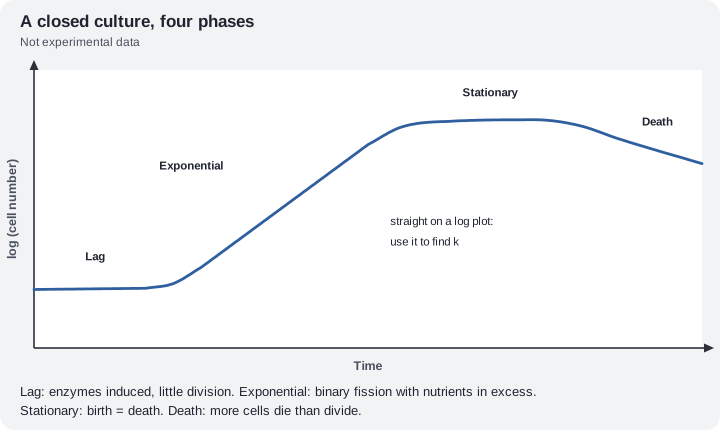
Control temperature, pHA measure of how acidic or alkaline a solution is, based on its H⁺ ion concentration. Below 7 is acidic, above 7 is alkaline. and nutrient concentration, and use the same strain and inoculum size. Mix before each sample. A blank of sterile medium zeros a colorimeter. Fictional absorbances such as 0.05, 0.08, 0.22, 0.51, 0.55 at 4-hour intervals are for discussing lag then exponential then a plateau — not for copying as yours.
A workable school method
Inoculate sterile broth aseptically, incubate in a water bath or incubator at the approved temperature (about 25 °C, not 37 °C), and sample aseptically at timed intervals. Measure absorbance, or plate a dilution for CFU if that is the approved method. Plot the measure against time, or log measure against time, and identify lag, exponential and later phases.
A growth rate or k comes from the exponential section only (6A 3). Turbidity is faster; dilution platingSpreading a known volume of a diluted culture on agar and counting colonies, to estimate the number of viable cells. is the viable countA count of living cells only, for example from colonies grown on agar.. Follow the teacher’s volumes. Do not pipette by mouth. Flame necks and loops as in 6A 4.
Safety, ethics and evaluation
Treat every culture as potentially hazardous even when the speciesA group of organisms that can interbreed to produce fertile offspring. is a teaching yeast. Use aseptic techniqueMethods that stop unwanted microorganisms contaminating a culture and stop cultures escaping, such as flaming loops and using sterile equipment., disinfect spills, autoclaveA machine that sterilises equipment and media with steam under pressure, at about 121 °C. or bag waste as instructed, and wash hands. Do not incubate at body temperature. Do not open plates to sniff. Ethics here means using a safe organism, not growing more than needed, and killing cultures before disposal — not a wildlife-licence argument.
Evaluation: settling if you forgot to mix; contaminants if aseptic technique slipped; dead cells inflating absorbance in death phaseThe phase when the death rate is greater than the rate of cell division, so the population falls.; a water bath that drifted. A colorimeter SOP with brand names is not the specification answer.
| Choice | Why you might use it | Limitation |
|---|---|---|
| Yeast in glucose broth | Non-pathogenic, grows in school time | Eukaryotic fungus, not Mycobacterium |
| Turbidity against time | Repeatable on one flask | Counts dead cells too |
| Dilution plating | Viable CFU | Slower; more plates |
| ~25 °C | Reduces human-pathogen risk | Not the organism’s medical optimum |
Graph skills: SLAPUK and choosing a scaleLine, line of best fit or curve? Check what the question asks.
The yeast growth curve lab
Inoculate glucose broth aseptically, sample a fictional yeast culture every few hours, read the absorbance against a sterile-broth blank, then use a log₁₀ graph to find the lag, exponential and stationary phases and the growth constant k. A teaching model: the yeast and every absorbance are fictional.
Simulation only. Use non-pathogenic yeast, work aseptically next to a blue Bunsen flame, incubate at about 25 °C (never 37 °C), never culture unknowns from the environment, and autoclave every culture before disposal.
Method 8 steps
- Disinfect the bench, light a Bunsen on a blue flame and work near its updraft.
- Zero the colorimeter with a cuvette of sterile broth (the blank: a control with no yeast, so readings measure only the cells).
- Aseptically inoculate the glucose broth with a standard volume of yeast suspension (flame the neck; keep the bung in your hand as a shield).
- Incubate in a water bath at about 25 °C (never 37 °C).
- At t = 0 and then every 2–4 h, swirl the flask, take a sample aseptically and read its absorbance. Discard each tip into disinfectant.
- If a reading is above about 0.8, dilute 1 in 2 with sterile broth, read again and multiply by 2.
- Plot absorbance against time, then log₁₀ absorbance against time; calculate k from two points on the straight (exponential) section.
- Autoclave all cultures before disposal; disinfect the bench and wash your hands.
Aligned with the order of the specification practical. Simulation only: a teacher sets the real volumes, concentrations and risk controls; this is not a laboratory protocol.
Variables
- Independent
- Time (or temperature or glucose concentration in a second experiment).
- Dependent
- Absorbance (turbidity) as a measure of cell number.
- Controlled
- Temperature
- Glucose concentration and volume of broth
- pH
- Strain of yeast
- Volume of inoculum
- Same colorimeter, filter and blank
Safety
- Use a non-pathogenic yeast (Saccharomyces cerevisiae). Never culture unknowns from the environment.
- Incubate at about 25 °C, never 37 °C.
- Aseptic technique throughout; autoclave all cultures and contaminated items.
Follow your school’s risk assessment; these notes are not a substitute for it.
Interpreting
- Fictional: 0.05, 0.08, 0.22, 0.51, 0.55 at 0, 4, 8, 12 and 16 h: lag, then exponential, then a plateau.
- From 4 h to 12 h: k = (log₁₀ 0.51 − log₁₀ 0.08) ÷ (8 × 0.301) ≈ 0.33 generations per hour.
- The plateau height depends on the glucose; the slope depends mostly on temperature.
- Absorbance includes dead cells, so it stays high in the death phase; a viable count (CFU) falls. Real yeast may creep upward again on ethanol (a diauxic shift), which this model leaves out.
Guided method · step 1 of 10
Click the Disinfect bench button in the simulator.
Aseptic technique starts with a clean surface: it keeps unwanted microbes out of the culture.
1 · Culture
Follow the guided steps: start by disinfecting the bench.
2 · Aseptic choices
3 · Time-lapse
The clock stops at each sampling time: swirl, then “Sample + read”, then press play.
Sampling
4 · Analyse
Blue: valid samples. Grey hollow: invalid samples (hover the table for the reason). On the log₁₀ axis the exponential phase is a straight line.
Evaluate
Yeast growth, absorbances and errors are fictional teaching values from a simple model (Baranyi growth: μ = 0.43 h⁻¹, lag 4.8 h at 25 °C, plateau set by glucose).
Make your reasoning visible
Name time and the growth measure
Those are IV and DV.
k only from exponential
A tangent on the plateau is not 6.3.
Avoid this misconception
The claim: Incubating at 37 °C is more scientific because that is body temperature.
The correction: School rules use a lower temperature to reduce the chance of growing human pathogens. Scientific here includes safety.
Check your understanding
Try each question before opening the suggested answer.
Check your understanding (continued)
Practice question
Retrieval and explanation · suggested answer
State the aim of Core Practical 13.
Show suggested answer
To investigate the rate of growth of microorganisms in a liquid culture, using safe and ethical procedures.
Practice question
Retrieval and explanation · suggested answer
Identify independent and dependent variables for yeast in glucose broth followed with a colorimeter.
Show suggested answer
Independent: time. Dependent: absorbance / turbidity as a growth measure.
Practice question
Retrieval and explanation · suggested answer
Name a suitable school organism and one reason it is ethical here.
Show suggested answer
Yeast (Saccharomyces cerevisiae): it is non-pathogenic, so you are not culturing a disease organism.
Practice question
Retrieval and explanation · suggested answer
Why mix the culture before each sample?
Show suggested answer
Cells settle; an unmixed sample would not represent the whole culture.
Take the idea further
Apply the same specification knowledge to an unfamiliar problem. Any extra assumptions are supplied in the question.
Stretch question
Fictional absorbances plateau from about 16 h, while a teacher’s CFU plates show fewer viable cells at 72 h than at 24 h. Interpret, and say what you would use to calculate k.
Show a hint
Two methods, two phases.
Explore the reasoning
Absorbance plateau plus falling CFU is death phase with dead cells still scattering light. Calculate k from exponential-phase CFU (or from the straight log section before the plateau), not from plateau absorbances after 16 h.
Recall this lesson
Lesson recall questions
Question 1 of 5: Outline, in order, how turbidity can be used to follow growth of a liquid culture, without writing a full recipe.
Growth rate in liquid culture
Practice question
Retrieval and explanation · suggested answer
Outline, in order, how turbidity can be used to follow growth of a liquid culture, without writing a full recipe.
Lesson: CP13: Growth of Microorganisms in Liquid Culture
Build the sequence from memory first. Then reveal the model order.
Tap the steps in the order you recall. Tap a placed step to send it back.
- 01Next step
- 02Waiting
- 03Waiting
Tap to place
Put your biology to work
Explore where these ideas appear in the world. Enrichment, not extra required recall.
Safe organism, then a measurement
CP13 · Growth of Microorganisms in Liquid CultureThe Microbiology Society’s case for laboratory microbiology still assumes you know what you inoculated. CP13 is that idea in one flask: a named non-pathogen, aseptic samples, a growth…Specification 6.4Read & use the scienceClose article
Why this matters
The Microbiology Society’s case for laboratory microbiology still assumes you know what you inoculated. CP13 is that idea in one flask: a named non-pathogen, aseptic samples, a growth measure, and a kill step. CDC and NIH disease pages on this course are for TB and HIV mechanisms, not for choosing a school culture. The professional parallel is quality control: a culture scientist records the inoculum, medium, temperature and sampling times before estimating growth. Turbidity is quick, but it counts how much light the suspension blocks, not automatically how many live cells remain. The school practical should never use an unknown environmental isolate to make the story more dramatic. Safety and validity both depend on knowing the material.
Back to the specification
Pearson Edexcel IAL Biology · Issue 2, February 2021 · Unit 4, pp. 29–32 · assessed through Unit 6. The application extends beyond required recall.
- 6.4 Core Practical 13: investigate microorganism growth rate in a liquid culture, including safe and ethical use.
Use the science
Why would “we swabbed the canteen floor so it would be more real” fail this practical?
Explore a possible response
Unknown mixed environmental samples can include pathogens, cannot be named, and are not an ethical or valid school culture for a growth-rate investigation.
Explore the source
- Microbiology Society: what is microbiologyMicrobiology Society
A cloudy flask is not a census of living cells
CP13 · Growth of Microorganisms in Liquid CultureResearchers use optical density, or OD, to follow microbial cultures quickly because a denser suspension blocks or scatters more light. A published calibration study compared OD readings with…Specification 6.4Read & use the scienceClose article
Why this matters
Researchers use optical density, or OD, to follow microbial cultures quickly because a denser suspension blocks or scatters more light. A published calibration study compared OD readings with viable cell counts and corrected readings against a blank. That matters for Core Practical 13: turbidity is an indirect measure of growth, and one OD value does not automatically equal a particular number of live microorganisms. Cells differ in size and cultures can contain dead material. A blank, dilution and a calibration relationship help turn a convenient signal into an interpretable measurement.
Back to the specification
Pearson Edexcel IAL Biology · Issue 2, February 2021 · Unit 4, pp. 29–32 · assessed through Unit 6. The application extends beyond required recall.
- 6.4 Core Practical 13: investigate microorganism growth rate in a liquid culture, including safe and ethical use.
Use the science
Why could two cultures have the same optical density but different viable cell counts?
Explore a possible response
Light scattering depends on more than live cell number: cell size, debris and dead cells can contribute. A viable count or calibration is needed before equating OD with living cells.
Explore the source
- Estimating microbial population data from optical densityPeer-reviewed study (PMC)