
What you need to know
- 5.22Core Practical 12: effects of temperature on development (seedling growth rate or brine shrimp hatch rates), taking into account ethical use of organisms.
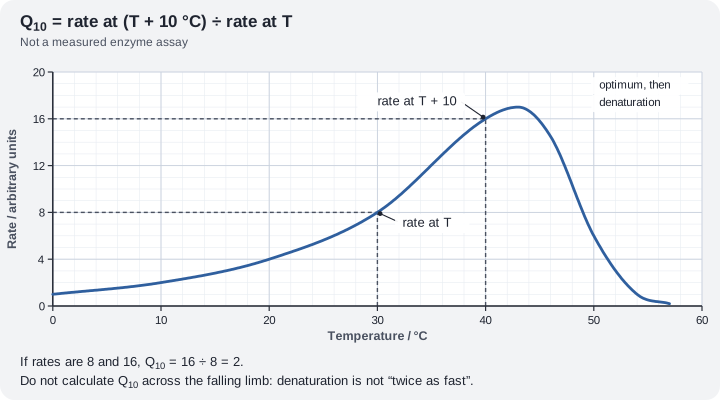
- 5.21Q10Temperature coefficient: the rate at (T + 10) °C divided by the rate at T °C. as the analysis that turns those rates into a comparable factor.
Preparation for supervised school work. Teachers approve species, temperatures, water baths and disposal. Fictional hatch and growth numbers below are teaching data, not results to copy into a book.
By the end, you should be able to…
- Name independent, dependent and control variableA variable kept the same throughout an investigation so that it does not affect the result..
- Compare a seedling method with a brine-shrimp method, including ethics.
- Calculate Q10 from class rates and evaluate the falling limb.
Build your understanding
What you are measuring
Independent variable: temperature, set with a water bath or incubator and checked with a thermometer in the vessel, not only on the dial. Dependent variable: a development measure — seedling length or growth rate after a fixed time, or percentage of brine-shrimp cysts that hatch in a fixed time. Replicates at each temperature.
control variableA variable kept the same throughout an investigation so that it does not affect the result.: same seed or cyst batch, same light, same volume and salinity (for shrimp), same water availability for seeds, same time. Equilibrate before timing starts. A fictional set of mean seedling lengths 8, 18, 27, 12 mm after 72 h at 10, 20, 30, 40 °C is for discussing Q10Temperature coefficient: the rate at (T + 10) °C divided by the rate at T °C. and damage — those millimetres are not yours.
Ethics and a workable choice
The specification allows seedlings or brine shrimp. Seedlings are plants: still treat them as living organisms, do not waste packets, and compost as instructed. Brine shrimp (Artemia) are animals. Use the smallest number that still gives a clear comparison, do not raise temperatures that cook them as a spectacle, provide aeration if the protocol says so, and dispose of cultures as the teacher directs — never release them into local water.
If both methods are available, say why you chose one. Hatch rate is a clear percentage; seedling length is easy to measure with a ruler. Neither is a full life-history study. Follow local rules for water baths, electrics and thermometers.
Risk, Q10 and evaluation
Risks: hot water, wet electrics, broken glass, and, for cysts, inhaling dust. Use the bath’s lid, dry hands, and the provided spatula.
Q10 = rate at T+10 / rate at T using the same unit. From the fictional 8 mm and 18 mm at 10 °C and 20 °C, Q10 = 18/8 = 2.25. Do not calculate a Q10 from 30 °C to 40 °C if length has collapsed: that is harm, not a temperature coefficient to report as “development”. Build the evaluation from: sample size, thermometer accuracy, seed viability, oxygen at high temperature for shrimp, and the fact that development is not only one enzymeA globular protein that acts as a biological catalyst, speeding up a specific reaction..
| Seedlings | Brine shrimp | |
|---|---|---|
| Dependent variable | Length or growth rate | Hatch percentage in a fixed time |
| Ethical note | Do not waste living plants | Minimise number; no release; avoid lethal “demos” |
| Extra control | Water, light, seed batch | Salinity, aeration, cyst batch |
Graph skills: SLAPUK and choosing a scaleRate against temperature: an even scale first, then read off the Q10 interval.
The temperature and development lab
Grow seedlings or hatch brine shrimp at several temperatures, measure after a fixed time and calculate Q10 on the rising part of the curve. The organisms and results are fictional.
Simulation only. Keep water-bath electrics dry, use the fewest organisms that answer the question, avoid lethal temperatures as a demonstration, and never release brine shrimp.
Method 8 steps
- Choose an organism (seedlings or brine shrimp) and justify it, including ethics. Use the smallest number per dish that gives a clear comparison.
- Set water baths or incubators to at least five temperatures, for example 10, 15, 20, 25, 30 and 35 °C.
- Check the temperature with a thermometer in the vessel, not only the dial, and adjust until it reads the target.
- Put the dishes (seeds on damp paper with a measured volume of water) or beakers (cysts in 30–35 g dm⁻³ salt water, aerated) in the baths and let them reach temperature.
- Add the seeds or cysts from one batch and start timing. Keep light and other conditions the same.
- After a fixed time (for example 72 h for seedlings, or 24–48 h for cysts), measure each radicle with thread and a ruler, or count hatched and unhatched cysts. Use three dishes per temperature.
- Calculate the mean rate at each temperature, plot rate against temperature, and calculate Q10 on the rising part of the curve.
- Dispose of organisms as directed: compost seedlings; never release brine shrimp.
Aligned with the order of the specification practical. Simulation only: a teacher sets the real volumes, concentrations and risk controls; this is not a laboratory protocol.
Variables
- Independent
- Temperature, measured in the vessel.
- Dependent
- Rate of development: radicle growth (mm day⁻¹) or percentage of cysts hatched in a fixed time.
- Controlled
- Seed or cyst batch
- Number per dish
- Light
- Water volume (seeds) or salinity and aeration (shrimp)
- Time before measuring
- Equilibration before adding organisms
Safety
- Water baths: keep electrics dry, use the lid and dry your hands before touching switches. Do not use water hot enough to scald.
- Handle glass thermometers and beakers carefully; report breakages.
- Cyst dust can irritate: use the spatula provided and do not inhale it. Wash hands after handling organisms and salt water.
- Ethics: use the minimum number of organisms, avoid lethal temperatures as a demonstration, never release brine shrimp, and dispose of organisms as instructed.
Follow your school’s risk assessment; these notes are not a substitute for it.
Interpreting
- Q10 = rate at (T + 10 °C) ÷ rate at T, using the same units. For 8 mm and 18 mm at 10 and 20 °C, Q10 = 18 ÷ 8 = 2.25.
- Use the rising part of the curve only. A fall at high temperature is damage (denaturation of enzymes, or death), not a second Q10.
- Percentage hatched by a fixed time is a rate only because the time is fixed; it levels off near the viable fraction, which squashes Q10.
- Development involves many enzymes, membranes and water uptake, so a lab result does not predict a habitat, where temperature changes daily and seasonally.
Guided method · step 1 of 12
- In 1 · Plan, just below these steps, set Organism to Seedlings or Brine shrimp.
- Pick the reason that justifies your choice under Why this organism?.
The specification allows either. Seedlings avoid using animals; brine shrimp give a clear hatch percentage but are animals, so their use must be justified and kept to a minimum.
1 · Plan
Choose an organism and justify it, then set up the baths.
2 · Controls
3 · Incubate
4 · Measure radicles
Do one dish by hand first; then auto unlocks. Pick another dish by clicking it in its bath.
5 · Analyse
Check a mean rate first; then choose two temperatures 10 °C apart.
Dispose and evaluate
Rates and hatch times are fictional teaching values; real Artemia timings vary with strain and cyst quality.
Make your reasoning visible
Thermometer in the experiment, not only on the bath
The independent variable is the organisms’ temperature.
Ethics is a method mark, not a slogan
State number, suffering, disposal.
Avoid this misconception
The claim: Using animals always gives better A-level data, so cook a dense culture at 50 °C for a big effect.
The correction: The specification names ethical use. A huge lethal effect is not better biology, and seedlings are a valid alternative.
Check your understanding
Try each question before opening the suggested answer.
Check your understanding (continued)
Practice question
Retrieval and explanation · suggested answer
State independent and dependent variables for this core practical.
Show suggested answer
Independent: temperature. Dependent: a development measure such as seedling growth rate or brine-shrimp hatch rate.
Practice question
Retrieval and explanation · suggested answer
Give two ethical points if brine shrimp are used.
Show suggested answer
Use the fewest animals that still answer the question; do not expose them to needless lethal temperatures; do not release them; dispose of as instructed (any two).
Practice question
Retrieval and explanation · suggested answer
Why equilibrate tubes in the water bath before timing hatch or growth?
Show suggested answer
So the organisms are actually at the stated temperature when the clock starts, otherwise early time is at the wrong temperature.
Practice question
Retrieval and explanation · suggested answer
Fictional growth rates 7 and 14 at 12 °C and 22 °C. Calculate Q10.
Show suggested answer
Q10 = 14/7 = 2.
Take the idea further
Apply the same specification knowledge to an unfamiliar problem. Any extra assumptions are supplied in the question.
Stretch question
Hatch percentages after 48 h are 55, 80 and 20 at 20, 30 and 40 °C, n = 3 dishes. A student reports two Q10 values, 80/55 ≈ 1.45 for 20–30 °C and 20/80 = 0.25 for 30–40 °C, and says the 40 °C result “proves enzymes denature in nature this summer”. Which parts of the claim hold up?
Show a hint
Rising limb only; lab versus habitat; sample size.
Explore the reasoning
The 20–30 °C value, 80/55 ≈ 1.45, is acceptable, but only if percentage hatched by a fixed time is treated as a rate. The 30–40 °C “Q10” of 0.25 should not be reported: that pair crosses the optimum, and the fall is heat damage, not a temperature coefficient. Nor does 20% at 40 °C with n = 3 prove field denaturation this summer: baths are not habitats, oxygen and volume differ, and three dishes are a small sample. Spec 5.20 (effects of climate change) needs field evidence such as rainfall and seasonal change, not one lethal lab result.
Recall this lesson
Lesson recall questions
Question 1 of 5: Describe, in order, why enzyme-controlled rates usually rise as temperature increases towards the optimum.
Temperature, enzymes and Q10
Practice question
Retrieval and explanation · suggested answer
Describe, in order, why enzyme-controlled rates usually rise as temperature increases towards the optimum.
Lesson: 5C 8: The Biological Impact of Climate Change
Build the sequence from memory first. Then reveal the model order.
Tap the steps in the order you recall. Tap a placed step to send it back.
- 01Next step
- 02Waiting
- 03Waiting
Tap to place
Put your biology to work
Explore where these ideas appear in the world. Enrichment, not extra required recall.
Temperature is a development cue in the real calendar too
CP12 · Temperature and the Development of OrganismsNASA uses phenology, the timing of seasonal events, to study when plants green up and organisms develop. Core Practical 12 isolates temperature in a small living system. The…Specification 5.22 · 5.21Read & use the scienceClose article
Why this matters
NASA uses phenology, the timing of seasonal events, to study when plants green up and organisms develop. Core Practical 12 isolates temperature in a small living system. The link to a changing season is useful, but a satellite green-up map is not a brine-shrimp hatch count and a lab rate is not a climate forecast. A controlled incubation helps isolate temperature, but a landscape is exposed to changing temperature, light and moisture at once. An apparent early spring in a satellite image may mean earlier leaves, a different species mix or a change in visibility. A developmental rate measured in one dish cannot simply be multiplied by a constant to forecast a whole ecosystem. The organism and measured stage must be named.
Back to the specification
Pearson Edexcel IAL Biology · Issue 2, February 2021 · Unit 4, pp. 29–32 · assessed through Unit 6. The application extends beyond required recall.
- 5.22 Core Practical 12: investigate how temperature affects organism development, taking account of ethical use.
- 5.21 Understand how temperature affects enzyme activity and organisms, including Q10.
Use the science
Why might a neat lab Q10 of 2 fail to predict this year’s insect hatch in a wood?
Explore a possible response
Field temperature fluctuates, moisture and photoperiod also cue development, and enzymes are not the only limit. The practical isolates one factor; the habitat does not.
Explore the source
A calendar observation can become climate data
CP12 · Temperature and the Development of OrganismsThe USGS describes Nature’s Notebook, a programme in which observers record whether seasonal events such as leaf-out or flowering are occurring. A consistent yes-or-no rule lets many people…Specification 5.22 · 5.21Read & use the scienceClose article
Why this matters
The USGS describes Nature’s Notebook, a programme in which observers record whether seasonal events such as leaf-out or flowering are occurring. A consistent yes-or-no rule lets many people make comparable records across sites and years. Core Practical 12 similarly needs a defined developmental endpoint, not an impression that one organism “looks more grown”. Temperature can affect development, but outdoors photoperiod, rainfall and species identity also vary. A long series can reveal a pattern; it does not prove that temperature alone caused every change in timing.
Back to the specification
Pearson Edexcel IAL Biology · Issue 2, February 2021 · Unit 4, pp. 29–32 · assessed through Unit 6. The application extends beyond required recall.
- 5.22 Core Practical 12: investigate how temperature affects organism development, taking account of ethical use.
- 5.21 Understand how temperature affects enzyme activity and organisms, including Q10.
Use the science
Why is a daily record of “visible first leaf: yes or no” more useful than “the plant looks springlike”?
Explore a possible response
The first rule defines an observable stage that different people can apply repeatedly. The second is subjective and may mean different things at different sites.
Explore the source
- Nature’s Notebook: recording seasonal activityU.S. Geological Survey