
What you need to know
- 5.20Climate change (rainfall patterns and seasonal cycles) affecting distribution, development and life cycles of plants and animals.
- 5.21Temperature, enzymeA globular protein that acts as a biological catalyst, speeding up a specific reaction. activity and Q10Temperature coefficient: the rate at (T + 10) °C divided by the rate at T °C., and the impact on plants, animals and microorganisms.
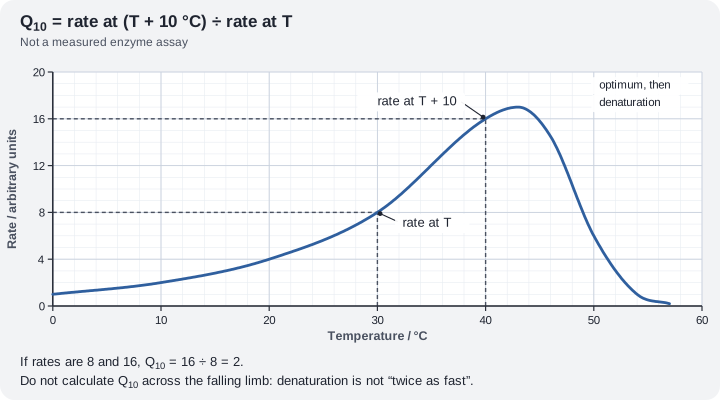
Core Practical 12 is the investigation of temperature and development. Evolution and speciation are 5C 9. Do not calculate Q10 on the denaturation slope.
By the end, you should be able to…
- Link rainfall and season shifts to distribution, development and life cycles.
- Define Q10 and calculate it from two rates 10 °C apart.
- Explain why enzyme-limited processes in ectotherms and microbes are climate-sensitive.
Build your understanding
Maps and calendars move
Climate change is not only “it is hotter”. Rainfall patterns shift: drought in one region, heavier rain in another. Seasonal cycles shift: earlier springs, later autumns, mismatched day-length and temperature cues. Specification 5.20 asks about plants and animals — distribution of speciesA group of organisms that can interbreed to produce fertile offspring., development, and life cycles.
Distribution: ranges can move poleward or uphill if the climate envelopeAn outer covering membrane. The nucleus and chloroplasts have a double-membrane envelope; some viruses, such as HIV, have a lipid envelope taken from the host cell. moves; species that cannot cross farmland or sea are stranded. Development: germination, insect hatching and larval growth are temperature- and moisture-dependent. Life cycles: breeding date, migration, hibernation and the number of insect generations in a year can all change. If a bird arrives after its caterpillar peak, chicks starve even if both species still “exist” on a list.
Q10
For many enzyme-catalysed processes, rate rises with temperature until denaturationA permanent change to a protein’s tertiary structure, for example by high temperature or extreme pH, so an enzyme’s active site no longer fits its substrate.. Q10Temperature coefficient: the rate at (T + 10) °C divided by the rate at T °C. is the factor by which rate changes when temperature increases by 10 °C: Q10 = rate at (T + 10 °C) / rate at T. A Q10 of 2 means the rate doubled. A Q10 of 3 means it trebled. Calculate from the two rates you are given; do not assume 2.
Q10 is useful on the rising limb. Once enzymeA globular protein that acts as a biological catalyst, speeding up a specific reaction. denature, rate falls and a Q10 below 1 is a warning, not “the organism got more efficient”. Fictional teaching rates of 12 mm day⁻¹ at 15 °C and 27 mm day⁻¹ at 25 °C give Q10 = 27/12 = 2.25.
Who feels it
Plants: enzyme-limited photosynthesisThe process in which plants use light energy to make glucose from carbon dioxide and water, releasing oxygen. and respirationThe breakdown of respiratory substrates such as glucose in cells to release energy, which is used to make ATP. (5A, 5.9), germination, and phenology. Animals: ectotherms in particular, because body temperature tracks the environment — development time, activity and range. Microorganisms: decomposition rates, infection, and algal blooms can accelerate in the warmth until some other factor or denaturation stops them.
Endotherms still feel habitatThe place where an organism lives. and food-web change even if their enzymes are buffered. Coral bleaching is a widely reported thermal example; treat named case studies as applications unless a question names them. The specification names Q10, not a particular reef.
| Statement | Typical evidence | Do not confuse with |
|---|---|---|
| Distribution | Range maps, first/last dates, altitude | Immediate evolution of a new species |
| Development / life cycle | Hatch time, growth, generations per year | A single weather anecdote |
| Q10 | Two rates 10 °C apart | The falling limb after denaturation |
Make your reasoning visible
Mismatch is a 5.20 answer
Name two speciesA group of organisms that can interbreed to produce fertile offspring. and the cue that no longer lines up.
Show Q10 as a quotient
Write both rates and the 10 °C gap.
Avoid this misconception
The claim: If Q10Temperature coefficient: the rate at (T + 10) °C divided by the rate at T °C. is 2, every 10 °C rise forever doubles life.
The correction: Only while enzymeA globular protein that acts as a biological catalyst, speeding up a specific reaction. remain functional. Beyond the optimum, proteins denature and rate collapses.
Check your understanding
Try each question before opening the suggested answer.
Practice question
Retrieval and explanation · suggested answer
Give one way changing seasonal cycles can affect a bird’s life cycle.
Show suggested answer
Breeding or migration may no longer match the peak of insect food, so chick survival falls (or equivalent mismatch).
Practice question
Retrieval and explanation · suggested answer
Rates of seedling growth are 9 mm day⁻¹ at 12 °C and 18 mm day⁻¹ at 22 °C. Calculate Q10.
Show suggested answer
Q10 = 18/9 = 2.
Practice question
Retrieval and explanation · suggested answer
Why are ectotherms often more immediately sensitive to a temperature rise than endotherms?
Show suggested answer
Their body temperature, and therefore enzyme activity, tracks the environment more closely.
Take the idea further
Apply the same specification knowledge to an unfamiliar problem. Any extra assumptions are supplied in the question.
Stretch question
Hatch rates of a fictional aquatic invertebrate: 40% at 20 °C, 70% at 30 °C, 15% at 40 °C. Calculate Q10 for 20–30 °C and explain why you should not use 30–40 °C the same way.
Show a hint
Denaturation.
Explore the reasoning
Q10 (20–30) = 70/40 = 1.75. From 30 to 40 °C the rate falls, so a Q10 of 15/70 ≈ 0.21 would describe damage, not a simple acceleration. Enzymes or membranes are being harmed; do not treat that as “Q10 biology as usual”.
Recall this lesson
Lesson recall questions
Question 1 of 5: List three ways climate change can affect plants and animals, as required by this specification point.
Climate change and organisms
Practice question
Retrieval and explanation · suggested answer
List three ways climate change can affect plants and animals, as required by this specification point.
Lesson: 5C 8: The Biological Impact of Climate Change
Try this from memory first.
Put your biology to work
Explore where these ideas appear in the world. Enrichment, not extra required recall.
The calendar of living things
5C · The Biological Impact of Climate ChangeNASA Earth Observatory’s phenology feature describes how satellite green-up and on-the-ground first-leaf records track shifting seasons. That is 5.20 at landscape scale. It is not a Q10 table,…Specification 5.20Read & use the scienceClose article
Why this matters
NASA Earth Observatory’s phenology feature describes how satellite green-up and on-the-ground first-leaf records track shifting seasons. That is 5.20 at landscape scale. It is not a Q10 table, and it is not your Core Practical 12 result. Ground observations help validate satellite green-up dates, while temperature and day length can act as different seasonal cues. A changed calendar can cause mismatch between flowering plants and pollinators even if both species survive.
Back to the specification
Pearson Edexcel IAL Biology · Issue 2, February 2021 · Unit 4, pp. 29–32. The application extends beyond required recall.
- 5.20 understand the effects of climate change (changing rainfall patterns and changes in seasonal cycles) on plants and animals (distribution of species, development and lifecycles)
Use the science
Why might earlier leaf-out still fail a migrating herbivore?
Explore a possible response
If the animal’s cue is day length, not temperature, it may arrive after the tender leaves or insect flush have peaked.
Explore the source
A spring diary becomes research data
5C · The Biological Impact of Climate ChangeThe USA National Phenology Network collects observations of seasonal events such as leaf-out and flowering. Comparing years can reveal how spring temperature relates to timing, but it requires…Specification 5.20 · 5.21Read & use the scienceClose article
Why this matters
The USA National Phenology Network collects observations of seasonal events such as leaf-out and flowering. Comparing years can reveal how spring temperature relates to timing, but it requires consistent species identification and recording dates. A citizen observer contributes a small local record; scientists combine many records and compare them with weather and other cues. Earlier flowering can affect a pollinator if its development responds differently to temperature or day length. The school Q10 idea concerns temperature and biological rates; a field phenology trend includes rainfall, genetics and ecology too. One warm day does not prove a long-term shift.
Back to the specification
Pearson Edexcel IAL Biology · Issue 2, February 2021 · Unit 4, pp. 29–32. The application extends beyond required recall.
- 5.20 understand the effects of climate change (changing rainfall patterns and changes in seasonal cycles) on plants and animals (distribution of species, development and lifecycles)
- 5.21 understand the effect of temperature on the rate of enzyme activity and its impact on plants, animals and microorganisms, to include Q10
Use the science
Why should researchers compare flowering dates across several years and locations before attributing an early bloom to climate change?
Explore a possible response
Seasonal weather, site and species differences can cause short-term variation. Repeated records help separate a trend from noise.
Explore the source
- Visualize and download phenology dataUSA National Phenology Network