
What you need to know
- 7.7Core Practical 15: use an artificial hydrogen carrier (redox indicator) to investigate respirationThe breakdown of respiratory substrates such as glucose in cells to release energy, which is used to make ATP. in yeast.
Preparation for supervised school work. Teachers choose the indicator, the yeast and the concentrations. Fictional times below are not results to copy. This is a short assay, not a 37 °C bacterial culture.
By the end, you should be able to…
- Identify the independent variable, the dye, and the time measurement.
- Explain a boiled-yeast control and a no-substrate control.
- Treat 1/time as a rate proxy, with units and limits.
Build your understanding
What the dye is standing in for
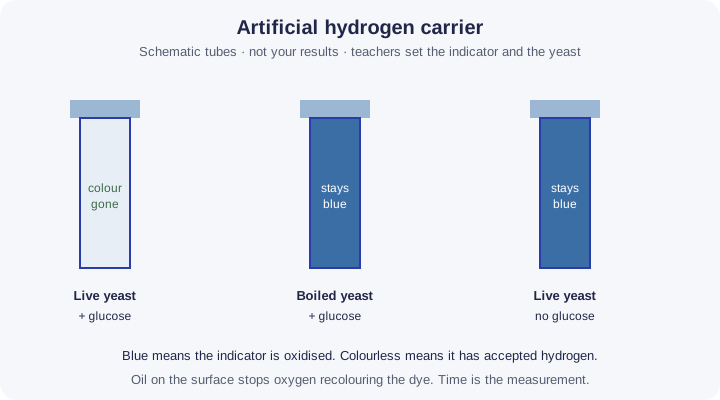
Aim: investigate respirationThe breakdown of respiratory substrates such as glucose in cells to release energy, which is used to make ATP. in yeast using an artificial hydrogen carrier. A redox indicator such as methylene blue or DCPIP is blue when oxidised and colourless when it has accepted hydrogen. Dehydrogenase enzymeA globular protein that acts as a biological catalyst, speeding up a specific reaction. in respiring yeast pass hydrogen toward coenzymeA non-protein molecule that helps an enzyme work, often by carrying hydrogen or chemical groups, such as NAD.. The dye can accept that hydrogen, so loss of colour is a proxy for dehydrogenase activity, not a direct count of ATPAdenosine triphosphate: the molecule that releases energy for cell processes when it is hydrolysed to ADP and Pi..
A thin layer of oil, if your teacher uses one, stops oxygen from reoxidising the dye, so the colour change is easier to time. Independent variable: the factor you change, such as temperature or glucoseA hexose (six-carbon) monosaccharide, C₆H₁₂O₆. It is the main respiratory substrate. concentration. Dependent variable: time for the blue colour to disappear. Rate proxy = 1/time. State the unit, for example per second.
Controls and one variable
The boiled-yeast control (boiled, then cooled, with the same glucose and dye) should stay blue: the proteins have been denaturationA permanent change to a protein’s tertiary structure, for example by high temperature or extreme pH, so an enzyme’s active site no longer fits its substrate., so it shows that decolourising needs active enzymes. The no-glucose control (live yeast without added glucose) should stay blue much longer if the cells have little stored substrateThe molecule that binds to an enzyme’s active site and is changed in the reaction., so it shows the substrate matters. Those two control tubes stop you claiming that the dye fades by itself or that yeast colour is the variable. The suspension itself may look yellow. A tube of the same suspension with no dye shows the colour to match when the indicator has lost its blue. Judge against that tube, not against clear water.
Controls and one variable (continued)
Keep volume of yeast, dye and substrate the same when temperature is the variable. Use a water bath. Do not heat a sealed tube. Illustrative times, not data to memorise: live yeast plus glucose, 90 seconds at about 24 °C; boiled yeast still blue at 10 minutes; no glucose still blue at 8 minutes. Your class numbers replace these.
What you must not conclude
A shorter time means hydrogen was transferred to the dye faster under those conditions. It does not name the substrate inside the cell, calculate an RQ, or show that the yeast was healthy enough to bake with. Ethanol may be the anaerobic product in yeast. You have not measured ethanol unless the method says so.
This is not Core Practical 13. Do not incubate plates at body temperature or grow an unknown broth. Wash spills as the teacher directs. The indicator stains. Concentrations are a school decision.
| Tube | Expected if the idea is right | What it rules out |
|---|---|---|
| Live yeast + glucose | Colour goes | The assay can detect activity |
| Boiled yeast + glucose (control) | Stays coloured | Fading needs active proteins |
| Live yeast, no glucose (control) | Stays coloured longer | Substrate matters |
The yeast and redox dye lab
Time how long yeast takes to decolourise methylene blue at different temperatures, with boiled and no-glucose controls, judge the end point against a no-dye tube and turn times into rates. A teaching model: the yeast and every time are fictional.
Simulation only. Wear eye protection (the dyes stain), keep the water bath at or below 45 °C and use a rack, cool boiled yeast before handling it, and never heat a sealed tube.
Method 6 steps
- Wear eye protection. Boil a sample of the yeast suspension for a few minutes, then cool it to the bath temperature for the control.
- Into each tube put the same volume of yeast suspension and glucose solution; set up a boiled-yeast + glucose control and a live yeast without glucose control.
- Pre-warm the tubes in the water bath until a thermometer in a tube reads the bath temperature.
- Add the same volume of methylene blue (or DCPIP), invert once to mix, add a thin layer of oil and start the timer.
- Stop the timer when the tube matches a no-dye tube of the same suspension (not clear water). Repeat three times at each temperature.
- Calculate the mean time and the rate as 1/t (s⁻¹), and plot rate against temperature.
Aligned with the order of the specification practical. Simulation only: a teacher sets the real volumes, concentrations and risk controls; this is not a laboratory protocol.
Variables
- Independent
- Temperature (or glucose concentration).
- Dependent
- Time for the dye to decolourise (s); rate = 1/t.
- Controlled
- Yeast concentration and volume
- Glucose concentration and volume
- Volume and concentration of dye
- Oil layer on every tube
- Same no-dye comparator for the end point
Safety
- Eye protection: the dyes stain skin, clothes and eyes.
- Water-bath scalds: keep the bath at or below 45 °C and use a rack; never heat a sealed tube.
- Cool boiled yeast before handling it.
Follow your school’s risk assessment; these notes are not a substitute for it.
Interpreting
- Fictional: 120 s at 20 °C and 40 s at 35 °C, so the rate rises from 1/120 to 1/40 s⁻¹, three times faster; about 90 s at 24 °C.
- The dye accepts hydrogen from dehydrogenases (in glycolysis and the Krebs cycle) in place of NAD and FAD; it is not NAD itself.
- The boiled control stays blue (denatured enzymes); the no-glucose control stays blue much longer (only stored substrate). A boiled control that fades means the run is invalid.
- Above about 40 °C the enzymes start to denature, so the rate falls again.
Guided method · step 1 of 12
Click the Eye protection button in the simulator to put on goggles.
Methylene blue and DCPIP stain skin and eyes, and the boiling water for the control can scald.
1 · Set up
Follow the guided steps: start with eye protection.
2 · Dye and end point
3 · Time the run
Time the first run by hand; auto-time then unlocks. Controls only need watching on one run.
Run so far
4 · Analyse
Shake and evaluate
Yeast activity, times and errors are fictional teaching values from a simple model (Q10 ≈ 2.1, denaturing above about 40 °C, glucose saturating).
Make your reasoning visible
Time is not the rate
A smaller time is a faster proxy. Plot 1/time if you compare rates.
Say artificial
The dye replaces a natural hydrogen carrier for the measurement. It is not NAD.
Avoid this misconception
The claim: The tube that loses colour first has the higher RQ.
The correction: The dye time is a proxy for hydrogen transfer. RQ needs both oxygen used and carbon dioxide produced. This practical measures neither volume.
Check your understanding
Try each question before opening the suggested answer.
Check your understanding (continued)
Practice question
Retrieval and explanation · suggested answer
State the dependent variable in a temperature investigation using methylene blue and yeast.
Show suggested answer
Time taken for the indicator to become colourless, or the rate proxy 1/time.
Practice question
Retrieval and explanation · suggested answer
Why include a boiled-yeast control?
Show suggested answer
It is a negative control: it shows that the colour change needs active enzymes, not just the chemicals mixed together.
Practice question
Retrieval and explanation · suggested answer
Illustrative times at the same glucose concentration: 20 °C, 120 s; 35 °C, 40 s. Which has the higher rate proxy?
Show suggested answer
35 °C, because 1/40 is greater than 1/120. These times are invented.
Practice question
Retrieval and explanation · suggested answer
Why might an oil layer be used?
Show suggested answer
To reduce oxygen redissolving and reoxidising the dye, so the colourless form stays colourless long enough to judge.
Take the idea further
Apply the same specification knowledge to an unfamiliar problem. Any extra assumptions are supplied in the question.
Stretch question
A group shakes the tube hard after the dye has gone colourless, and the blue returns. They conclude the yeast has died. Offer a better explanation. Assume oxygen was mixed back in and the dye can be reoxidised by oxygen.
Show a hint
The colour reports the dye, not a heartbeat.
Explore the reasoning
Oxygen can reoxidise the indicator, so blue returning shows the dye gave up hydrogen, not that the cells died. A boiled control that stays blue, or a repeat that decolourises again when oxygen is excluded, would test the cells. Death is an extra claim the colour alone does not support.
Recall this lesson
Lesson recall questions
Question 1 of 5: Describe, in order, a valid method using a redox indicator with yeast.
Redox indicator in yeast
Practice question
Retrieval and explanation · suggested answer
Describe, in order, a valid method using a redox indicator with yeast.
Lesson: CP15: Respiration in Yeast
Build the sequence from memory first. Then reveal the model order.
Tap the steps in the order you recall. Tap a placed step to send it back.
- 01Next step
- 02Waiting
- 03Waiting
Tap to place
Put your biology to work
Explore where these ideas appear in the world. Enrichment, not extra required recall.
Yeast is chosen because it is a manageable living cell
CP15 · Respiration in YeastThe Microbiology Society introduces microorganisms as organisms that can be studied. That is the limit of the citation. It does not specify methylene blue times or a safe…Specification 7.7Read & use the scienceClose article
Why this matters
The Microbiology Society introduces microorganisms as organisms that can be studied. That is the limit of the citation. It does not specify methylene blue times or a safe concentration. Your method is a school assay of hydrogen transfer, not an identification key. Dough rising is a familiar food image, but it follows carbon dioxide, not the redox change the specified investigation uses. The indicator accepts hydrogen as yeast metabolises substrate; decolourisation time can be compared only when starting colour, yeast amount and temperature are held constant. A shorter time suggests faster dye reduction under those conditions. It is not a direct measurement of ATP yield or a complete map of aerobic and anaerobic pathways.
Back to the specification
Pearson Edexcel IAL Biology · Issue 2, February 2021 · Unit 5, pp. 35–38 · assessed through Unit 6. The application extends beyond required recall.
- 7.7 Core Practical 15: use an artificial hydrogen carrier (redox indicator) to investigate respiration in yeast.
Use the science
Why is a photograph of bread dough not a result for this practical?
Explore a possible response
Rising dough may show carbon dioxide production. Core Practical 15 asks for the indicator colour change as a hydrogen-carrier measurement. A different observation needs a different conclusion.
Explore the source
- Microbiology Society: what is microbiologyMicrobiology Society
A blue dye can report a changing yeast state
CP15 · Respiration in YeastResearchers have used methylene blue staining while following the viability of yeast grown under different metabolic conditions. Core Practical 15 asks a more specific question: an artificial hydrogen…Specification 7.7Read & use the scienceClose article
Why this matters
Researchers have used methylene blue staining while following the viability of yeast grown under different metabolic conditions. Core Practical 15 asks a more specific question: an artificial hydrogen carrier changes colour as it is reduced during yeast respiration. The shared lesson is that a colour is a proxy for cell activity, not a direct picture of ATP molecules. Dye concentration, oxygen exposure and the amount of yeast affect the time to a visible change. A kitchen fermentation story may be memorable, but its dough volume is a different observable.
Back to the specification
Pearson Edexcel IAL Biology · Issue 2, February 2021 · Unit 5, pp. 35–38 · assessed through Unit 6. The application extends beyond required recall.
- 7.7 Core Practical 15: use an artificial hydrogen carrier (redox indicator) to investigate respiration in yeast.
Use the science
Why would a faster loss of dye colour not prove that each yeast cell produced more ATP?
Explore a possible response
The result is the rate of indicator reduction for the whole sample. Different cell numbers, dye concentration or oxygen conditions could change the time without showing ATP yield per cell.
Explore the source
- Metabolic remodelling during yeast cultivationPeer-reviewed study (PMC)