
What you need to know
- 7.8Core Practical 16: a simple respirometer to determine rate of respirationThe breakdown of respiratory substrates such as glucose in cells to release energy, which is used to make ATP. and RQ of a suitable material such as germinating seeds or small invertebrates.
Teachers set up soda lime or potassium hydroxide. Those absorbents are corrosive. Invertebrates are kept enclosed for the shortest time and are not vertebrates. Volumes below are illustrative. One pair of tubes is not a statistical test.
By the end, you should be able to…
- Explain why a carbon dioxide absorber lets you measure oxygen use.
- Use a control tube to correct for temperature and pressure.
- Calculate a rate and an RQ from stated volumes.
Build your understanding
Oxygen use when carbon dioxide is removed
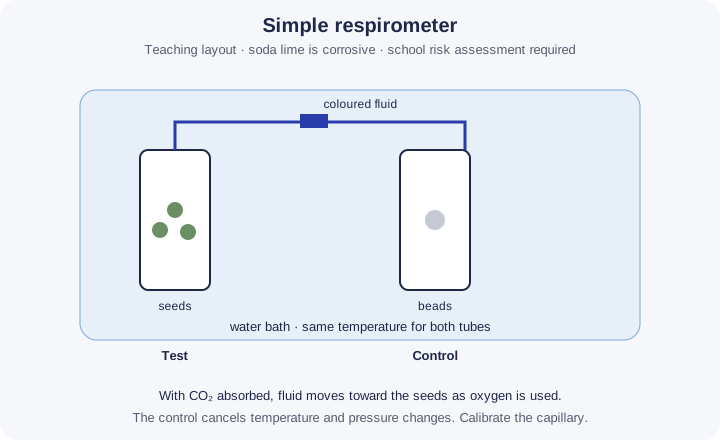
A simple respirometer is a sealed chamber joined to a capillaryA tiny vessel whose wall is a single layer of endothelium, giving a short diffusion distance for exchange with tissues. of coloured fluid. Respiring seeds or small invertebrates use oxygen and produce carbon dioxide. If soda lime or potassium hydroxide absorbs the carbon dioxide, the net change in gas volume is the oxygen used. Fluid moves toward the organisms. Distance along a calibrated capillary can be converted to volume. State the calibrationChecking or setting a measuring instrument against a known standard, such as finding what one eyepiece division is worth.. Do not assume 1 mm equals 1 mm³ unless you have measured the bore.
A control tube with glass beads of the same volume, in the same water bath, shows movement caused by temperature or pressure, not by respirationThe breakdown of respiratory substrates such as glucose in cells to release energy, which is used to make ATP.. Subtract that control movement, with its direction, from the test movement. Equilibrate before you close the system or start the clock.
Rate, then RQ
Rate of respiration here is volume of oxygen used per unit time, often per gram of seeds. Illustrative, not a real run: 2.0 g of seeds, fluid movement equivalent to 12 mm³ of oxygen in 10 minutes, control movement 0. Rate = 12 / 10 / 2.0 = 0.6 mm³ min⁻¹ g⁻¹. If the time or the mass differs between tubes, the raw millimetres are not comparable.
Rate, then RQ (continued)
RQ needs a second measurement without the carbon dioxide absorber, or a method that lets you find carbon dioxide as well. With absorber, volume decrease = oxygen used. Without absorber, the net volume change is oxygen used minus carbon dioxide produced, once the signs are consistent. If both are decreases: carbon dioxide = oxygen minus the net decrease. Illustrative: oxygen 12 mm³, net decrease without absorber 3 mm³, so carbon dioxide = 9 mm³, RQ = 9/12 = 0.75. That is consistent with a mixed substrateThe molecule that binds to an enzyme’s active site and is changed in the reaction.. It is invented.
Material, ethics and limits
Germinating seeds are suitable because the stored fuel is being respired. Boiled, killed seeds are a biological control and should show little oxygen use. Small invertebrates may be used if the school method protects them: short enclosure, no drying out, no corrosive chemical in contact with the animal, and return to a suitable habitatThe place where an organism lives.. Do not use vertebrates.
Temperature changes the rate, so both tubes stay in the same bath. A single pair of readings has no statistical test. Leaks, an uncalibrated capillary, and absorbent that is exhausted are reasons to distrust a tidy number. This practical measures gases. It does not show mitochondrionThe organelle where the link reaction, Krebs cycle and oxidative phosphorylation of aerobic respiration take place..
The respirometer lab
Measure how fast fictional germinating seeds use oxygen with soda lime and a bead control, calibrate the capillary, then remove the absorber to find the carbon dioxide and the RQ. A teaching model: the seeds and every volume are fictional.
Simulation only. Soda lime and potassium hydroxide are corrosive: wear gloves and eye protection and keep them below the gauze. Small invertebrates only with the school’s permission, briefly, at or below 25 °C, never touching the absorber, and returned to a suitable habitat.
Method 8 steps
- Wear gloves and eye protection. Weigh the germinating seeds (for example 2.0 g).
- Put soda lime (or potassium hydroxide) in the bottom of the test tube, a gauze platform above it and the seeds on the gauze.
- Set up a control tube with glass beads of the same volume as the seeds, and the same absorber.
- Join both tubes to capillaries of coloured fluid and stand them in the same water bath with the taps open until a thermometer reads the bath temperature.
- Calibrate the capillary: inject a known volume (10 mm³) with the syringe and measure how far the fluid moves.
- Close the taps, start the timer and read both scales every 2 minutes for 10 minutes. Reset with the syringe and repeat three times.
- Repeat without the absorber (replace it with the same volume of inert pellets) to find the net change.
- Corrected movement = test − control (with sign); volume = corrected mm × calibration; rate = volume ÷ time ÷ mass. CO₂ = O₂ − net; RQ = CO₂ ÷ O₂.
Aligned with the order of the specification practical. Simulation only: a teacher sets the real volumes, concentrations and risk controls; this is not a laboratory protocol.
Variables
- Independent
- With or without the CO₂ absorber (for RQ); or temperature (for rate).
- Dependent
- Distance moved by the fluid in 10 min, converted to volume of gas.
- Controlled
- Mass and type of seeds
- Bath temperature
- Volume of gas in each tube (beads, pellets)
- Time
- Same capillary and calibration
Safety
- Soda lime and potassium hydroxide are corrosive: gloves, eye protection, and keep them below the gauze.
- Small invertebrates: shortest time sealed in, no temperatures above about 25 °C, never in contact with the absorber, and return them to a suitable habitat. No vertebrates.
- No mercury manometers.
Follow your school’s risk assessment; these notes are not a substitute for it.
Interpreting
- Fictional: 2.0 g, 12 mm³ of O₂ in 10 min → 0.6 mm³ min⁻¹ g⁻¹.
- Without absorber, net 3 mm³ → CO₂ = 12 − 3 = 9 mm³, RQ = 9 ÷ 12 = 0.75: consistent with a mixed substrate.
- Fluid can move away from the tube without absorber if RQ > 1 (more CO₂ out than O₂ in, for example some anaerobic respiration) or if the gas warms.
- The lesson-scale rates are well below typical values for real germinating peas; they are teaching numbers.
Guided method · step 1 of 12
Click the Gloves + goggles button in the simulator.
Soda lime and potassium hydroxide are corrosive to skin and eyes.
1 · Material
Follow the guided steps: start with gloves and goggles.
2 · Tubes
3 · Run and read
Read the first run yourself from the magnified scales; later runs are noted for you.
Calibration
4 · Analyse
Blue: with soda lime (O₂ used). Orange: inert pellets (net = O₂ − CO₂). Grey hollow: invalid runs. The gradient is the rate for the whole sample.
Evaluate
Seeds, rates and errors are fictional teaching values from a simple model (q₂₀ = 0.6 mm³ min⁻¹ g⁻¹ doubling every 10 °C, RQ 0.75, gas warming with τ ≈ 4 min). Real germinating peas respire several times faster.
Make your reasoning visible
Absorber on, then absorber off
Oxygen comes from the tube with the absorber. RQ needs both gases.
Per gram, per minute
State the unit of rate. A distance without a calibrationChecking or setting a measuring instrument against a known standard, such as finding what one eyepiece division is worth. is not a volume.
Avoid this misconception
The claim: The fluid always moves toward the organism by the oxygen volume, even when carbon dioxide is not absorbed.
The correction: Without an absorber, carbon dioxide replaces much of the oxygen volume. Movement is the net change, and it can be small or even outward.
Check your understanding
Try each question before opening the suggested answer.
Check your understanding (continued)
Practice question
Retrieval and explanation · suggested answer
Why is soda lime used in a respirometer when the aim is oxygen uptake?
Show suggested answer
It absorbs carbon dioxide, so the decrease in gas volume equals the oxygen consumed.
Practice question
Retrieval and explanation · suggested answer
What is the control tube for?
Show suggested answer
Glass beads of equal volume show fluid movement due to temperature or pressure, which is subtracted from the test reading.
Practice question
Retrieval and explanation · suggested answer
Illustrative: oxygen used 8 mm³, carbon dioxide produced 8 mm³. Calculate RQ.
Show suggested answer
8/8 = 1. Consistent with carbohydrate. Invented volumes.
Practice question
Retrieval and explanation · suggested answer
Give one ethical limit if the material is a small invertebrate.
Show suggested answer
Keep it enclosed only briefly, protect it from the absorbent, and do not use a vertebrate. Any one of those.
Take the idea further
Apply the same specification knowledge to an unfamiliar problem. Any extra assumptions are supplied in the question.
Stretch question
Illustrative capillary: test tube moves 15 mm toward the seeds, control moves 3 mm toward the beads, in the same 5 minutes. The bore is given as 1 mm², so 1 mm = 1 mm³. Seeds mass 1.5 g. Carbon dioxide was absorbed. Calculate the rate in mm³ min⁻¹ g⁻¹.
Show a hint
Correct the distance, convert, then divide by time and mass.
Explore the reasoning
Corrected movement = 15 − 3 = 12 mm = 12 mm³ of oxygen. Rate = 12 / 5 / 1.5 = 1.6 mm³ min⁻¹ g⁻¹. The volumes are invented and the bore was an assumption supplied in the question. No RQ is possible because carbon dioxide was absorbed and not measured.
Recall this lesson
Lesson recall questions
Question 1 of 5: State what soda lime (or potassium hydroxide) absorbs in a respirometer.
Respirometer rate and RQ
Practice question
Retrieval and explanation · suggested answer
State what soda lime (or potassium hydroxide) absorbs in a respirometer.
Lesson: CP16: Rate of Respiration and Respiratory Quotient
Try this from memory first.
Put your biology to work
Explore where these ideas appear in the world. Enrichment, not extra required recall.
Lungs are not a seed chamber
CP16 · Rate of Respiration and Respiratory QuotientNHLBI describes human lungs moving oxygen into blood and carbon dioxide out. A seed respirometer is a different measurement: volume change in a closed tube around the material.…Specification 7.8Read & use the scienceClose article
Why this matters
NHLBI describes human lungs moving oxygen into blood and carbon dioxide out. A seed respirometer is a different measurement: volume change in a closed tube around the material. Use the lung page only to keep breathing distinct from this practical. It is not a method sheet. A sealed seed chamber makes oxygen uptake visible as a tiny displacement. Carbon dioxide absorption changes which gas contributes to that displacement, and leaks or temperature changes can mimic respiration. The control tube therefore matters before any rate is calculated. A mammal's lungs exchange gases with blood, whereas a seed has no lungs; borrowing a breathing-rate figure from a human source would confuse ventilation with cellular respiration.
Back to the specification
Pearson Edexcel IAL Biology · Issue 2, February 2021 · Unit 5, pp. 35–38 · assessed through Unit 6. The application extends beyond required recall.
- 7.8 Core Practical 16: use a simple respirometer to determine respiration rate and respiratory quotient of suitable material.
Use the science
Why would quoting a human breathing rate not answer a seed respirometer question?
Explore a possible response
The material, the closed tube and the carbon dioxide absorbent are different. Rate must come from the volume change you corrected and calibrated.
Explore the source
- NHLBI: how the lungs workNHLBI, NIH
Seed oxygen use can test seed quality
CP16 · Rate of Respiration and Respiratory QuotientA seed-metabolism study measured oxygen consumption in small respirometry chambers across many angiosperm species. Researchers are interested in whether metabolism relates to germination, ecology and storage. This is…Specification 7.8Read & use the scienceClose article
Why this matters
A seed-metabolism study measured oxygen consumption in small respirometry chambers across many angiosperm species. Researchers are interested in whether metabolism relates to germination, ecology and storage. This is recognisably connected to Core Practical 16, although a research instrument is more sensitive than a school capillary tube. Oxygen uptake can change with seed size, water uptake and temperature, so comparisons need rates per mass or per seed under stated conditions. Oxygen uptake alone gives a respiration rate; respiratory quotient additionally needs carbon dioxide production.
Back to the specification
Pearson Edexcel IAL Biology · Issue 2, February 2021 · Unit 5, pp. 35–38 · assessed through Unit 6. The application extends beyond required recall.
- 7.8 Core Practical 16: use a simple respirometer to determine respiration rate and respiratory quotient of suitable material.
Use the science
Why is “one large seed moved the marker farther” insufficient evidence that its cells respire faster than those of a small seed?
Explore a possible response
The large seed may contain more respiring tissue. Compare oxygen uptake per unit mass and time under the same conditions, and include a control for non-biological gas movement.
Explore the source
- Metabolic rate of angiosperm seedsPeer-reviewed study (PMC)