
What you need to know
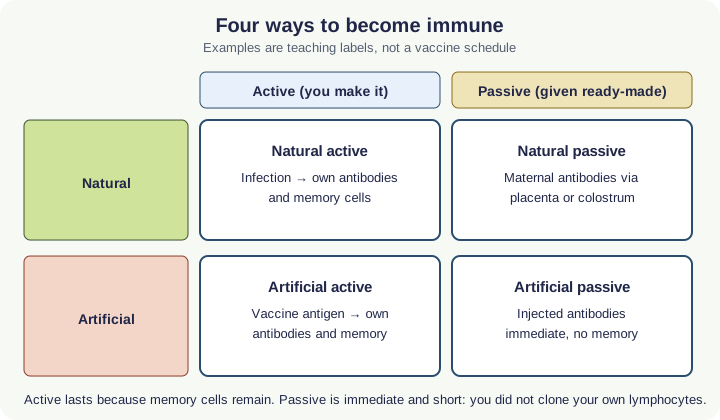
- 6.11artificial active immunityImmunity gained from a vaccine: antigens trigger the body to make its own antibodies and memory cells.: antigenA molecule, often a protein or glycoprotein on a cell surface, that the immune system recognises as non-self. that the person responds to.
- 6.13antibioticA substance that kills bacteria or stops them growing, without harming human cells. Antibiotics do not work on viruses. act on bacteria, not on viruses or on “the immune system in a dish”.
Historical method is enrichment. Required types remain the 6.11 grid; required antibiotic words remain static versus cidal.
By the end, you should be able to…
- State that a vaccine supplies antigen so the recipient makes memory cells.
- Contrast that with artificial passive immunityImmunity from an injection of ready-made antibodies. It works at once but does not last. antibodyA Y-shaped protein made by plasma cells that binds specifically to one antigen..
- Refuse to treat a zone of inhibitionThe clear area around an antibiotic disc on a bacterial lawn, where bacteria have not grown. as a vaccination result.
Build your understanding
What you inject matters
If you inject antigenA molecule, often a protein or glycoprotein on a cell surface, that the immune system recognises as non-self., the recipient’s own B and T cells run a primary response and may leave memory: artificial active immunityImmunity gained from a vaccine: antigens trigger the body to make its own antibodies and memory cells.. If you inject ready-made antibodyA Y-shaped protein made by plasma cells that binds specifically to one antigen., protection starts at once and there is no clone of theirs: artificial passive immunityImmunity from an injection of ready-made antibodies. It works at once but does not last.. CDC’s “how vaccines work” language is the first of those, not the second.
Jenner’s cowpox story is a method ancestor of antigen exposure. You do not need extra smallpox detail. You do need to classify a modern vaccine as artificial active.
A plate is not an immune system
CP14 measures whether bacteria can grow near an antibioticA substance that kills bacteria or stops them growing, without harming human cells. Antibiotics do not work on viruses. disc. That is 6.13/6.14, not 6.11. A clear zone does not mean the bacterium was vaccinated, and a vaccine does not leave a millimetre ring on agar.
Fleming’s contaminated plate is a discovery story for an antibiotic effect, not a clinical trial (4A 7 already warned about that gap). Enrichment ends there.
Make your reasoning visible
Name the cargo
antigenA molecule, often a protein or glycoprotein on a cell surface, that the immune system recognises as non-self. → active. antibodyA Y-shaped protein made by plasma cells that binds specifically to one antigen. → passive.
Keep CP14 off the immunity grid
Zones are growth, not memory cells.
Avoid this misconception
The claim: Vaccines work because the disc kills the virus on a plate.
The correction: Vaccines are antigen for lymphocytes. Discs test antibioticA substance that kills bacteria or stops them growing, without harming human cells. Antibiotics do not work on viruses. on a bacterial lawn. Viruses would not grow as that lawn.
Check your understanding
Try each question before opening the suggested answer.
Practice question
Retrieval and explanation · suggested answer
Why is a standard vaccine classified as artificial active immunity?
Show suggested answer
Antigen is introduced deliberately; the person’s own lymphocytes produce antibodies and memory cells.
Practice question
Retrieval and explanation · suggested answer
Why is a zone of inhibition not evidence that a person has been immunised?
Show suggested answer
The zone shows an antibiotic (or other chemical) prevented bacterial growth on agar. Immunisation is a lymphocyte response to antigen in a host.
Take the idea further
Apply the same specification knowledge to an unfamiliar problem. Any extra assumptions are supplied in the question.
Stretch question
A student wants to “test a vaccine” by putting vaccine liquid on a bacterial lawn, like CP14. Identify two category errors.
Show a hint
Organism and cargo.
Explore the reasoning
A vaccine is for a host immune system, usually against a specified pathogen that may be a virus, which will not form that bacterial lawn. The cargo is antigen for lymphocytes, not an antibiotic meant to clear a zone. You would be running CP14 on the wrong substance and the wrong biological question.
Recall this lesson
Lesson recall questions
Question 1 of 5: What is meant by natural passive immunity?
Types of immunity
Practice question
Retrieval and explanation · suggested answer
What is meant by natural passive immunity?
Lesson: 6B 3: Developing Immunity
Try this from memory first.
Put your biology to work
Explore where these ideas appear in the world. Enrichment, not extra required recall.
How vaccines work, in CDC’s sentence
6B · Thinking BiggerCDC describes vaccines as helping the immune system know how to fight a germ by using antigen, so later infection meets a prepared response. That sentence is 6.11…Specification 6.11Read & use the scienceClose article
Why this matters
CDC describes vaccines as helping the immune system know how to fight a germ by using antigen, so later infection meets a prepared response. That sentence is 6.11 artificial active. It does not turn this page into a clinic, and it does not add extra immunity types. The CDC explanation is a starting point for classifying immunity. To test it, ask whether the recipient made the antibodies and memory cells or received an antibody product already made elsewhere.
Back to the specification
Pearson Edexcel IAL Biology · Issue 2, February 2021 · Unit 4, pp. 29–32. The application extends beyond required recall.
- 6.11 understand how individuals may develop immunity (natural, artificial, active and passive)
Use the science
Why might an injected monoclonal antibody be the other artificial box?
Explore a possible response
It is ready-made antibody (passive), so the recipient did not have to clone their own B cells for that protection.
Explore the source
What an mRNA vaccine actually supplies
6B · Developing ImmunityCDC explains that an mRNA vaccine gives cells instructions to make a harmless target protein, which the immune system can recognise. The recipient then produces an active response,…Specification 6.11Read & use the scienceClose article
Why this matters
CDC explains that an mRNA vaccine gives cells instructions to make a harmless target protein, which the immune system can recognise. The recipient then produces an active response, including memory B and T cells. The vaccine is therefore artificial active immunity, not an injection of ready-made antibodies. Online claims often skip the distinction between the temporary instructions and the immune memory that remains. This example is enrichment, not advice about anyone’s own vaccination. The specification classification depends on who makes the antibody and memory: the recipient does, after exposure to antigen.
Back to the specification
Pearson Edexcel IAL Biology · Issue 2, February 2021 · Unit 4, pp. 29–32. The application extends beyond required recall.
- 6.11 understand how individuals may develop immunity (natural, artificial, active and passive)
Use the science
Why is an mRNA vaccine classified as active rather than passive immunity?
Explore a possible response
The recipient’s own immune system responds to an antigen and can form memory; no ready-made protective antibody is simply transferred.