
What you need to know
- 6.8–6.11Non-specific and specific responses; four types of immunity.
- 6.12–6.15Evasion, static versus cidal, CP14 evaluation, hospital codes.
Core Practical 14 has the disc method. 6A barriers and HIV/TB infection stay linked.
By the end, you should be able to…
- Keep 6.8 processes off the antibodyA Y-shaped protein made by plasma cells that binds specifically to one antigen. page, and vice versa.
- Classify immunity with two adjectives.
- Separate evasion biology from ward codes.
Build your understanding
Start with the layer
Barrier (6.7), then inflammationA local response to infection or damage: histamine makes blood vessels dilate and become leakier, causing heat, redness and swelling and bringing in phagocytes./lysozymeAn enzyme in tears, saliva and mucus that breaks down bacterial cell walls./interferonA protein released by virus-infected cells that inhibits viral replication in nearby cells./phagocytosisEngulfing a pathogen or particle into a vesicle by endocytosis. (6.8), then clone (6.9–6.10), then how the person got the antibodyA Y-shaped protein made by plasma cells that binds specifically to one antigen. (6.11). antibioticA substance that kills bacteria or stops them growing, without harming human cells. Antibiotics do not work on viruses. are bacterial drugs (6.13). All numerical zones below are fictional.
Finish the mechanism
histamineA chemical released in inflammation. It dilates arterioles and makes capillaries more permeable., not “it swells”. variable regionThe part of an antibody that differs between antibodies and forms the antigen-binding site., not “the Y is sticky”. cytokineA signalling protein released by immune cells, such as T helper cells, that stimulates other immune cells., not “T cells help”. antigenA molecule, often a protein or glycoprotein on a cell surface, that the immune system recognises as non-self. in a vaccine, not antibody. Static holds CFU; cidal drops CFU. Hands → gel is 6.15, HIVHuman immunodeficiency virus: an RNA retrovirus that infects T helper cells and can lead to AIDS. mutationA change in the sequence of bases in DNA. is 6.12.
Make your reasoning visible
Do not import 6C
PCR and DNA profiling are later.
Name the cell
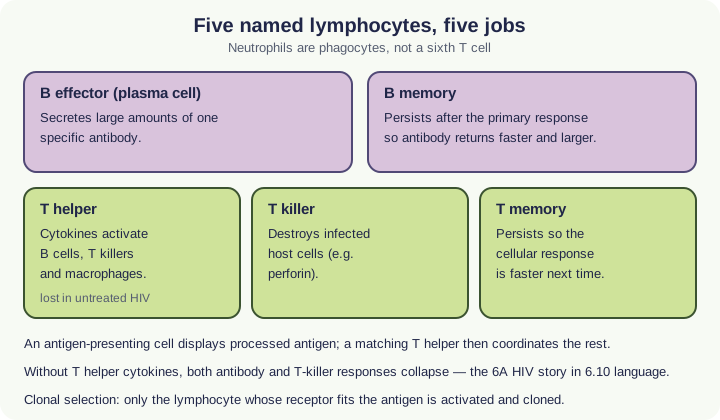
Plasma, T helper, T killer, macrophage — not “white blood cell” for every role.
Avoid this misconception
The claim: antibodyA Y-shaped protein made by plasma cells that binds specifically to one antigen., antibioticA substance that kills bacteria or stops them growing, without harming human cells. Antibiotics do not work on viruses. and interferonA protein released by virus-infected cells that inhibits viral replication in nearby cells. are three names for the same killing chemical.
The correction: Antibodies are specific proteins from plasma cells. Antibiotics are bacterial drugs. Interferon is a non-specific viral-alert protein from infected cells.
Check your understanding
Try each question before opening the suggested answer.
Check your understanding (continued)
Check your understanding (continued)
Practice question
Retrieval and explanation · suggested answer
Name the four 6.8 responses.
Show suggested answer
Inflammation, lysozyme action, interferon, phagocytosis.
Practice question
Retrieval and explanation · suggested answer
What fuses with a phagosome so the pathogen is digested?
Show suggested answer
A lysosome, forming a phagolysosome.
Practice question
Retrieval and explanation · suggested answer
State two jobs of antibodies after they bind antigen.
Show suggested answer
Any two of: neutralisation, agglutination, opsonisation.
Practice question
Retrieval and explanation · suggested answer
State the role of T killer cells.
Show suggested answer
They destroy infected host cells, for example by releasing perforin.
Practice question
Retrieval and explanation · suggested answer
Classify immunity from colostrum and from a measles vaccine.
Show suggested answer
Natural passive; artificial active.
Practice question
Retrieval and explanation · suggested answer
Define bacteriostatic.
Show suggested answer
Inhibits bacterial growth and division without directly killing the cells.
Practice question
Retrieval and explanation · suggested answer
Give one HIV evasion mechanism.
Show suggested answer
Antigenic variation of envelope proteins, or destruction of T helper cells, or latency as a provirus. (Any one named.)
Practice question
Retrieval and explanation · suggested answer
Why should antibiotics not be prescribed for a viral cold?
Show suggested answer
They have no viral target, and unnecessary use selects resistant bacteria that contribute to hospital-acquired infection.
Take the idea further
Apply the same specification knowledge to an unfamiliar problem. Any extra assumptions are supplied in the question.
Stretch question
Fictional zones: control disc (sterile water) 0 mm, antibiotic P 20 mm, Q 0 mm. A patient has almost no T helpers. Which drug might still fail even if P looks “best”, and which 6.10 fact explains the risk if P is bacteriostatic?
Show a hint
Zone ≠ immune clearance.
Explore the reasoning
P inhibited the lawn more than Q, but if P is bacteriostatic it leaves living bacteria. Almost no T helpers means poor activation of B cells and macrophages, so those living bacteria may not be cleared. Q’s zero zone suggests resistance on the plate, which is a different failure. Neither millimetre is a dose in a person.
Recall this lesson
Lesson recall questions
Question 1 of 5: Describe, in order, how inflammation develops after tissue damage.
Non-specific responses
Practice question
Retrieval and explanation · suggested answer
Describe, in order, how inflammation develops after tissue damage.
Lesson: 6B 1: Non-specific Responses to Infection
Build the sequence from memory first. Then reveal the model order.
Tap the steps in the order you recall. Tap a placed step to send it back.
- 01Next step
- 02Waiting
- 03Waiting
Tap to place
Put your biology to work
Explore where these ideas appear in the world. Enrichment, not extra required recall.
Cause, then rule
6B · Exam PracticeWHO’s resistance fact sheet and CDC vaccine pages both move from a biological mechanism to a public rule. That is the 6.15 habit: overuse selects resistance, so prescription…Specification 6.15Read & use the scienceClose article
Why this matters
WHO’s resistance fact sheet and CDC vaccine pages both move from a biological mechanism to a public rule. That is the 6.15 habit: overuse selects resistance, so prescription is restricted; antigen trains lymphocytes, so vaccines are classified as artificial active. Exam answers still need the mechanism, not a slogan. A public-health instruction becomes a biological explanation only when the causal chain is explicit. Identify the organism or transmission route, then show how the proposed action interrupts it.
Back to the specification
Pearson Edexcel IAL Biology · Issue 2, February 2021 · Unit 4, pp. 29–32. The application extends beyond required recall.
- 6.15 know how an understanding of the contributory causes of hospital-acquired infections has led to codes of practice regarding antibiotic prescription and hospital practice that relate to infection prevention and control
Use the science
Why is a copied hospital poster weaker than “hands carry MRSA, therefore gel between patients”?
Explore a possible response
The specification wants the causal link from a named cause of HAI to the code. A poster without that link is decoration.
Explore the source
The hospital pharmacist as an evolution manager
6B · Antibiotic ResistanceCDC describes antibiotic stewardship teams that review prescribing, monitor resistance patterns and give feedback to clinicians. A pharmacist on such a team is using evolutionary biology: unnecessary exposure…Specification 6.15Read & use the scienceClose article
Why this matters
CDC describes antibiotic stewardship teams that review prescribing, monitor resistance patterns and give feedback to clinicians. A pharmacist on such a team is using evolutionary biology: unnecessary exposure selects bacteria already carrying resistance traits, while infection-control measures reduce opportunities for those bacteria to spread. Stewardship is not simply “never use antibiotics”; an appropriate drug can be lifesaving. The role joins data, clinical judgement and clear communication. The specification asks for contributory causes of hospital-acquired infection and resulting codes of practice, so an exam answer should link the cause to the particular measure rather than list a generic poster.
Back to the specification
Pearson Edexcel IAL Biology · Issue 2, February 2021 · Unit 4, pp. 29–32. The application extends beyond required recall.
- 6.15 know how an understanding of the contributory causes of hospital-acquired infections has led to codes of practice regarding antibiotic prescription and hospital practice that relate to infection prevention and control
Use the science
Why might a hospital combine prescription review with hand hygiene rather than choose only one?
Explore a possible response
Prescription review reduces selection pressure; hand hygiene reduces transmission. The measures interrupt different steps in the problem.
Explore the source
Killing bacteria is not the only useful outcome
6B · Antibiotics: Treating Bacterial DiseaseBactericidal drugs kill bacteria in a laboratory test; bacteriostatic drugs mainly stop growth under the tested conditions. A clinical review notes that the distinction can vary with organism,…Specification 6.13Read & use the scienceClose article
Why this matters
Bactericidal drugs kill bacteria in a laboratory test; bacteriostatic drugs mainly stop growth under the tested conditions. A clinical review notes that the distinction can vary with organism, concentration and test conditions. It is therefore poor reasoning to assume a drug labelled “cidal” must always be the best treatment. The immune system, infection site, dosing and resistance all affect outcomes. Students still need the clean specification definitions, but the clinical extension shows why a binary laboratory label is not a whole treatment decision. An antibiotic has a bacterial target and does not treat a viral infection merely because symptoms look severe.
Back to the specification
Pearson Edexcel IAL Biology · Issue 2, February 2021 · Unit 4, pp. 29–32. The application extends beyond required recall.
- 6.13 understand the difference between bacteriostatic and bactericidal antibiotics
Use the science
Why should a clinician not choose an antibiotic solely because a laboratory classifies it as bactericidal?
Explore a possible response
The label depends on testing conditions and does not include pathogen susceptibility in the patient, infection site, dose, resistance or host factors.
Explore the source
- Bactericidal versus bacteriostatic antibacterialsJournal of Antimicrobial Chemotherapy · Abstract