
What you need to know
- 7.22geneA sequence of DNA bases that codes for a polypeptide or a functional RNA. are switched on and off by DNADeoxyribonucleic acid: a double-stranded polynucleotide that carries the genetic code. transcription factorA protein that binds to DNA near a gene and switches its transcription on or off.. peptide hormoneA hormone made of amino acids. It cannot cross the membrane, so it binds to a receptor on the cell surface. act extracellularly. steroid hormoneA lipid-soluble hormone that passes through the cell membrane and binds to a receptor inside the cell, often acting as a transcription factor. act intracellularly.
Names of second messengers are not required. Adrenaline is a fight-or-flight signal in 7B, not an example of a peptide. Insulin and ADH are the peptide examples. The kidney detail of ADH is 7C 3. Recombinant DNA is Topic 8.
By the end, you should be able to…
- State that a transcription factor binds DNA and changes transcriptionMaking an mRNA copy of a gene, using one strand of DNA as a template, in the nucleus..
- Contrast a peptide hormone’s surface receptor with a steroid’s intracellular receptor.
- Avoid naming a second-messenger cascade as required recall.
Build your understanding
Transcription factors are the switch
A transcription factorA protein that binds to DNA near a gene and switches its transcription on or off. is a protein that binds a specific region of DNADeoxyribonucleic acid: a double-stranded polynucleotide that carries the genetic code. and increases or decreases transcriptionMaking an mRNA copy of a gene, using one strand of DNA as a template, in the nucleus. of a geneA sequence of DNA bases that codes for a polypeptide or a functional RNA.. More messenger RNAA single-stranded RNA copy of a gene that carries the code from the nucleus to a ribosome. can mean more of a protein. Less transcription can switch that gene’s product down. Cells do not express every gene at once. Homeostatic signals, including hormones, use this control so a cell changes what it makes, not only what it already contains.
The specification point is the switch, not a list of promoter sequences. If you write “the hormone becomes the gene”, that is wrong. The hormone changes the activity of transcription factors. The gene stays DNA.
Peptide hormones stay outside
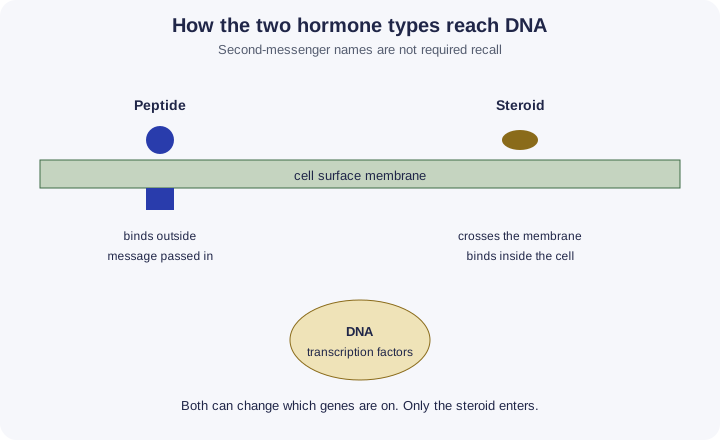
peptide hormoneA hormone made of amino acids. It cannot cross the membrane, so it binds to a receptor on the cell surface. are not lipid-soluble, so they do not cross the cell surface membraneThe partially permeable membrane around a cell that controls which substances enter and leave. freely. ADHAntidiuretic hormone: released from the posterior pituitary, it makes the collecting duct more permeable to water, so less water is lost in urine. and insulin are peptides. They bind a receptor on the outside of the target cell. The receptor then passes the message inward. Inside, transcription factors may be activated or inhibited, so gene expression changes. A second messenger is the usual go-between. You do not need its name.
adrenalineA hormone from the adrenal glands that prepares the body for action, for example by raising heart rate. also binds a surface receptor, but it is not a peptide. Do not use it as your 7.22 peptide example. Its fight-or-flight effects on heart rateThe number of heartbeats per minute. were 7B 7. Here, choose a peptide when the question says peptide.
Steroid hormones enter
steroid hormoneA lipid-soluble hormone that passes through the cell membrane and binds to a receptor inside the cell, often acting as a transcription factor., such as oestrogen or testosterone, are lipid-soluble. They cross the phospholipid bilayerTwo layers of phospholipids with the hydrophobic tails inside and the hydrophilic heads facing the water on each side. and bind a receptor inside the cell. The hormone–receptor complex acts as, or activates, a transcription factor and binds DNA. Transcription of particular genes then rises or falls. The receptor is intracellular. That is the contrast with the peptide.
Not every effect of a hormone has to be a new protein. Some peptide effects, including ADH inserting water channels, are faster than transcription. If a question asks about 7.22, talk about transcription factors. If it asks how ADH changes the collecting ductThe tube that carries urine through the medulla. ADH controls how much water is reabsorbed from it. within minutes, the permeability change is 7C 3. Do not force every answer through the nucleusThe organelle that contains the cell’s chromosomes, surrounded by a nuclear envelope with pores..
| Hormone type | Example | Where it binds |
|---|---|---|
| Peptide | ADH or insulin | Receptor on the outside; message passed in |
| Steroid | Oestrogen or testosterone | Receptor inside; complex affects DNA |
| Not the peptide example | Adrenaline | Surface receptor, but not a peptide |
Make your reasoning visible
Outside versus inside
Peptide: extracellular receptor. Steroid: crosses the membrane, intracellular receptor, transcriptionMaking an mRNA copy of a gene, using one strand of DNA as a template, in the nucleus..
Factor binds DNA
A transcription factorA protein that binds to DNA near a gene and switches its transcription on or off. is a protein at the geneA sequence of DNA bases that codes for a polypeptide or a functional RNA., not the hormone itself sitting in the bloodstream.
Avoid this misconception
The claim: Both hormone types enter the nucleusThe organelle that contains the cell’s chromosomes, surrounded by a nuclear envelope with pores. and become part of the DNADeoxyribonucleic acid: a double-stranded polynucleotide that carries the genetic code..
The correction: steroid hormoneA lipid-soluble hormone that passes through the cell membrane and binds to a receptor inside the cell, often acting as a transcription factor. can act inside the cell via a receptor that affects transcription. peptide hormoneA hormone made of amino acids. It cannot cross the membrane, so it binds to a receptor on the cell surface. bind outside. Neither hormone is written into the DNA sequence.
Put hormone action in order
Peptide and steroid hormones both end by changing transcription, but they reach the transcription factors by different routes. Order each route.
Order the steps
What to do
- Pick a chain with Chain, just below these steps: Peptide hormone or Steroid hormone.
- Reorder the cards below: drag a card (on a touch screen, drag its number), tap a card then tap where it goes, or use the ↑ and ↓ arrows at its right.
- Press Check under the cards to mark each one green (right place) or red; the count shows how many are right.
- Stuck? Hint first outlines the first wrong place, then gives a clue, then places that step for you.
- Shuffle mixes the cards again; Start again returns them to the starting order. Keyboard: Space picks up, arrow keys move, Space drops.
A peptide hormone such as ADH or insulin reaches its target. Put the steps in order.
1 of 5 in the right place
The name of the second messenger (for example cAMP) is not required. Some hormones also act without changing transcription; 7.22 is about gene expression.
Check your understanding
Try each question before opening the suggested answer.
Practice question
Retrieval and explanation · suggested answer
What does a transcription factor do?
Show suggested answer
It binds DNA and increases or decreases transcription of a gene.
Practice question
Retrieval and explanation · suggested answer
Why does a peptide hormone not cross the membrane to reach DNA directly?
Show suggested answer
It is not lipid-soluble. It binds an extracellular receptor, and the message is passed in to affect transcription factors.
Practice question
Retrieval and explanation · suggested answer
Describe how a steroid hormone can switch a gene on.
Show suggested answer
It crosses the membrane, binds an intracellular receptor, and the complex acts on DNA as, or through, a transcription factor so transcription increases.
Take the idea further
Apply the same specification knowledge to an unfamiliar problem. Any extra assumptions are supplied in the question.
Stretch question
A new hormone is lipid-soluble and a target cell changes which proteins it makes over several hours. A second hormone is a short peptide and the cell responds in seconds by changing membrane permeability, with a later change in transcription as well. Classify both. Which response is the 7.22 point, and which is an extra fast effect?
Show a hint
Solubility decides the route. The specification sentence is about transcription.
Explore the reasoning
The lipid-soluble hormone is acting as a steroid: intracellular receptor and transcription. The peptide uses an extracellular receptor. The fast permeability change is a membrane effect, like ADH and water channels, and is not itself transcription. The later change in which proteins are made is the 7.22 transcription-factor effect. No second-messenger name is required.
Recall this lesson
Lesson recall questions
Question 1 of 5: Compare where peptide hormones and steroid hormones bind their receptors.
Transcription factors and hormones
Practice question
Retrieval and explanation · suggested answer
Compare where peptide hormones and steroid hormones bind their receptors.
Lesson: 7C 1: Homeostasis and Hormones
Try this from memory first.
Put your biology to work
Explore where these ideas appear in the world. Enrichment, not extra required recall.
Cells keep most genes quiet
7C · Homeostasis and HormonesMedlinePlus Genetics explains that cells express only some of their genes, and that transcription factors are proteins which bind DNA and raise or lower transcription when signals arrive.…Specification 7.22Read & use the scienceClose article
Why this matters
MedlinePlus Genetics explains that cells express only some of their genes, and that transcription factors are proteins which bind DNA and raise or lower transcription when signals arrive. That is the general idea behind 7.22. The page does not classify peptide and steroid hormones, so the extracellular versus intracellular contrast still has to come from the specification. 7.22: transcription factors switch genes, peptide hormones act from outside the cell, and steroid hormones act inside.
Back to the specification
Pearson Edexcel IAL Biology · Issue 2, February 2021 · Unit 5, pp. 35–38. The application extends beyond required recall.
- 7.22 Transcription factors and peptide versus steroid hormone action.
Use the science
Why is “every cell uses every gene, and hormones only add energy” inconsistent with this source and with 7.22?
Explore a possible response
Cells transcribe a fraction of their genes. Hormones in this lesson change transcription through transcription factors. They are not a general energy drink, and peptide hormones do not even enter the cell.
Explore the source
- MedlinePlus Genetics: can genes be turned on and off?US National Library of Medicine
A steroid signal reaches the transcription machinery
7C · Homeostasis and HormonesA molecular review describes nuclear receptors as transcription factors whose activity can change when they bind steroid hormones. That is a concrete extension of 7.22: a lipid-soluble signal…Specification 7.22Read & use the scienceClose article
Why this matters
A molecular review describes nuclear receptors as transcription factors whose activity can change when they bind steroid hormones. That is a concrete extension of 7.22: a lipid-soluble signal can cross a cell membrane and influence which genes are transcribed. It does not mean every steroid binds DNA directly or that every hormone uses the same receptor. Peptide hormones usually act through surface receptors and intracellular signalling before transcription changes. Researchers can compare RNA production before and after hormone exposure, but that measurement alone still needs controls to show which receptor and promoter are responsible.
Back to the specification
Pearson Edexcel IAL Biology · Issue 2, February 2021 · Unit 5, pp. 35–38. The application extends beyond required recall.
- 7.22 Transcription factors and peptide versus steroid hormone action.
Use the science
Why can a steroid hormone alter transcription even though it is not itself a transcription factor?
Explore a possible response
It can bind an intracellular receptor. The hormone–receptor complex, or a downstream factor it controls, can then regulate transcription at target genes.
Explore the source
- Signalling by nuclear receptorsPeer-reviewed review via NIH PubMed Central