
What you need to know
- 8.12Core Practical 18: production of amylase in germinating cereal grains.
Teachers choose the grain, the gibberellin preparation and the incubation. Diameters below are illustrative. Iodine stains. Do not eat the plates. A clear zone shows starch loss, not a weighed mass of maltose.
By the end, you should be able to…
- Identify the embryo as the source of gibberellinA plant growth substance that causes stem elongation and switches on amylase genes in germinating seeds..
- Use a no-embryo control and a gibberellin replacement.
- Read a clear zone after iodine as digested starchThe storage polysaccharide in plants, made of amylose and amylopectin. It is compact and insoluble, so it does not affect water potential..
Build your understanding
What the grain is doing
Aim: investigate amylase production when a cereal grain germinates. In an intact grain the embryo releases gibberellinA plant growth substance that causes stem elongation and switches on amylase genes in germinating seeds., the aleurone transcribes the amylase geneA sequence of DNA bases that codes for a polypeptide or a functional RNA., and amylase digests starchThe storage polysaccharide in plants, made of amylose and amylopectin. It is compact and insoluble, so it does not affect water potential. in the endosperm. On a starch-agar plate you see that digestion as a clear zone after iodine, because iodine turns remaining starch blue-black.
Independent variable: whether the embryo is present, or whether gibberellin is added to a half-grain that has no embryo. Dependent variable: diameter of the clear zone after a set incubation. Same grain speciesA group of organisms that can interbreed to produce fertile offspring., same incubation time and temperature, same volume of any solution. An alternative design varies how long whole grains have been germinating before they are cut.
Three plates, one conclusion
Surface-sterilise the soaked grains (for example in dilute disinfectant, then rinse in sterile water) so microbes on the husk do not digest the starch. Cut the grains. Place half-grains with the embryo still attached, half-grains with the embryo removed, and embryo-free half-grains plus the gibberellin solution your teacher supplies. Incubate as directed, often about a day at room temperature, not as a bacterial culture at 37 °C. Flood with iodine. Rinse gently. Measure the clear zone including the half-grain, and record 0 if no clear agar extends beyond the grain.
Three plates, one conclusion (continued)
Illustrative pattern, not a class result: with embryo, a clear zone about 12 mm across; no embryo, no clear zone; no embryo plus gibberellin, a clear zone about 11 mm. The embryo is replaceable by the hormone. A no-grain control plate should stay blue-black: it shows the agar really contained starch and the iodine works. Do not claim you measured maltoseA disaccharide of two α-glucose molecules joined by a 1,4 glycosidic bond. unless you did a reducing-sugar test on a sample.
Limits
A larger zone can mean more enzymeA globular protein that acts as a biological catalyst, speeding up a specific reaction., a longer incubation, or easier diffusionThe net movement of molecules from a region of higher concentration to a region of lower concentration. It is passive. through that agar. Compare zones only when time and agar match. A zone is not a concentration in micromoles. Seeds are not animals, but iodine and any hormone solution are still handled as the risk assessment says.
This practical does not show phytochromeA plant pigment that exists in two forms, Pr and Pfr, which change into each other in red and far-red light. or flowering. It shows the gibberellin-to-amylase step. transcriptionMaking an mRNA copy of a gene, using one strand of DNA as a template, in the nucleus. is inferred, unless you have a separate molecular test you were not given.
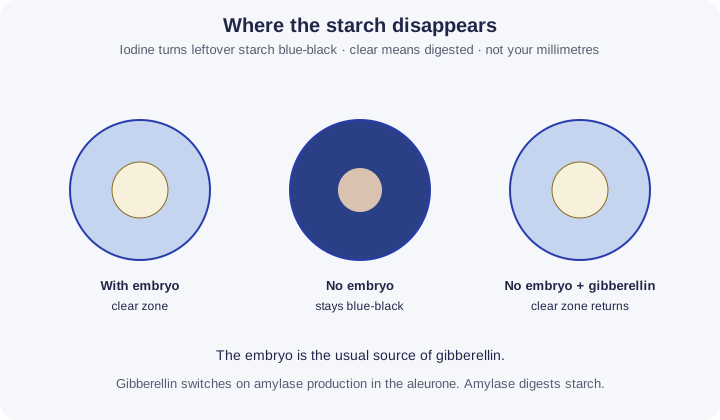
| Treatment | Expected starch | Conclusion if the pattern holds |
|---|---|---|
| Embryo present | Clear zone | The embryo is enough |
| Embryo removed | Blue-black | The endosperm alone does not make the enzyme |
| Embryo removed plus gibberellin | Clear zone | The hormone can replace the embryo |
The amylase in grains lab
Surface-sterilise and cut soaked grains, give some embryo-free halves gibberellin, incubate them on starch agar and flood with iodine to see where starch has gone. A teaching model: the grains, timings and zones are fictional.
Simulation only. Wear eye protection (iodine solution stains and irritates eyes; the disinfectant is an irritant), cut on a tile with the blade away from your fingers, keep lids taped and dispose of plates as directed.
Method 6 steps
- Wear eye protection. Surface-sterilise soaked grains in dilute disinfectant and rinse them in sterile water.
- On a tile, cut each grain across into a half with the embryo and a half without it.
- Soak some embryo-free halves in gibberellin solution and others in water for the same time.
- Place the halves cut face down on starch agar, at least 15 mm apart, and label the plate bases. Set up two control plates: a no-grain plate (shows the agar contains starch and the iodine works) and a gibberellin-only plate (shows the hormone itself does not digest starch).
- Incubate all plates for the same time (for example 24 h at about 25 °C).
- Flood all plates with iodine solution at the same time, rinse, and measure two diameters of each clear zone including the half-grain (0 if no clear agar extends beyond it).
Aligned with the order of the specification practical. Simulation only: a teacher sets the real volumes, concentrations and risk controls; this is not a laboratory protocol.
Variables
- Independent
- Embryo present or removed, with or without gibberellin (or gibberellin concentration, or germination time).
- Dependent
- Diameter of the clear zone after iodine (mm).
- Controlled
- Grain species and size
- Starch agar concentration and depth
- Incubation time and temperature
- Cut face down
- Same time in iodine, then rinsed
Safety
- Eye protection: iodine solution stains and irritates eyes; the disinfectant is an irritant.
- Cut on a tile with the blade away from your fingers.
- Tape lids, do not open plates after incubation except to flood them, and dispose of plates as directed. Wash hands.
Follow your school’s risk assessment; these notes are not a substitute for it.
Interpreting
- Fictional 24 h zones: embryo about 12 mm, no embryo 0, no embryo + gibberellin about 11 mm; the gibberellin-only and no-grain control plates stay blue-black.
- The embryo makes gibberellin; the aleurone responds by producing α-amylase, which digests the starch around the grain. Some β-amylase is already in the endosperm, so an embryo-free half can show a trace.
- Gibberellin alone on agar does not digest starch: the hormone is a signal, not the enzyme. Transcription of the amylase gene is inferred, not shown.
- A bigger zone can mean more enzyme, a longer incubation or easier diffusion. Timings are fictional; real half-grain assays often need 24–48 h.
Guided method · step 1 of 13
Click the Eye protection button in the simulator.
Iodine solution stains and irritates eyes; the disinfectant is an irritant; you will be using a scalpel.
1 · Design
Measure
Measure 5 zones yourself, then “Measure the rest” uses the same rule. Control plates have no grains: check they are evenly blue-black.
Follow the guided steps: start with eye protection.
2 · Method
3 · Results
Evaluate
Gibberellin response R = [GA] ÷ ([GA] + 10⁻⁸ mol dm⁻³); secretion starts after 14 h with an embryo and 10 h with gibberellin supplied; about 1 in 10 embryo-free halves keeps a trace of β-amylase. Unsterilised grains carry microbes in about 4 plates in 10.
Make your reasoning visible
Iodine colour
Blue-black means starchThe storage polysaccharide in plants, made of amylose and amylopectin. It is compact and insoluble, so it does not affect water potential. is still there. Clear means it has been digested.
Hormone is not the enzyme
gibberellinA plant growth substance that causes stem elongation and switches on amylase genes in germinating seeds. on the plate does not digest starch by itself. The aleurone has to respond.
Avoid this misconception
The claim: The clear zone is maltoseA disaccharide of two α-glucose molecules joined by a 1,4 glycosidic bond. that you can see, and gibberellin is amylase.
The correction: The clear zone is the absence of starch. Maltose is soluble and is not the blue colour. Gibberellin causes amylase to be produced. Amylase digests the starch.
Check your understanding
Try each question before opening the suggested answer.
Check your understanding (continued)
Practice question
Retrieval and explanation · suggested answer
What is the dependent variable if you compare grains with and without an embryo?
Show suggested answer
The diameter of the clear zone after iodine, or whether a clear zone is present.
Practice question
Retrieval and explanation · suggested answer
Why include a half-grain with the embryo removed and no added hormone?
Show suggested answer
It is a control: it shows that the endosperm and aleurone do not produce enough amylase without the embryo’s signal.
Practice question
Retrieval and explanation · suggested answer
Why add gibberellin to some embryo-free half-grains?
Show suggested answer
To test whether the hormone can replace the embryo and switch on amylase production.
Practice question
Retrieval and explanation · suggested answer
What does a blue-black colour after iodine mean?
Show suggested answer
Starch is still present, so little or no amylase has digested it.
Take the idea further
Apply the same specification knowledge to an unfamiliar problem. Any extra assumptions are supplied in the question.
Stretch question
Illustrative zones after 24 hours: embryo 12 mm, no embryo 0 mm, no embryo plus gibberellin 11 mm, gibberellin solution on starch agar with no grain 0 mm. A student says gibberellin is an enzyme that digests starch. Which plate contradicts that, and what is the better conclusion?
Show a hint
Look at the plate that has hormone but no living tissue.
Explore the reasoning
Gibberellin on agar with no grain leaves the starch intact, so the hormone does not digest starch itself. The similar zones with the embryo and with embryo-free grains plus gibberellin show that the living aleurone responds to the hormone by producing amylase. The diameters are invented.
Recall this lesson
Lesson recall questions
Question 1 of 5: List the independent, dependent and one control variable in a typical CP18 investigation of germination time.
Amylase in germinating grains
Practice question
Retrieval and explanation · suggested answer
List the independent, dependent and one control variable in a typical CP18 investigation of germination time.
Lesson: CP18: Amylase Production in Germinating Cereal Grains
Try this from memory first.
Put your biology to work
Explore where these ideas appear in the world. Enrichment, not extra required recall.
Compost microbes are a different starch story
CP18 · Amylase Production in Germinating Cereal GrainsThe US EPA says microorganisms break down organic material in compost. They use extracellular enzymes too. Core Practical 18 is not that community. The enzyme comes from the…Specification 8.12Read & use the scienceClose article
Why this matters
The US EPA says microorganisms break down organic material in compost. They use extracellular enzymes too. Core Practical 18 is not that community. The enzyme comes from the grain’s aleurone after a gibberellin signal. A clear zone next to a half-grain is not evidence that compost bacteria were on the plate, especially if the no-grain plate stays blue-black. Compost is a useful contrast because its mixed microorganisms release enzymes outside their cells to dismantle organic matter. In a germinating cereal grain, gibberellin signalling triggers amylase production by the grain itself. Both can clear starch, but the mechanism and organism differ. A no-grain control and an ungerminated comparison help you decide whether clearing is associated with the grain treatment rather than contamination or a property of the agar.
Back to the specification
Pearson Edexcel IAL Biology · Issue 2, February 2021 · Unit 5, pp. 35–38 · assessed through Unit 6. The application extends beyond required recall.
- 8.12 Core Practical 18: investigate amylase production in germinating cereal grains.
Use the science
Why would swabbing a compost heap onto the same agar answer a different question?
Explore a possible response
That would test microbial enzymes from the heap. This practical tests whether the grain produces amylase when the embryo or gibberellin is present. The organisms are not the same.
Explore the source
- US EPA: composting at homeUS Environmental Protection Agency
Malting connects a cereal grain to gene expression
CP18 · Amylase Production in Germinating Cereal GrainsA study of germinating barley measured gibberellin-related transcripts and enzyme activity in different grain tissues. It links Core Practical 18 to cereal science: amylase production helps mobilise stored…Specification 8.12Read & use the scienceClose article
Why this matters
A study of germinating barley measured gibberellin-related transcripts and enzyme activity in different grain tissues. It links Core Practical 18 to cereal science: amylase production helps mobilise stored starch as a seedling begins to grow, and the same chemistry matters during malting. A starch-clearing zone is a useful school proxy for secreted enzyme action, not a direct measurement of every gene transcript. The researcher can compare treated and untreated grain, but must also control germination time and tissue position before attributing a difference to gibberellin.
Back to the specification
Pearson Edexcel IAL Biology · Issue 2, February 2021 · Unit 5, pp. 35–38 · assessed through Unit 6. The application extends beyond required recall.
- 8.12 Core Practical 18: investigate amylase production in germinating cereal grains.
Use the science
Why might two barley halves show different starch-clearing zones even if they received the same gibberellin treatment?
Explore a possible response
They may differ in germination stage, tissue position, starting starch or enzyme amount. A controlled comparison needs matched material and equal incubation conditions.
Explore the source
- Gibberellin expression and content in germinated barleyPeer-reviewed study (PMC)