
What you need to know
- 8.20microarrayA slide with thousands of known DNA probes, used to detect which sequences or mRNAs are present in a sample. identify active geneA sequence of DNA bases that codes for a polypeptide or a functional RNA..
- 8.21bioinformaticsUsing computers to store and analyse biological data, such as DNA and protein sequences.: computing with large biological data sets.
A microarray is not a DNA profile and not gel electrophoresis. Bioinformatics is not “using a computer in a lesson”. Sequencing every base by hand is not required. No personal genetic data.
By the end, you should be able to…
- Explain why messenger RNAA single-stranded RNA copy of a gene that carries the code from the nucleus to a ribosome., not genomic DNADeoxyribonucleic acid: a double-stranded polynucleotide that carries the genetic code. alone, shows that a gene is active.
- Describe hybridisation of labelled cDNA to a probe on the chip.
- Define bioinformatics and give one use of sequence comparison.
Build your understanding
Active means transcribed
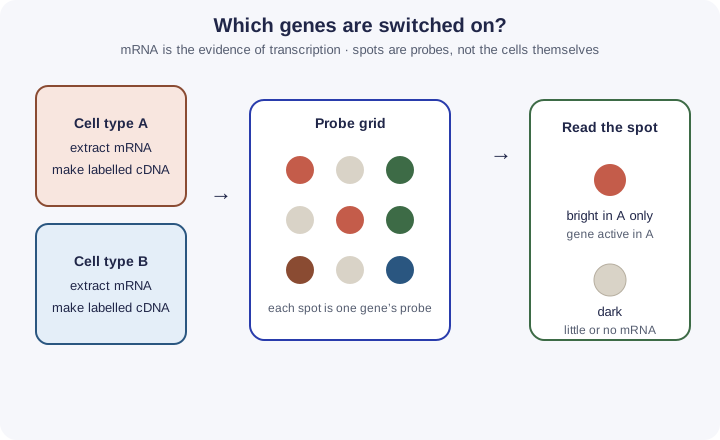
A geneA sequence of DNA bases that codes for a polypeptide or a functional RNA. is active in a cell when it is being transcribed. Genomic DNADeoxyribonucleic acid: a double-stranded polynucleotide that carries the genetic code. is present whether or not the gene is on, so a sample of DNA alone cannot answer 8.20. messenger RNAA single-stranded RNA copy of a gene that carries the code from the nucleus to a ribosome. can. In an expression microarrayA slide with thousands of known DNA probes, used to detect which sequences or mRNAs are present in a sample., mRNA is extracted and copied into complementary DNA (cDNA). The cDNA is labelled, often with a fluorescent tag.
The chip holds thousands of spots. Each spot is a probe, a single-stranded DNA of known sequence for one gene. Labelled cDNA hybridises only to the probe with the complementary sequence. A bright spot means a lot of that mRNA was in the sample, so that gene was active. A dark spot means little or no mRNA from that gene.
Comparing two samples
Two cell types can be labelled with different colours and washed over the same chip. A spot that is bright in only one colour was active in only one cell type. That is how a microarray supports the idea from Topic 3 that specialised cells express different sets of genes.
The result is a pattern, not a diagnosis. A bright spot is not a drug and not proof of a disease by itself. The chip does not separate fragments by length the way a gel does, and it is not a DNA profilingComparing the lengths of non-coding repeated DNA sequences to identify individuals or show relationships. of repeated sequences.
Bioinformatics is the computing
bioinformaticsUsing computers to store and analyse biological data, such as DNA and protein sequences. uses computers and databases to store, organise and analyse large biological data sets, especially DNA and protein sequences. A genome is too long to compare by eye. An algorithm can align two sequences and show where they match.
That comparison can suggest a related gene, a conserved region, or a protein family. It does not, by itself, prove what the protein does in a cell. A microarray file is also a large data set: bioinformatics is how the spot intensities are stored and compared. The word is not a synonym for “ICT in biology lessons”.
| Method | Question it answers | What a bright or distant band is not |
|---|---|---|
| Expression microarray | Which genes were being transcribed? | Not a length, and not an identity profile |
| Gel electrophoresis | How long are these fragments? | Not a measure of how active a gene is |
| Sequence alignment | Where do these sequences match? | Not proof of a function you were not given |
Make your reasoning visible
Start from mRNA
Active geneA sequence of DNA bases that codes for a polypeptide or a functional RNA. → messenger RNAA single-stranded RNA copy of a gene that carries the code from the nucleus to a ribosome. → cDNA → hybridises to its probe → bright spot.
Alignment is the computing step
If the question says bioinformaticsUsing computers to store and analyse biological data, such as DNA and protein sequences., name computers, databases or sequence alignment, not a single pipette.
Avoid this misconception
The claim: A bright microarrayA slide with thousands of known DNA probes, used to detect which sequences or mRNAs are present in a sample. spot means that gene is a mutation, or that the fragment is short.
The correction: In an expression array, brightness means abundant mRNA from that gene. Length is a gel. A mutation test is a different use of some arrays and is not what 8.20 asks.
Order a microarray experiment
A microarray shows which of thousands of genes are being transcribed in a sample. Order the procedure.
Order the steps
What to do
- Reorder the cards below: drag a card (on a touch screen, drag its number), tap a card then tap where it goes, or use the ↑ and ↓ arrows at its right.
- Press Check under the cards to mark each one green (right place) or red; the count shows how many are right.
- Stuck? Hint first outlines the first wrong place, then gives a clue, then places that step for you.
- Shuffle mixes the cards again; Start again returns them to the starting order. Keyboard: Space picks up, arrow keys move, Space drops.
You want to know which genes are active in a tissue. Put the steps in order.
0 of 7 in the right place
Real experiments often label two samples in different colours on one array. The amount of mRNA does not always match the amount of protein.
Check your understanding
Try each question before opening the suggested answer.
Practice question
Retrieval and explanation · suggested answer
Why is mRNA a better sample than genomic DNA if you want to know which genes are active?
Show suggested answer
mRNA is only made from genes that are being transcribed. Genomic DNA is present for genes that are switched off as well.
Practice question
Retrieval and explanation · suggested answer
What does a bright spot on an expression microarray show?
Show suggested answer
Labelled cDNA from that gene’s mRNA has hybridised to the probe, so the gene was active in the sample.
Practice question
Retrieval and explanation · suggested answer
Define bioinformatics and give one example of its use.
Show suggested answer
Using computers and databases to store and analyse large biological data sets. One use is aligning DNA sequences to find matching regions.
Take the idea further
Apply the same specification knowledge to an unfamiliar problem. Any extra assumptions are supplied in the question.
Stretch question
Two fictional cell samples are labelled red and green and mixed on one chip. Spot 12 is red only. Spot 40 is dark in both. Spot 7 is bright in both colours. Interpret each spot. Assume red is cell type A and green is cell type B, and that darkness means no hybridisation.
Show a hint
Colour reports which sample supplied the mRNA.
Explore the reasoning
Spot 12: the gene was transcribed in A but not in B. Spot 40: the gene was not active in either sample, or its mRNA was too scarce to detect. Spot 7: the gene was active in both. These colours are a teaching key, not a scan of a patient.
Recall this lesson
Lesson recall questions
Question 1 of 5: State what a microarray is used to identify.
Microarrays and active genes
Practice question
Retrieval and explanation · suggested answer
State what a microarray is used to identify.
Lesson: 8C 3: Microarrays and Bioinformatics
Try this from memory first.
Put your biology to work
Explore where these ideas appear in the world. Enrichment, not extra required recall.
Turned on, then compared
8C · Microarrays and BioinformaticsThe NHGRI microarray fact sheet says microarrays can study the extent to which certain genes are turned on or off in cells and tissues, by isolating and measuring…Specification 8.20Read & use the scienceClose article
Why this matters
The NHGRI microarray fact sheet says microarrays can study the extent to which certain genes are turned on or off in cells and tissues, by isolating and measuring RNA. That is the expression pattern. Comparing the sequences themselves, at genome scale, is the computing in the bioinformatics glossary and is a separate page from the chip. 8.20 is the active-gene pattern. 8.21 is the computing that makes large sequence and expression data usable.
Back to the specification
Pearson Edexcel IAL Biology · Issue 2, February 2021 · Unit 5, pp. 35–38. The application extends beyond required recall.
- 8.20 Microarrays to identify active genes.
Use the science
Why can a sequence database not replace the mRNA extraction if the question is which genes are active today in this tissue?
Explore a possible response
The database holds the sequence, which is present whether or not the gene is transcribed. Activity still needs evidence from RNA, which is what the microarray measures.
Explore the source
- NHGRI: DNA microarray technologyUS National Human Genome Research Institute
A tumour profile measures RNA, not destiny
8C · Microarrays and BioinformaticsNHGRI explains that a microarray can use RNA-derived material to compare which genes are active in different samples. Researchers may use such expression profiles to investigate disease or…Specification 8.20Read & use the scienceClose article
Why this matters
NHGRI explains that a microarray can use RNA-derived material to compare which genes are active in different samples. Researchers may use such expression profiles to investigate disease or compare tissues. A fluorescent signal indicates hybridisation to a probe under the assay conditions; it does not show that the corresponding protein is present in the same quantity or that the gene caused a disease. Bioinformatics is needed to manage and compare the many measurements, but statistical patterns still require biological validation. This is a useful response to advertisements promising a diagnosis from one colourful gene-expression heat map.
Back to the specification
Pearson Edexcel IAL Biology · Issue 2, February 2021 · Unit 5, pp. 35–38. The application extends beyond required recall.
- 8.20 Microarrays to identify active genes.
Use the science
Why can a high microarray signal for one transcript not by itself prove that its protein is causing a tumour?
Explore a possible response
The signal concerns RNA abundance, not protein amount or causation. Translation, protein breakdown and other variables can differ; experiments must test the proposed mechanism.
Explore the source
- NHGRI: DNA microarray technologyUS National Human Genome Research Institute