
What you need to know
- 8.18recombinant DNADNA made by joining DNA from two different sources, such as a human gene inserted into a bacterial plasmid.: restriction endonucleaseAn enzyme that cuts DNA at a specific base sequence, often leaving sticky ends. and DNA ligaseAn enzyme that joins DNA fragments by forming phosphodiester bonds..
- 8.19Inserting recombinant DNA into other cells, including a marker that shows uptake.
PCR amplification is 6C 4. Gel electrophoresis is 6C 5. Microarrays and bioinformatics are 8C 3. Do not write a full laboratory protocol or a brand of kit.
By the end, you should be able to…
- State what a restriction endonuclease does and why the same enzymeA globular protein that acts as a biological catalyst, speeding up a specific reaction. is used on both pieces of DNADeoxyribonucleic acid: a double-stranded polynucleotide that carries the genetic code..
- State the role of DNA ligase.
- Describe how a plasmid vector and a marker geneA gene, such as one for antibiotic resistance or fluorescence, used to identify cells that have taken up recombinant DNA. show which cells took up the recombinant DNA.
Build your understanding
Cut so the ends match
recombinant DNADNA made by joining DNA from two different sources, such as a human gene inserted into a bacterial plasmid. contains DNADeoxyribonucleic acid: a double-stranded polynucleotide that carries the genetic code. from more than one source joined in one molecule. A restriction endonucleaseAn enzyme that cuts DNA at a specific base sequence, often leaving sticky ends. cuts DNA at a short recognition sequence. Many of these enzymeA globular protein that acts as a biological catalyst, speeding up a specific reaction. leave sticky endA short single-stranded section of DNA left by a restriction enzyme. It pairs with a complementary sticky end.: short single-stranded overhangs. If the same enzyme cuts the donor DNA and the vector, the overhangs are complementary and can base-pair.
A vector is the DNA that will carry the geneA sequence of DNA bases that codes for a polypeptide or a functional RNA. into a host cell. In bacteria the usual teaching vector is a plasmid, a small circular DNA that replicates separately from the chromosomeA long DNA molecule wound around histone proteins. After replication it is two sister chromatids joined at a centromere.. The gene of interest is inserted into that circle. The specification names the two enzymes. It does not require a catalogue of enzyme names.
Ligase seals the backbone
Sticky ends hydrogen-bond, but that does not finish the sugar-phosphate backbone. DNA ligaseAn enzyme that joins DNA fragments by forming phosphodiester bonds. forms those phosphodiester bondThe bond that links nucleotides: a phosphate group joins the sugar of one nucleotide to the sugar of the next. and so joins the fragments into one recombinant molecule. Without ligase the gene can fall out again.
Blunt ends can also be joined, less efficiently. If the question says sticky ends, describe the complementary overhangs. Do not say ligase “unzips” DNA. That is the job of helicaseThe enzyme that unwinds DNA and breaks the hydrogen bonds between bases, separating the two strands. in replication, or of heat in polymerase chain reactionA method that makes many copies of a DNA sequence by repeated cycles of heating (denaturing), cooling (annealing primers) and extending with Taq polymerase..
Get the molecule into a cell
The recombinant plasmid is mixed with host cells that have been made competent, so some take the DNA up. That uptake is transformation. Not every cell is transformed. A marker geneA gene, such as one for antibiotic resistance or fluorescence, used to identify cells that have taken up recombinant DNA. already on the plasmid, such as a gene for resistance to a particular antibioticA substance that kills bacteria or stops them growing, without harming human cells. Antibiotics do not work on viruses., lets you select the cells that contain the plasmid: only those colonies grow on agar that contains that antibiotic.
A second check may be needed, because some plasmids reseal without the insert. The specification point is the idea of insertionA mutation in which one or more extra bases are added to the DNA sequence. and a way to identify the cells that received the recombinant DNA, not a named commercial strain. Plant and animal cells can also receive recombinant DNA, by different physical methods. The enzymes that built the molecule are the same.
Follow the process
The same restriction endonuclease cuts the donor DNA and the plasmid → complementary sticky ends base-pair → DNA ligase forms the phosphodiester bonds, so the backbone is sealed → competent host cells take up the plasmid, which is transformation → a marker already on the plasmid, such as antibiotic resistance, lets only those cells form colonies. The marker shows uptake of the plasmid. It does not prove the donor gene was inserted or expressed. Ligase does not cut, and the restriction enzyme does not copy the gene. Copying a sequence by PCR, and separating fragments on a gel, are earlier topics, not this sequence.
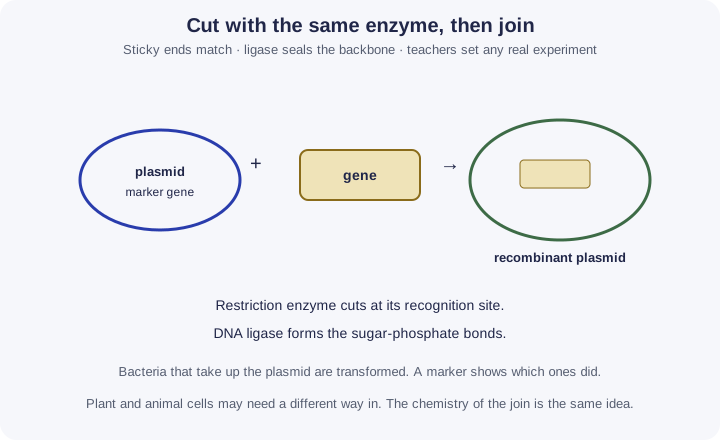
| Enzyme | What it does | What it does not do |
|---|---|---|
| Restriction endonuclease | Cuts at a recognition site | Does not copy the gene |
| DNA ligase | Seals the sugar-phosphate backbone | Does not decide which cells took up the DNA |
Make your reasoning visible
Build the explanation
X happens because Y, leading to Z. X: colonies grow on antibioticA substance that kills bacteria or stops them growing, without harming human cells. Antibiotics do not work on viruses. agar. Y: the plasmid carries a resistance marker and the cell took that plasmid up. Z: you have selected transformed cells, but you still need a second check if the question asks whether the donor geneA sequence of DNA bases that codes for a polypeptide or a functional RNA. is inside. Incomplete: “The antibiotic proves the human gene is being made.” Improved: “The marker reports the plasmid. A plasmid can reseal with no insert, so resistance is not expression of the donor gene.”
Same enzyme, matching ends
Say why one restriction endonucleaseAn enzyme that cuts DNA at a specific base sequence, often leaving sticky ends. is used on both the gene and the plasmid.
Marker is not the drug gene
The marker shows uptake. The inserted gene is the one you want expressed.
Avoid this misconception
The claim: Ligase cuts the plasmid and restriction enzymes join the gene in.
The correction: Restriction endonucleases cut. DNA ligaseAn enzyme that joins DNA fragments by forming phosphodiester bonds. joins by forming phosphodiester bondThe bond that links nucleotides: a phosphate group joins the sugar of one nucleotide to the sugar of the next.. The marker geneA gene, such as one for antibiotic resistance or fluorescence, used to identify cells that have taken up recombinant DNA. is what lets you find the transformed cells.
How do you put a gene into a plasmid?
A restriction endonuclease cuts DNA at a recognition sequence and leaves sticky ends. DNA ligase seals the joins. Cells that take up the plasmid are picked out with a marker gene.
What the model shows
A fictional plasmid and gene being cut, joined, sealed, put into bacteria and plated, with a close-up of the bases at one join.
What to look for
Whether the sticky ends are complementary, whether the backbone is sealed, and what the colonies on antibiotic agar really tell you.
What it tells us
Use the same enzyme for matching ends and ligase for the backbone. The marker shows that the plasmid was taken up, not that the gene is there.
Be careful what you claim
Fictional enzymes, numbers and plate.
Try it in the model: press Next through all five stages, then Second check.
Making recombinant DNA
Cut a plasmid and a gene, let the sticky ends pair, seal them with ligase, then put the plasmids into bacteria and select with the marker. The enzymes, batch and plate are fictional.
What you see
- A plasmid with an antibiotic-resistance marker gene and a gene of interest in donor DNA, taken through cutting, mixing, sealing, transformation and plating, with a base-by-base close-up of one join.
- A count of what a fictional batch of 100 plasmid molecules becomes and of the colonies on the plate.
How to use it
- Choose the enzyme for each piece of DNA, ligase on or off and the agar, then step through the stages. On the plate, run the second check.
What it shows
- One restriction endonuclease on both pieces gives complementary sticky ends that base-pair. DNA ligase forms the phosphodiester bonds (8.18).
- Competent cells take up the plasmid (transformation). A marker gene lets you select cells that took up a plasmid, but it does not show the insert (8.19).
Limits of the model
- The two enzymes are fictional names with real-style recognition sites. The batch, the 60% insert rate and the colony numbers are invented.
- The second check stands for any test of the insert; no method is named. Cutting the gene out also needs sites on both sides, and a real protocol has more steps.
Guided tour · step 1 of 10
- In Method, just below these steps, keep Cut the plasmid with and Cut the gene with on Enzyme A (G↓AATTC).
- Keep Stage on Cut (options: Cut, Mix, Seal, Transform, Plate) and look at the sticky ends in the simulator.
A restriction endonuclease cuts both strands at its recognition sequence, G↓AATTC. The staggered cut leaves sticky ends: short single-stranded overhangs (AATT). Cutting the gene and the plasmid with the same enzyme gives them matching ends.
Method
Questions
Check your understanding
Try each question before opening the suggested answer.
Practice question
Retrieval and explanation · suggested answer
Why cut the plasmid and the donor DNA with the same restriction enzyme?
Show suggested answer
They then have complementary sticky ends, so the gene can base-pair into the cut plasmid.
Practice question
Retrieval and explanation · suggested answer
What bond does DNA ligase form in recombinant DNA?
Show suggested answer
Phosphodiester bonds in the sugar-phosphate backbone, sealing the insert into the vector.
Practice question
Retrieval and explanation · suggested answer
Why are transformed bacteria grown on agar containing an antibiotic?
Show suggested answer
The plasmid carries a resistance marker. Only cells that took up the plasmid form colonies. Cells without it are killed or cannot grow.
Take the idea further
Apply the same specification knowledge to an unfamiliar problem. Any extra assumptions are supplied in the question.
Stretch question
A tube of competent bacteria is mixed with plasmids that were cut and ligated. After plating on antibiotic agar, colonies grow, but none of them produce the protein coded by the donor gene. Give two different explanations that still fit a successful marker. Assume the antibiotic matches the marker and the donor gene is not itself a resistance gene.
Show a hint
The marker only reports the plasmid. The insert is a separate question.
Explore the reasoning
The plasmid may have resealed with no insert, so the marker works but the donor gene is absent. Or the insert is present but in the wrong orientation, or the promoter does not drive it in this host, so the protein is not made. Antibiotic resistance does not prove the donor gene is expressed. The two explanations are teaching possibilities, not a failed class practical.
Recall this lesson
Lesson recall questions
Question 1 of 5: Name the enzymes that cut DNA at specific recognition sequences.
Making recombinant DNA
Practice question
Retrieval and explanation · suggested answer
Name the enzymes that cut DNA at specific recognition sequences.
Lesson: 8C 1: Producing Recombinant DNA
Try this from memory first.
Put your biology to work
Explore where these ideas appear in the world. Enrichment, not extra required recall.
The same idea made insulin
8C · Producing Recombinant DNAThe NHGRI glossary describes recombinant DNA technology as joining DNA segments, often from different species, and propagating them in bacterial or yeast cells. Its narration says the method…Specification 8.18Read & use the scienceClose article
Why this matters
The NHGRI glossary describes recombinant DNA technology as joining DNA segments, often from different species, and propagating them in bacterial or yeast cells. Its narration says the method has been used to make proteins for treating disease, including insulin and growth hormone. That is the link to the next lesson. This page does not give a dose or a brand protocol. 8.18 and 8.19: cut, join, and insert. Expression of the protein is what turns the method into a product.
Back to the specification
Pearson Edexcel IAL Biology · Issue 2, February 2021 · Unit 5, pp. 35–38. The application extends beyond required recall.
- 8.18 Restriction endonucleases and ligase in recombinant DNA.
Use the science
Why is “we grew bacteria on antibiotic agar” not yet evidence that human insulin was made?
Explore a possible response
The antibiotic only selects for the marker on the plasmid. Insulin is made only if the insulin gene is present, in a usable orientation, and is transcribed and translated.
Explore the source
- NHGRI: recombinant DNA technologyUS National Human Genome Research Institute
CRISPR is a different question from cut-and-join cloning
8C · Producing Recombinant DNANHGRI describes CRISPR as a technology adapted from bacterial systems to make targeted changes in living DNA. It appears often in headlines, but it is not the same…Specification 8.18Read & use the scienceClose article
Why this matters
NHGRI describes CRISPR as a technology adapted from bacterial systems to make targeted changes in living DNA. It appears often in headlines, but it is not the same operation as the 8.18 textbook method of cutting DNA with restriction endonucleases and joining fragments with ligase. Both involve enzymes and DNA specificity, yet their goals and steps differ. A news story about editing a gene in a cell should not be used as proof that a plasmid was assembled by the cut-and-join route. Students can compare the two methods without learning CRISPR’s molecular details for the Unit 5 exam.
Back to the specification
Pearson Edexcel IAL Biology · Issue 2, February 2021 · Unit 5, pp. 35–38. The application extends beyond required recall.
- 8.18 Restriction endonucleases and ligase in recombinant DNA.
Use the science
A headline says scientists edited a gene with CRISPR. Why does this not establish that they used DNA ligase to make a recombinant plasmid?
Explore a possible response
Editing DNA in a cell and assembling recombinant DNA are distinct workflows. The headline names one technology, not the specific restriction-and-ligation steps of a plasmid method.
Explore the source
- CRISPRUS National Human Genome Research Institute