
What you need to know
- 8.6(i)Synapse structure and function, including neurotransmitterA chemical released from a presynaptic neurone that diffuses across the synaptic cleft and binds to receptors on the next cell. and acetylcholineA neurotransmitter used at many synapses and at neuromuscular junctions..
- 8.6(ii)How the pupil dilates and constricts.
- 8.9habituationA reduced response to a repeated stimulus that is harmless. is a reduced response to a repeated harmless stimulus.
A recommended practical on habituation is included as a school idea, not a numbered core practical. Do not harm an animal. The pupil reflex is cranial, not the spinal arc of 8A 2. Not every synapse uses acetylcholine.
By the end, you should be able to…
- Order calcium entry, vesicle release, diffusionThe net movement of molecules from a region of higher concentration to a region of lower concentration. It is passive., receptor binding and breakdown.
- Explain pupil size using circular and radial muscles.
- Define habituation and separate it from fatigue.
Build your understanding
A chemical, one-way junction
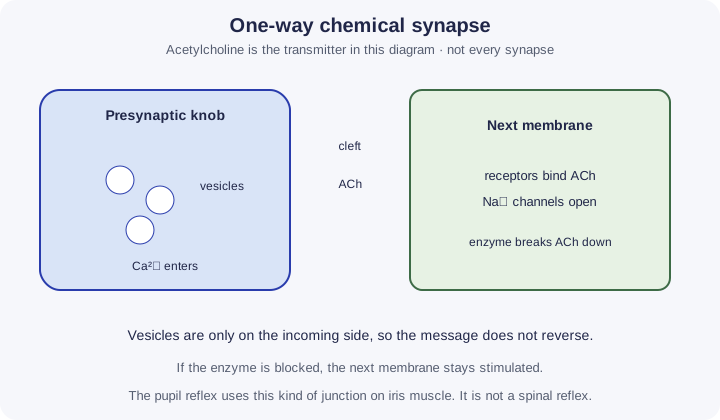
A synapse is a gap between a neurone and the next cell. When the impulse arrives at the presynaptic knob, voltage-gated calcium channels open and calcium ions enter. Vesicles move to the membrane and release acetylcholineA neurotransmitter used at many synapses and at neuromuscular junctions. into the cleft by exocytosisReleasing material from a cell when a vesicle fuses with the cell surface membrane. It uses ATP.. Acetylcholine diffuses across and binds receptors on the postsynaptic membrane.
The receptors open sodium channels. Sodium enters and the next membrane depolarises. If threshold is reached, that cell fires an action potentialA rapid reversal of the potential difference across a neurone membrane, caused by Na⁺ ions flowing in, then K⁺ ions flowing out. or, if it is a muscle, it contracts. Acetylcholinesterase in the cleft breaks acetylcholine into products that are not active. The products can be reabsorbed and used to make more transmitter. Breakdown stops the signal becoming permanent. Vesicles are only on the incoming side, so the synapse works in one direction.
The pupil is an antagonistic muscle pair
The iris has circular muscles and radial muscles. In bright light, circular muscles contract and the pupil constricts, so less light enters. In dim light, radial muscles contract and the pupil dilates, so more light enters. When one set contracts, the other relaxes. They are an antagonisticDescribes a pair of muscles that work in opposite directions: when one contracts, the other relaxes. pair, like flexorA muscle that bends a joint when it contracts. and extensorA muscle that straightens a joint when it contracts., but the effector is the iris.
These responses are reflexes coordinated through the brain, not through a spinal relay. Parasympathetic pathways are the usual teaching route for constriction, and sympathetic pathways for dilation. You should name the muscles and the stimulus. Do not call this grey matter of the spinal cord.
Habituation ignores a useless stimulus
habituationA reduced response to a repeated stimulus that is harmless. is a decrease in response when a harmless stimulus is repeated. The animal has not gone numb, and the muscle has not fatigued. At the synapse involved, less neurotransmitterA chemical released from a presynaptic neurone that diffuses across the synaptic cleft and binds to receptors on the next cell. is released for the same stimulus. A new, different stimulus can still produce a full response. That control shows the sensory path and the muscle still work.
Habituation ignores a useless stimulus (continued)
A recommended investigation, not a core practical, is to touch a snail’s tentacle gently and repeatedly, or to use another school method your teacher approves. Count how far the tentacle withdraws. Illustrative counts, not data to memorise: withdrawal scored 5, 4, 2, 1, 1 over five identical touches, then 5 again when a different part of the head is touched. The animal is not harmed, the stimulus stays mild, and the animal is returned. Do not invent a painful stimulus. Fatigue would reduce the response to the new touch as well. Habituation does not.
Follow the process
Cholinergic synapse: the impulse arrives → voltage-gated calcium channels open and calcium enters the knob → vesicles release acetylcholine by exocytosis → acetylcholine diffuses and binds receptors → sodium channels open on the next membrane → if threshold is reached, that cell fires or the muscle contracts → acetylcholinesterase breaks the transmitter down, so the signal stops, and the products can be reused. Vesicles are only on the incoming side, so the junction is one-way. Pupil, as a separate reflex: bright light → circular muscles contract → the pupil constricts. Dim light → radial muscles contract → the pupil dilates. Habituation is less transmitter released to a repeated harmless stimulus. A different stimulus should still work.
| Light | Muscle that contracts | Pupil |
|---|---|---|
| Bright | Circular | Constricts |
| Dim | Radial | Dilates |
Make your reasoning visible
Build the explanation
X happens because Y, leading to Z. X: the signal crosses only one way and then stops. Y: vesicles and calcium entry are on the presynaptic side, and acetylcholinesterase removes acetylcholineA neurotransmitter used at many synapses and at neuromuscular junctions. from the cleft. Z: the next cell is depolarised only while transmitter is bound, and the impulse cannot jump back. Incomplete: “The electricity jumps the gap.” Improved: “Calcium makes the knob release acetylcholine. The chemical binds the next membrane and opens sodium channels. The esterase then ends the signal.”
Calcium before the vesicle
No calcium entry, no release. Then name acetylcholine and the esterase.
New stimulus
In a habituationA reduced response to a repeated stimulus that is harmless. question, the control is a different stimulus that still works.
Avoid this misconception
The claim: Acetylcholine is an enzyme, and the pupil dilates because circular muscles contract.
The correction: Acetylcholine is the neurotransmitterA chemical released from a presynaptic neurone that diffuses across the synaptic cleft and binds to receptors on the next cell.. Acetylcholinesterase is the enzyme that breaks it down. Circular muscles constrict the pupil. Radial muscles dilate it.
How does a signal cross a gap that electricity cannot jump?
At a synapse the impulse stops. A chemical, acetylcholine, carries the signal across the cleft, and an enzyme removes it so the signal ends.
What the model shows
One cholinergic synapse in slow motion, with calcium, two drugs and an enzyme inhibitor, and a habituation investigation on a snail’s tentacle.
What to look for
What has to enter the knob before release. What the esterase does to the trace. How the response changes when the same touch is repeated, and when a new spot is touched.
What it tells us
Release needs Ca²⁺. Acetylcholine opens receptors and depolarises the next membrane; the esterase ends the signal. Habituation is less transmitter released to a repeated harmless stimulus.
Be careful what you claim
Amounts and timings are illustrative. Scores are a model scale, not real snail data, and no animal is harmed.
Try it in the model: press Send one impulse and watch the trace cross the threshold.
Across the synapse
An impulse arrives at a cholinergic synapse. Calcium ions trigger release of acetylcholine, which crosses the cleft and opens receptors on the next membrane until acetylcholinesterase breaks it down. Amounts and timings are illustrative model values.
What you see
- A cholinergic synapse: the presynaptic knob with vesicles and Ca²⁺ channels, the cleft with acetylcholinesterase, and receptors on the postsynaptic membrane.
- Orange dots are Ca²⁺ (faint in the tissue fluid, bright once inside the knob), small blue dots are acetylcholine, and green arrows are Na⁺ entering through open receptors.
- On the right, the postsynaptic membrane potential with the threshold and the impulses that arrived, and a table of habituation trials.
How to use it
- Send one impulse, or touch the tentacle (a burst of five impulses in the sensory neurone). The episode plays in slow motion.
- Change Calcium outside and the Drug, then send another impulse.
- Touch the tentacle repeatedly to see habituation, then touch a new spot. Rest lets the synapse recover.
What it shows
- The structure and function of a cholinergic synapse: Ca²⁺ entry, exocytosis, diffusion, receptor binding, Na⁺ entry and breakdown by acetylcholinesterase (8.6(i)).
- Habituation as less transmitter released to a repeated harmless stimulus, with a new stimulus as the control (8.9).
- How an agonist (nicotine) and an antagonist (cobra venom α-toxin) act at acetylcholine receptors (8.7, from 8A 4).
Limits of the model
- Timings and amounts are illustrative model values. The real breakdown of acetylcholine is faster than this slow-motion playback suggests.
- Withdrawal scores are the number of impulses that cross, out of five: an illustrative scale, not snail data.
- The AChE inhibitor is an extra comparison, not one of the drugs named in the specification. The pupil reflex (8.6(ii)) is in the lesson text, not this model.
- Not every synapse uses acetylcholine, and real postsynaptic cells sum inputs from many synapses.
Guided tour · step 1 of 11
- In Synapse, just below these steps, press Send one impulse.
- Follow it in the simulator: Ca²⁺ enters, vesicles fuse, acetylcholine crosses the cleft and binds to receptors.
The impulse opens voltage-gated calcium channels. Ca²⁺ entry makes vesicles release acetylcholine by exocytosis. It diffuses across and opens receptors, so Na⁺ enters and the next membrane depolarises.
Synapse
A touch is a burst of five impulses in the sensory neurone. Repeating the same harmless touch releases less acetylcholine each time (habituation). Rest lets the synapse recover. The playback is slowed down several hundred times around each impulse.
Questions
Final check: put it in order
What to do
- Reorder the cards below: drag a card (on a touch screen, drag its number), tap a card then tap where it goes, or use the ↑ and ↓ arrows at its right.
- Press Check under the cards to mark each one green (right place) or red; the count shows how many are right.
- Stuck? Hint first outlines the first wrong place, then gives a clue, then places that step for you.
- Shuffle mixes the cards again; Start again returns them to the starting order. Keyboard: Space picks up, arrow keys move, Space drops.
An action potential reaches a cholinergic synapse. Put the steps in order.
0 of 7 in the right place
Only excitatory, cholinergic transmission is shown. Several impulses may be needed to reach threshold (summation).
Check your understanding
Try each question before opening the suggested answer.
Check your understanding (continued)
Practice question
Retrieval and explanation · suggested answer
Why does calcium enter the presynaptic knob, and what does it cause?
Show suggested answer
The arriving impulse opens calcium channels. Calcium entry causes vesicles to release acetylcholine into the cleft.
Practice question
Retrieval and explanation · suggested answer
Why does the signal stop after a short time?
Show suggested answer
Acetylcholinesterase breaks acetylcholine down, so it no longer binds the receptors.
Practice question
Retrieval and explanation · suggested answer
Which iris muscles contract in bright light, and what happens to the pupil?
Show suggested answer
Circular muscles contract and the pupil constricts.
Practice question
Retrieval and explanation · suggested answer
Define habituation.
Show suggested answer
A reduced response to a repeated harmless stimulus, without the sense organ or the muscle having failed.
Take the idea further
Apply the same specification knowledge to an unfamiliar problem. Any extra assumptions are supplied in the question.
Stretch question
Illustrative snail scores fall from 5 to 1 over five gentle touches of one tentacle. A sixth touch on the other tentacle scores 5. A student says the muscle tired. Why is that a weak conclusion? What synaptic change fits 8.9? Assume the animal was not hurt.
Show a hint
The new touch still works.
Explore the reasoning
A tired muscle would respond poorly to the new touch as well. The full response on the other tentacle shows the muscle and much of the nervous system still work. Habituation fits: at the synapses used by the repeated stimulus, less neurotransmitter is released. The scores are invented.
Recall this lesson
Lesson recall questions
Question 1 of 5: Explain, in causal order, why calcium ions are required for synaptic transmission.
Synapses and the pupil
Practice question
Retrieval and explanation · suggested answer
Explain, in causal order, why calcium ions are required for synaptic transmission.
Lesson: 8A 6: Synapses and Habituation
Build the sequence from memory first. Then reveal the model order.
Tap the steps in the order you recall. Tap a placed step to send it back.
- 01Next step
- 02Waiting
- 03Waiting
Tap to place
Put your biology to work
Explore where these ideas appear in the world. Enrichment, not extra required recall.
The eye page names detection, not the iris muscles
8A · Synapses and HabituationThe National Eye Institute describes photoreceptors creating electrical signals from light. Brightness is the stimulus for the pupil reflex as well as for rods. The page does not…Specification 8.6(ii)Read & use the scienceClose article
Why this matters
The National Eye Institute describes photoreceptors creating electrical signals from light. Brightness is the stimulus for the pupil reflex as well as for rods. The page does not describe circular and radial muscles or acetylcholine. Those belong to 8.6. 8.6 and 8.9: synaptic transmission, pupil size, and habituation. A behaviour or symptom is the output of a pathway, not a direct recording of ion movement in one axon or synapse.
Back to the specification
Pearson Edexcel IAL Biology · Issue 2, February 2021 · Unit 5, pp. 35–38. The application extends beyond required recall.
- 8.6(ii) Pupil dilation and constriction.
Use the science
Why is “the retina is the muscle that constricts the pupil” incorrect?
Explore a possible response
The retina detects light. The effectors are the iris muscles. Neurones and synapses join the two. A photoreceptor is not the muscle.
Explore the source
- National Eye Institute: how the eyes workUS National Eye Institute
A sea slug taught neuroscientists about habituation
8A · Synapses and HabituationEric Kandel’s Nobel account describes work with the sea slug Aplysia. Repeated harmless touch to its gill-withdrawal system could lead to a weaker response: habituation. The research linked…Specification 8.9Read & use the scienceClose article
Why this matters
Eric Kandel’s Nobel account describes work with the sea slug Aplysia. Repeated harmless touch to its gill-withdrawal system could lead to a weaker response: habituation. The research linked this behavioural change to altered effectiveness at specific synapses. That is a more precise idea than “the animal got bored”, because the stimulus still arrives but the pathway responds differently. The Aplysia model is an enrichment example, not proof that all human learning is one synapse. It also helps separate habituation from sensory adaptation: in habituation, the nervous system changes its response to a repeated, non-threatening input.
Back to the specification
Pearson Edexcel IAL Biology · Issue 2, February 2021 · Unit 5, pp. 35–38. The application extends beyond required recall.
- 8.9 Habituation to a repeated stimulus.
Use the science
If the sensory receptor still responds to each touch but the gill withdraws less, why is a changed synapse a plausible explanation?
Explore a possible response
The input is still detected, so a weaker output may arise where the sensory signal is passed to the next neurone or motor pathway. The conclusion needs pathway evidence, not behaviour alone.
Explore the source
- Eric Kandel: research on Aplysia habituationNobel Prize Outreach