
What you need to know
- 7.9Muscles, tendonTough, inelastic connective tissue that attaches a muscle to a bone., the skeleton and ligamentStrong connective tissue that joins bone to bone at a joint. interact to produce movement, including antagonisticDescribes a pair of muscles that work in opposite directions: when one contracts, the other relaxes. pairs, extensors and flexors.
Fibre structure and the sliding filament mechanism are later 7B lessons. Clinical words such as sprain are not extra required recall. The elbow is the standard example, not the only joint in the body.
By the end, you should be able to…
- State what a tendon and a ligament connect.
- Explain why muscles must work as an antagonistic pair.
- Name a flexorA muscle that bends a joint when it contracts. and an extensorA muscle that straightens a joint when it contracts. at the elbow.
Build your understanding
Four structures, four jobs
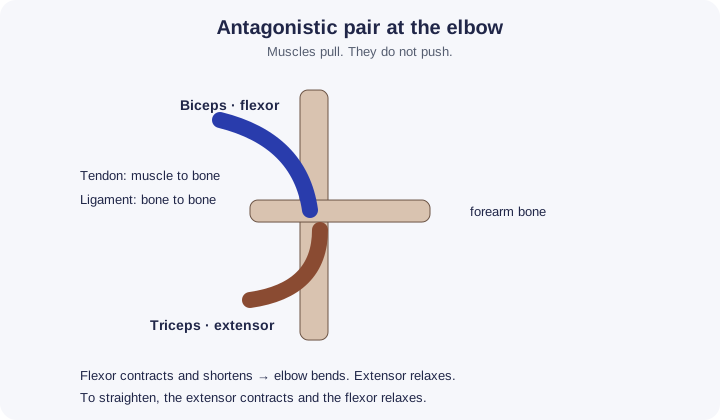
The skeleton is a set of rigid levers and the points where muscles attach. A skeletal muscle crosses a joint and pulls on a bone. A tendonTough, inelastic connective tissue that attaches a muscle to a bone. attaches muscle to bone and transmits that pull. A ligamentStrong connective tissue that joins bone to bone at a joint. attaches bone to bone and holds the joint together while still allowing the intended movement. Swap tendon and ligament and the sentence is wrong.
Muscle tissue shortens when it contracts. It does not lengthen itself to push a bone back. Something else must pull the other way. That is why movement at a hinge joint uses a pair.
Antagonistic pairs
antagonisticDescribes a pair of muscles that work in opposite directions: when one contracts, the other relaxes. muscles produce opposite movements at the same joint. At the elbow, the biceps brachii is the flexorA muscle that bends a joint when it contracts.: when it contracts, the elbow bends. The triceps brachii is the extensorA muscle that straightens a joint when it contracts.: when it contracts, the elbow straightens. While one contracts, the other relaxes so it can be stretched.
Flexion decreases the angle at the joint. Extension increases it. The skeleton supplies the fulcrum at the joint and the rigid bars. Without the rigid bone, contraction would bunch the limb instead of moving a lever. Without the opposing muscle, the joint could be pulled one way and not returned by muscle.
What an injury leaflet is not
A sprain is damage to a ligament. A strain is damage to a muscle. Those clinical words are not the specification list. In an exam, write tendon, ligament, flexor and extensor, and say which structures they join or which movement they cause.
This page is about the arrangement of tissues. It is not yet the sliding of actinThe protein of the thin filaments in muscle. Myosin heads bind to it. and myosinThe protein of the thick filaments in muscle. Its heads bind to actin and pull it, using ATP., and it is not cardiac muscle.
| Structure | Joins | Role in movement |
|---|---|---|
| Skeletal muscle | Across a joint, via tendons | Pulls a bone when it contracts |
| Tendon | Muscle to bone | Transmits the pull |
| Ligament | Bone to bone | Stabilises the joint |
| Skeleton | Bone to bone at joints | Lever and attachment |
Make your reasoning visible
Pull, then the partner
Name which muscle contracts and which relaxes for the movement in the question.
Tendon versus ligament
tendonTough, inelastic connective tissue that attaches a muscle to a bone.: muscle to bone. ligamentStrong connective tissue that joins bone to bone at a joint.: bone to bone.
Avoid this misconception
The claim: The biceps contracts to bend the elbow and contracts again to straighten it.
The correction: The biceps is the flexorA muscle that bends a joint when it contracts.. The triceps, the extensorA muscle that straightens a joint when it contracts., contracts to straighten the elbow while the biceps relaxes. Muscles do not push.
Check your understanding
Try each question before opening the suggested answer.
Practice question
Retrieval and explanation · suggested answer
What does a tendon connect, and what does a ligament connect?
Show suggested answer
A tendon connects muscle to bone. A ligament connects bone to bone.
Practice question
Retrieval and explanation · suggested answer
Why are two muscles needed at the elbow?
Show suggested answer
A muscle can only pull. The biceps flexes the joint and the triceps extends it. They are an antagonistic pair.
Practice question
Retrieval and explanation · suggested answer
During flexion, what happens to the extensor?
Show suggested answer
It relaxes and is stretched while the flexor contracts.
Take the idea further
Apply the same specification knowledge to an unfamiliar problem. Any extra assumptions are supplied in the question.
Stretch question
A hinge joint is described, but the species is not human and the muscle names are not biceps and triceps. The question says muscle P contracts to decrease the joint angle and muscle Q contracts to increase it. Identify the flexor and the extensor, and state what the tendon of P must be attached to.
Show a hint
Use the angle, not the famous names.
Explore the reasoning
P is the flexor because it decreases the angle. Q is the extensor. The tendon of P attaches that muscle to a bone so the pull moves the lever. Ligaments would be bone to bone and would not be the pulling cable.
Recall this lesson
Lesson recall questions
Question 1 of 5: Compare a flexor with an extensor at a hinge joint.
Muscles, tendons, ligaments, skeleton
Practice question
Retrieval and explanation · suggested answer
Compare a flexor with an extensor at a hinge joint.
Lesson: 7B 1: Tissues of the Skeletal System
Try this from memory first.
Put your biology to work
Explore where these ideas appear in the world. Enrichment, not extra required recall.
Sprain and strain are not the specification pair
7B · Tissues of the Skeletal SystemThe NHS distinguishes a sprain as a damaged ligament from a strain as a damaged muscle. That is clinical language for injuries. It does not replace 7.9. You…Specification 7.9Read & use the scienceClose article
Why this matters
The NHS distinguishes a sprain as a damaged ligament from a strain as a damaged muscle. That is clinical language for injuries. It does not replace 7.9. You still have to say how intact muscles, tendons, ligaments and bones produce movement. 7.9: tendons link muscle to bone, ligaments link bone to bone, and antagonistic muscles move the joint in opposite directions. An injury, symptom or whole-body performance result is not a direct image of a sarcomere or cardiac conduction pathway.
Back to the specification
Pearson Edexcel IAL Biology · Issue 2, February 2021 · Unit 5, pp. 35–38. The application extends beyond required recall.
- 7.9 Muscles, tendons, bones and ligaments in movement.
Use the science
Why is “a sprain means the flexor failed” a mix-up?
Explore a possible response
A sprain, on the NHS page, is a ligament injury. A flexor is a muscle that decreases the joint angle. Different structures.
Explore the source
A prosthetic joint still needs opposing pulls
7B · Tissues of the Skeletal SystemEngineers working on a prosthetic limb have tried to preserve an agonist–antagonist muscle pair, so the wearer can move a joint in both directions and receive position feedback.…Specification 7.9Read & use the scienceClose article
Why this matters
Engineers working on a prosthetic limb have tried to preserve an agonist–antagonist muscle pair, so the wearer can move a joint in both directions and receive position feedback. The research paper starts from the same mechanical fact as 7.9: a muscle pulls when it contracts; it cannot actively push the joint back. In a natural limb, tendons transfer those pulls to bones and ligaments help stabilise the joint. A prosthesis changes the hardware but still needs a way to control opposing actions. This is a design problem, not evidence that an artificial joint has all the properties of a biological one.
Back to the specification
Pearson Edexcel IAL Biology · Issue 2, February 2021 · Unit 5, pp. 35–38. The application extends beyond required recall.
- 7.9 Muscles, tendons, bones and ligaments in movement.
Use the science
Why would linking only one contracting muscle to a bidirectional prosthetic joint make control difficult?
Explore a possible response
One muscle can pull in one direction. Opposing movement needs another active force or a mechanical return, and without the paired muscle feedback, position control is poorer.
Explore the source
- The agonist–antagonist myoneural interfacePeer-reviewed research via NIH PubMed Central