
What you need to know
- 5.4(i)carbon fixationCombining CO₂ with RuBP, catalysed by RUBISCO, to form two molecules of GP. in the Calvin cycleThe cycle of light-independent reactions: CO₂ is fixed by RuBP to make GP, GP is reduced to GALP, and RuBP is regenerated..
- 5.7chromatographyA method that separates the substances in a mixture by how far each moves with a solvent. as a way of separating photosynthetic molecules.
Historical method is enrichment. Required names remain GP, GALP, RuBP and RUBISCO.
By the end, you should be able to…
- Explain why a short labelling time was needed to catch early intermediates.
- Link chromatography to identifying those intermediates.
- Separate the prize-winning method from extra names you need not learn.
Build your understanding
Catch the first organic molecule
If you wait minutes after feeding labelled carbon dioxide, 14C is already scattered through many sugars. Calvin’s group used unicellular algae and stopped the reactions after a few seconds so the first labelled compounds could still be seen. The earliest stable labelled product was a three-carbon acid, now taught as GP.
That timing argument still matters. A cycle can hide its order if you only look at the end-point, glucoseA hexose (six-carbon) monosaccharide, C₆H₁₂O₆. It is the main respiratory substrate.. The specification still wants the named steps, not a list of every historical intermediate.
Chromatography as a research tool
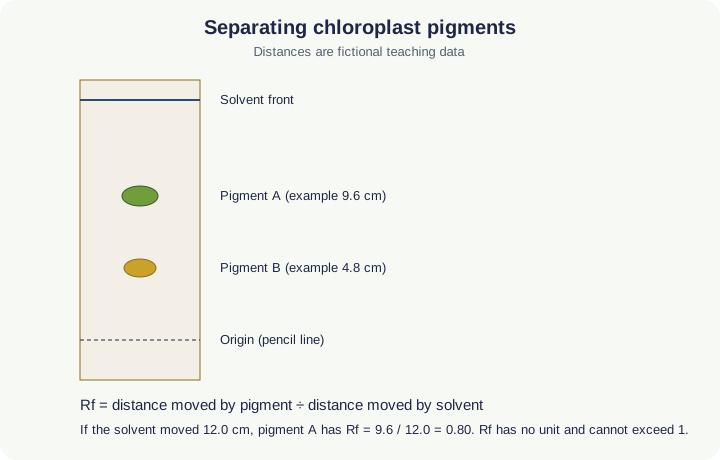
The labelled extracts were separated by chromatographyA method that separates the substances in a mixture by how far each moves with a solvent., then radioactivity was located on the paper. Molecules that had taken up 14C appeared as spots. School Rf work on leaf pigments is a simpler version of the same idea: dissolve, separate, identify. You are not repeating Calvin’s solventA liquid in which other substances (solutes) dissolve. Water is a good solvent for ions and polar molecules. systems, and you must not treat a leaf-pigment chromatogram as a Calvin-cycle map.
The Nobel account emphasises isotopes and chromatography as the tools. Enrichment ends there. RUBISCOThe enzyme that catalyses carbon fixation, joining CO₂ to RuBP., RuBPRibulose bisphosphate: the five-carbon compound that accepts CO₂ in the Calvin cycle., GP and GALPGlyceraldehyde 3-phosphate: a three-carbon sugar made by reducing GP. It is used to make glucose and other organic molecules and to regenerate RuBP. remain the required language of 5.4.
Make your reasoning visible
Method, then molecule
“They used 14C” is incomplete until you say it showed which carbon compounds formed first.
Do not inflate the syllabus
Extra cycle intermediates from a research paper are not automatic 5.4 content.
Avoid this misconception
The claim: Calvin discovered photosynthesis.
The correction: Photosynthesis was already known. The work mapped the path of carbon from carbon dioxide into organic molecules.
Check your understanding
Try each question before opening the suggested answer.
Practice question
Retrieval and explanation · suggested answer
Why would a long labelling time fail to identify GP as an early product?
Show suggested answer
Carbon would already have moved through later sugars, so many spots would be labelled and the first product would be hidden.
Practice question
Retrieval and explanation · suggested answer
How is school pigment chromatography similar to, and different from, Calvin’s separations?
Show suggested answer
Similar: a mixture is dissolved and separated on a stationary phase. Different: school work identifies coloured pigments by Rf; Calvin tracked radioactive carbon compounds that need not be coloured.
Practice question
Retrieval and explanation · suggested answer
Which specification names still have to appear in a 5.4 answer after reading this page?
Show suggested answer
GP, GALP, RuBP and RUBISCO, plus ATP and reduced NADP as the reducing and energy supply from the light-dependent stage.
Take the idea further
Apply the same specification knowledge to an unfamiliar problem. Any extra assumptions are supplied in the question.
Stretch question
A student argues that because chromatography separated pigments in 5.7, the Calvin cycle intermediates must also be pigments. Correct the reasoning.
Show a hint
Chromatography separates by solubility and adsorption, not by colour alone.
Explore the reasoning
Chromatography separates many kinds of molecule. Pigments are visible; GP and GALP are not green. Radioactive label, not colour, located Calvin’s spots. 5.7 and 5.4 share a technique, not a chemical class.
Recall this lesson
Lesson recall questions
Question 1 of 5: List the four named Calvin-cycle substances this specification point requires.
Light-independent reactions and the Calvin cycle
Practice question
Retrieval and explanation · suggested answer
List the four named Calvin-cycle substances this specification point requires.
Lesson: 5A 3: The Biochemistry of Photosynthesis
Try this from memory first.
Put your biology to work
Explore where these ideas appear in the world. Enrichment, not extra required recall.
The prize citation, in context
5A · Thinking BiggerThe Nobel Foundation summarises Calvin’s work as tracing the path of carbon through photosynthesis in algae with radioactive isotopes and chromatography, including the role of phosphorylated compounds. That…Specification 5.4(i)Read & use the scienceClose article
Why this matters
The Nobel Foundation summarises Calvin’s work as tracing the path of carbon through photosynthesis in algae with radioactive isotopes and chromatography, including the role of phosphorylated compounds. That is a primary-source description of the research. It is not a mark scheme, and it does not replace GP and GALP. The historical method matters because a radioactive label follows atoms rather than showing an enzyme at work directly. A student should distinguish the observed pattern of labelled spots from the inferred sequence of carbon-fixation reactions.
Back to the specification
Pearson Edexcel IAL Biology · Issue 2, February 2021 · Unit 4, pp. 29–32. The application extends beyond required recall.
- 5.4(i) understand the light-independent reactions as reduction of carbon dioxide using the products of the light-dependent reactions (carbon fixation in the Calvin cycle, the role of GP, GALP, RuBP and RUBISCO)
Use the science
Why is “phosphorylated compounds” in the prize text a hint rather than a new specification list?
Explore a possible response
ATP, GP and GALP are phosphorylated, which is already inside 5.2 and 5.4. Extra named phosphates from the 1950s papers remain enrichment unless a question gives them.
Explore the source
- Nobel Prize in Chemistry 1961: Melvin CalvinNobel Prize Outreach
A pigment fingerprint from space
5A · Chloroplasts and ChlorophyllNASA’s PACE Ocean Color Instrument measures many narrow bands of light reflected from the ocean. Scientists use the pattern, alongside ship measurements, to distinguish groups of phytoplankton that…Specification 5.7Read & use the scienceClose article
Why this matters
NASA’s PACE Ocean Color Instrument measures many narrow bands of light reflected from the ocean. Scientists use the pattern, alongside ship measurements, to distinguish groups of phytoplankton that would all look like a green patch in a simple image. This is a career-scale extension of absorption spectra: different pigments change the wavelengths detected. It is not paper chromatography, because the organisms have not been separated on a strip and no Rf value is measured. Nor is it an action spectrum, because the instrument does not directly measure photosynthetic rate at each wavelength.
Back to the specification
Pearson Edexcel IAL Biology · Issue 2, February 2021 · Unit 4, pp. 29–32. The application extends beyond required recall.
- 5.7 understand that chloroplast pigments can be separated using chromatography and the pigments identified using Rf values
Use the science
Why should an ocean-colour scientist compare the satellite signal with water samples before naming a phytoplankton group?
Explore a possible response
Water, sediments and dissolved material can also alter reflected light. Samples help calibrate and test the inferred pigment pattern.