
What you need to know
- 5.1–5.2Overall reaction and ATPAdenosine triphosphate: the molecule that releases energy for cell processes when it is hydrolysed to ADP and Pi. couple.
- 5.3–5.4Light-dependent and light-independent biochemistry.
- 5.5–5.7chloroplastThe organelle where photosynthesis takes place. It contains thylakoids and stroma. structure, spectra and Rf.
Core Practical 10 has its own method page.
By the end, you should be able to…
- Choose the correct stage and organelleA structure inside a cell with a particular function, such as a mitochondrion or ribosome. compartment.
- Use specification names without mixing spectra.
- Calculate Rf and interpret a limiting-factor sentence without inventing data.
Build your understanding
Place the process
If the question is photolysisThe splitting of water using light energy, giving H⁺ ions, electrons and O₂. or photophosphorylationMaking ATP from ADP and Pi using energy from light., you are on the thylakoidA flattened membrane sac in a chloroplast, where the light-dependent reactions take place. membrane. If it is RUBISCOThe enzyme that catalyses carbon fixation, joining CO₂ to RuBP. or RuBPRibulose bisphosphate: the five-carbon compound that accepts CO₂ in the Calvin cycle., you are in the stromaThe fluid inside a chloroplast, where the light-independent reactions take place.. If it is Rf, you are looking at a chromatogram, not a spectrum. If it is immediate energy, hydrolyse ATPAdenosine triphosphate: the molecule that releases energy for cell processes when it is hydrolysed to ADP and Pi.; if it is rebuilding ATP with light, say photophosphorylation.
Keep oxygen attached to photolysis of water. Keep hydrogen’s destination as glucoseA hexose (six-carbon) monosaccharide, C₆H₁₂O₆. It is the main respiratory substrate. via the Calvin cycleThe cycle of light-independent reactions: CO₂ is fixed by RuBP to make GP, GP is reduced to GALP, and RuBP is regenerated., not as “energy”. All questions below are original.
Show the comparison
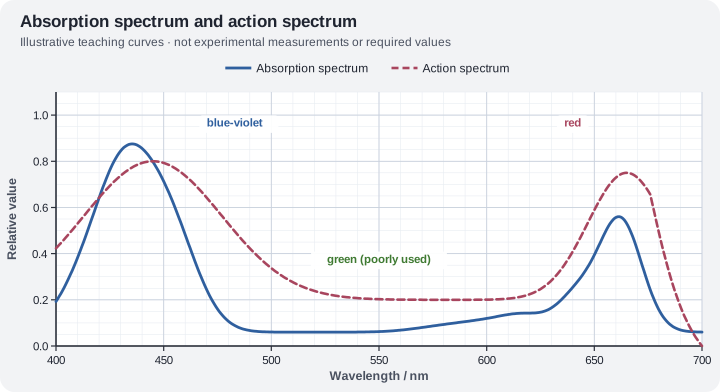
Cyclic versus non-cyclic is a products table: ATP in both; reduced NADPNADP that has accepted hydrogen in the light-dependent reactions. It supplies the hydrogen to reduce GP to GALP. and oxygen only in non-cyclic. Absorption versus action is a definition pair. Do not award yourself a spectrum by describing a chromatogram.
Make your reasoning visible
Quote 5.1 in 5.1 questions
Split water, store hydrogen in fuel with carbon dioxide, release oxygen.
Both reducing power and ATP
GP to GALP needs reduced NADPNADP that has accepted hydrogen in the light-dependent reactions. It supplies the hydrogen to reduce GP to GALP. and ATPAdenosine triphosphate: the molecule that releases energy for cell processes when it is hydrolysed to ADP and Pi..
Avoid this misconception
The claim: The action spectrum is a chromatogram of chlorophyll.
The correction: An action spectrum plots rate against wavelength. A chromatogram separates pigments in space so Rf can be calculated.
Check your understanding
Try each question before opening the suggested answer.
Check your understanding (continued)
Check your understanding (continued)
Practice question
Retrieval and explanation · suggested answer
Why must photophosphorylation of ADP require energy?
Show suggested answer
ADP + Pi → ATP is the reverse of hydrolysis. An energy input, from light in photosynthesis, is needed to form ATP.
Practice question
Retrieval and explanation · suggested answer
State where in the chloroplast ATP and reduced NADP are made, and where they are used.
Show suggested answer
Made on thylakoid membranes in the light-dependent reactions; used in the stroma in the Calvin cycle.
Practice question
Retrieval and explanation · suggested answer
Explain the advantage of stacked thylakoids.
Show suggested answer
A large membrane area in a small volume holds more pigment and electron-transport machinery, increasing the capacity for light capture and photophosphorylation.
Practice question
Retrieval and explanation · suggested answer
A solvent front travels 80 mm. A yellow pigment travels 68 mm. Calculate Rf.
Show suggested answer
Rf = 68 / 80 = 0.85.
Practice question
Retrieval and explanation · suggested answer
Why can two pigments from one chloroplast have different Rf values?
Show suggested answer
They differ in solubility in the solvent and in adsorption to the paper, so they travel different distances from the origin.
Practice question
Retrieval and explanation · suggested answer
Describe non-cyclic photophosphorylation, including the source of replacement electrons.
Show suggested answer
Light excites chlorophyll electrons; they pass along carriers from photosystem II to I, generating ATP and reducing NADP. Photolysis of water replaces electrons in photosystem II and releases oxygen.
Practice question
Retrieval and explanation · suggested answer
Outline the roles of RuBP and RUBISCO.
Show suggested answer
RuBP is the five-carbon carbon-dioxide acceptor. RUBISCO catalyses the fixation of carbon dioxide to RuBP, producing GP.
Practice question
Retrieval and explanation · suggested answer
Give two uses of the sugars made from GALP.
Show suggested answer
Respiration, and synthesis of polysaccharides, amino acids, proteins, lipids or nucleic acids.
Take the idea further
Apply the same specification knowledge to an unfamiliar problem. Any extra assumptions are supplied in the question.
Stretch question
Isolated thylakoids are given ADP, Pi, NADP and light, but no carbon dioxide and no stroma enzymes. Which products still form, and which cannot? Assume membranes remain intact.
Show a hint
Separate the two stages.
Explore the reasoning
ATP, reduced NADP and oxygen can still form because they come from the light-dependent reactions. GP, GALP, RuBP regeneration and sugars cannot, because carbon fixation needs carbon dioxide and the stromal Calvin-cycle enzymes, including RUBISCO.
Recall this lesson
Lesson recall questions
Question 1 of 5: Describe, in order, how a photosynthetic cell can both make and then use ATP.
ATP: photophosphorylation and hydrolysis
Practice question
Retrieval and explanation · suggested answer
Describe, in order, how a photosynthetic cell can both make and then use ATP.
Lesson: 5A 1: The Importance of ATP
Build the sequence from memory first. Then reveal the model order.
Tap the steps in the order you recall. Tap a placed step to send it back.
- 01Next step
- 02Waiting
- 03Waiting
Tap to place
Put your biology to work
Explore where these ideas appear in the world. Enrichment, not extra required recall.
Why a green ocean patch is not a chromatogram
5A · Exam PracticeNASA’s PACE mission continues chlorophyll-a measurements in surface seawater as a proxy for phytoplankton. Those maps rest on how pigments absorb and scatter light — the same optical…Specification 5.6Read & use the scienceClose article
Why this matters
NASA’s PACE mission continues chlorophyll-a measurements in surface seawater as a proxy for phytoplankton. Those maps rest on how pigments absorb and scatter light — the same optical idea as an absorption spectrum — but they do not separate pigments on paper or measure Rf. Treat the satellite numbers as enrichment, not a 5.7 data set. PACE colour products also need calibration against water samples. A colourful map is a representation of measurements and a model, not a direct photograph of ATP formation inside each phytoplankton cell.
Back to the specification
Pearson Edexcel IAL Biology · Issue 2, February 2021 · Unit 4, pp. 29–32. The application extends beyond required recall.
- 5.6 understand what is meant by the terms absorption spectrum and action spectrum
Use the science
If a satellite chlorophyll map is high, can you conclude that non-cyclic photophosphorylation is faster than cyclic?
Explore a possible response
No. The map estimates pigment. It does not resolve cyclic versus non-cyclic electron flow, ATP, reduced NADP or oxygen output.
Explore the source
A pigment fingerprint from space
5A · Chloroplasts and ChlorophyllNASA’s PACE Ocean Color Instrument measures many narrow bands of light reflected from the ocean. Scientists use the pattern, alongside ship measurements, to distinguish groups of phytoplankton that…Specification 5.6Read & use the scienceClose article
Why this matters
NASA’s PACE Ocean Color Instrument measures many narrow bands of light reflected from the ocean. Scientists use the pattern, alongside ship measurements, to distinguish groups of phytoplankton that would all look like a green patch in a simple image. This is a career-scale extension of absorption spectra: different pigments change the wavelengths detected. It is not paper chromatography, because the organisms have not been separated on a strip and no Rf value is measured. Nor is it an action spectrum, because the instrument does not directly measure photosynthetic rate at each wavelength.
Back to the specification
Pearson Edexcel IAL Biology · Issue 2, February 2021 · Unit 4, pp. 29–32. The application extends beyond required recall.
- 5.6 understand what is meant by the terms absorption spectrum and action spectrum
Use the science
Why should an ocean-colour scientist compare the satellite signal with water samples before naming a phytoplankton group?
Explore a possible response
Water, sediments and dissolved material can also alter reflected light. Samples help calibrate and test the inferred pigment pattern.
Explore the source
Can sunlight be turned into a stored fuel?
5A · The Importance of ATPThe US Department of Energy studies solar fuels made with light, water and carbon dioxide. That ambition is inspired by photosynthesis, but an artificial device is not a…Specification 5.1 · 5.2Read & use the scienceClose article
Why this matters
The US Department of Energy studies solar fuels made with light, water and carbon dioxide. That ambition is inspired by photosynthesis, but an artificial device is not a chloroplast and it need not make glucose. The difficult step is storing intermittent light energy in chemical bonds rather than merely collecting electricity while the sun shines. In a leaf, light-driven reactions help form ATP and reduced NADP; the Calvin cycle then uses their energy and reducing power to fix carbon dioxide. Comparing the two systems reveals why an energy input is necessary before a stable fuel can be made.
Back to the specification
Pearson Edexcel IAL Biology · Issue 2, February 2021 · Unit 4, pp. 29–32. The application extends beyond required recall.
- 5.1 understand the overall reaction of photosynthesis as requiring energy from light to split apart the strong bonds in water molecules, storing the hydrogen in a fuel (glucose) by combining it with carbon dioxide and releasing oxygen into the atmosphere
- 5.2 understand how photophosphorylation of ADP requires energy and that hydrolysis of ATP provides an immediate supply of energy for biological processes
Use the science
If a device splits water in sunlight but never reduces carbon dioxide, which important part of the overall photosynthesis comparison is missing?
Explore a possible response
It has harvested light and may release oxygen, but it has not fixed carbon dioxide into an organic fuel. Water splitting alone is not the full photosynthesis reaction.
Explore the source
- DOE Explains: Solar FuelsUS Department of Energy