
What you need to know
- 4.1(i–ii)chloroplastThe organelle where photosynthesis takes place. It contains thylakoids and stroma., amyloplast, vacuoleA fluid-filled sac. In plant cells, the large permanent vacuole contains cell sap and keeps the cell turgid. and tonoplastThe membrane around the vacuole in a plant cell.: structure, function and comparison with animal cells.
- 4.2Recognise the organelleA structure inside a cell with a particular function, such as a mitochondrion or ribosome. in 4.1 from electron microscope images.
Nucleus, mitochondria, ER and Golgi were covered in 3A. This lesson adds the plant-specific structures in 4.1. Photosynthetic biochemistry is Topic 5, not required recall here.
By the end, you should be able to…
- Describe chloroplasts, amyloplasts, the vacuole and the tonoplast.
- Compare a plant cell with a typical animal cell using 4.1 structures.
- Use visible EM evidence rather than colour or the word “plant-like”.
Build your understanding
Plastids that store or photosynthesise
chloroplastThe organelle where photosynthesis takes place. It contains thylakoids and stroma. are double-membrane organelleA structure inside a cell with a particular function, such as a mitochondrion or ribosome. containing thylakoidA flattened membrane sac in a chloroplast, where the light-dependent reactions take place., often stacked, and a stromaThe fluid inside a chloroplast, where the light-independent reactions take place.. They are the site of photosynthesisThe process in which plants use light energy to make glucose from carbon dioxide and water, releasing oxygen. in green tissues. starchThe storage polysaccharide in plants, made of amylose and amylopectin. It is compact and insoluble, so it does not affect water potential. grains can appear inside chloroplasts, but a chloroplast is identified by its thylakoid system, not by starch alone.
Amyloplasts are colourless plastids specialised for starch storage. They lack the photosynthetic thylakoid apparatus of a chloroplast. Finding starch does not automatically identify every plastid: check whether photosynthetic membranes are present. Both plastids are bounded by membranes; neither is a vacuoleA fluid-filled sac. In plant cells, the large permanent vacuole contains cell sap and keeps the cell turgid..
The vacuole and its membrane
A mature plant cell typically has a large permanent vacuole. The tonoplastThe membrane around the vacuole in a plant cell. is the membrane around it. The vacuole can store water, ions, sugars and waste, and its contents contribute to turgorThe pressure of a plant cell’s contents pushing outwards against the cell wall. as water enters the protoplast. Shrinking the vacuole as water leaves reduces turgor and can plasmolyse the cell if the protoplast pulls from the wall.
Animal cells may have small vesicles, but not this large, permanent, tonoplast-bound vacuole. Do not call the vacuole “empty space”: it is a compartment with a solution, separated from the cytosol by a selective membrane.
Reading an electron micrograph
Specification 4.2 requires recognition from EM images. TEM sections are greyscale. Identify a chloroplast by stacked internal membranes inside a double envelopeAn outer covering membrane. The nucleus and chloroplasts have a double-membrane envelope; some viruses, such as HIV, have a lipid envelope taken from the host cell.; an amyloplast by starch inclusions without that thylakoid system; a vacuole as a large, often pale compartment bounded by a single membrane (the tonoplast); the wall as a thick extracellular layer, sometimes with a middle lamellaThe layer of pectin, mainly calcium pectate, that sticks neighbouring plant cell walls together. and pit fields.
A structure missing from one thin section is not proof it is absent from the cell. Colour in published images is usually added. Scale bars give size; “it looks like a plant cell” is not evidence.
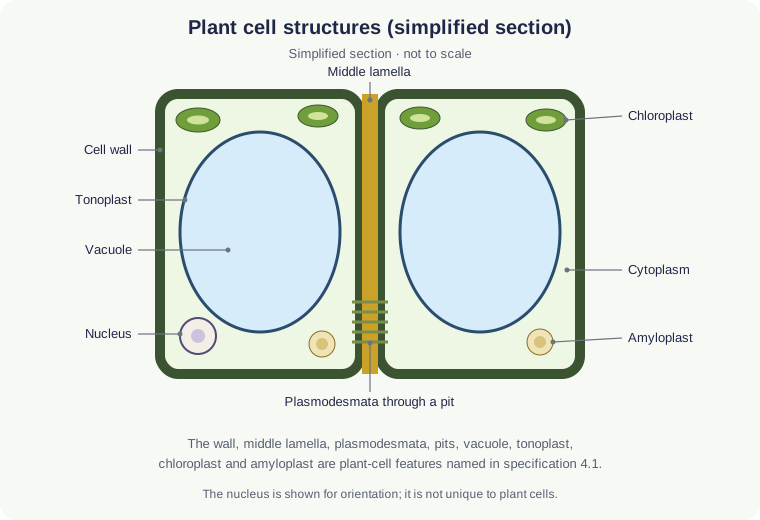
| Structure | Function in the plant cell | Typical animal cell |
|---|---|---|
| Chloroplast | Photosynthesis; thylakoids in a double envelope | Absent |
| Amyloplast | Starch storage | Absent |
| Large vacuole | Storage and turgor | No equivalent large permanent vacuole |
| Tonoplast | Selective membrane around the vacuole | Absent |
Make your reasoning visible
Use the evidence in the image
Name stacked membranes, starchThe storage polysaccharide in plants, made of amylose and amylopectin. It is compact and insoluble, so it does not affect water potential. inclusions, a bounding membrane or a thick wall. Do not rely on false colour.
Keep plastids distinct
chloroplastThe organelle where photosynthesis takes place. It contains thylakoids and stroma. ≠ amyloplast. Starch can occur in both contexts; photosynthetic membranes do not.
Avoid this misconception
The claim: The vacuoleA fluid-filled sac. In plant cells, the large permanent vacuole contains cell sap and keeps the cell turgid. is just an empty hole, so it has no membrane and no function.
The correction: The tonoplastThe membrane around the vacuole in a plant cell. encloses a solution. The vacuole stores substances and contributes to turgorThe pressure of a plant cell’s contents pushing outwards against the cell wall..
Check your understanding
Try each question before opening the suggested answer.
Practice question
Retrieval and explanation · suggested answer
Give two differences between a chloroplast and an amyloplast that you could use on a TEM image.
Show suggested answer
A chloroplast shows thylakoid membranes; an amyloplast does not. An amyloplast is dominated by starch storage; a chloroplast is identified by its photosynthetic membrane system even if starch is also present.
Practice question
Retrieval and explanation · suggested answer
What is the tonoplast, and why is it not the cell wall?
Show suggested answer
The tonoplast is the membrane around the vacuole. The cell wall is the cellulose layer outside the plasma membrane.
Practice question
Retrieval and explanation · suggested answer
A TEM section of a plant cell shows no chloroplast. Does that prove the cell never had chloroplasts?
Show suggested answer
No. A thin section can miss an organelle, and not all plant cells are photosynthetic. Absence from one image is not absence from the cell or the plant.
Take the idea further
Apply the same specification knowledge to an unfamiliar problem. Any extra assumptions are supplied in the question.
Stretch question
Two labelled TEM images show a large pale compartment. Image A has stacked internal membranes around it; image B has a single bounding membrane and no thylakoids. Identify each compartment and one mistake that would mix them up.
Show a hint
Count membranes and look for thylakoids.
Explore the reasoning
A is consistent with a chloroplast (thylakoids inside a double envelope). B is consistent with a vacuole bounded by a tonoplast. A mistake is calling any pale region a vacuole, or calling any double membrane a chloroplast without internal thylakoids (mitochondria also have double membranes).
Recall this lesson
Lesson recall questions
Question 1 of 5: List the plant-cell structures you must be able to name that animal cells lack.
Plant cell ultrastructure
Practice question
Retrieval and explanation · suggested answer
List the plant-cell structures you must be able to name that animal cells lack.
Try this from memory first.
Put your biology to work
Explore where these ideas appear in the world. Enrichment, not extra required recall.
Growing plants where sunlight is engineered
4A · Plant OrganellesNASA describes plant-growth systems on the International Space Station that supply light, water and a rooting environment so crews can grow salad crops. The engineering problem still depends…Specification 4.1(ii)Read & use the scienceClose article
Why this matters
NASA describes plant-growth systems on the International Space Station that supply light, water and a rooting environment so crews can grow salad crops. The engineering problem still depends on chloroplasts capturing light and vacuoles maintaining turgid tissues. The space context is enrichment, not extra specification detail. On the ISS, engineers control light and water, while plant cells still perform familiar functions. Chloroplasts capture light; amyloplasts store starch; vacuoles help maintain turgor. The NASA example is useful because a stressful environment forces scientists to measure which part of the plant system is limiting. A pale leaf could reflect several causes, so colour alone cannot identify an absent organelle. The exam task is to recognise plant structures and explain their roles, not to memorise the space hardware.
Back to the specification
Pearson Edexcel IAL Biology · Issue 2, February 2021 · Unit 2, pp. 21–24. The application extends beyond required recall.
- 4.1(ii) understand the function of the structures listed in (i)
Use the science
If a space-grown leaf is pale, is that enough to conclude that chloroplasts are absent?
Explore a possible response
No. Chlorophyll content, light quality or nutrient supply can change colour without deleting chloroplasts. Microscopy or a pigment assay would be needed.
Explore the source
A vertical farm still needs plant biology
4A · Plant OrganellesControlled-environment growers can supply light with LEDs and deliver mineral ions in nutrient solution. A US agricultural research study compared lighting approaches for leafy greens. Technology changes the…Specification 4.1(ii) · 4.8Read & use the scienceClose article
Why this matters
Controlled-environment growers can supply light with LEDs and deliver mineral ions in nutrient solution. A US agricultural research study compared lighting approaches for leafy greens. Technology changes the surroundings, but chloroplasts still capture light and vacuoles still help keep cells turgid. The grower must measure yield, resource use and plant health rather than assuming more light always helps. This links plant organelles and inorganic ions to a contemporary job. The equipment is enrichment; the exam answer should name the plant structure, state its function and connect a changed condition to the expected biological effect. Promotional images of vertical farms show equipment, but crop quality still depends on the cells working inside the leaves.
Back to the specification
Pearson Edexcel IAL Biology · Issue 2, February 2021 · Unit 2, pp. 21–24. The application extends beyond required recall.
- 4.1(ii) understand the function of the structures listed in (i)
- 4.8 understand the importance of water and inorganic ions (nitrate, calcium ions and magnesium ions) to plants
Use the science
Why might adding more LED light fail to improve a crop if nitrate supply is limiting?
Explore a possible response
Photosynthesis may increase only if other requirements allow growth. Nitrate is needed for amino acids and proteins, so insufficient nitrate can limit biomass even with ample light.
Explore the source
- Blue and green light effects on indoor lettuceUSDA Agricultural Research Service