
What you need to know
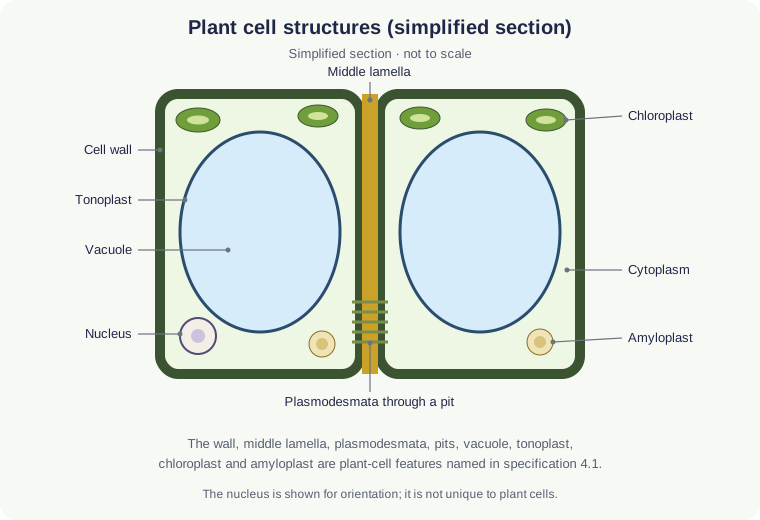
- 4.1(i–ii)cell wallA rigid layer outside the cell membrane. In plants it is made mainly of cellulose; it supports the cell and resists bursting., middle lamellaThe layer of pectin, mainly calcium pectate, that sticks neighbouring plant cell walls together., plasmodesmataChannels through plant cell walls that link the cytoplasm of neighbouring cells. and pits: structure and function, compared with animal cells.
- 4.3celluloseA structural polysaccharide of β-glucose. Straight chains are linked by hydrogen bonds into microfibrils that strengthen plant cell walls. structure, hydrogen bondA weak attraction between a partially positive hydrogen atom and a partially negative atom such as oxygen or nitrogen. between β-glucoseThe form of glucose with the –OH on carbon 1 above the ring. It is the monomer of cellulose. chains and microfibrilA bundle of parallel cellulose chains held together by many hydrogen bonds, giving the cell wall high tensile strength. formation.
β-glucose and cellulose are required here (specification 4.3). They were excluded from Topic 1 storage-polysaccharide notes. Starch is developed in 4A 5. Collenchyma is not one of the tissues named in 4.5.
By the end, you should be able to…
- Describe cellulose as an unbranched β-glucose polymer with hydrogen-bonded microfibrils.
- Explain how the wall, middle lamella, pits and plasmodesmata function.
- Compare these plant-cell features with a typical animal cell.
Build your understanding
A wall animal cells do not have
A typical plant cell is surrounded by a cell wallA rigid layer outside the cell membrane. In plants it is made mainly of cellulose; it supports the cell and resists bursting. outside the cell surface membraneThe partially permeable membrane around a cell that controls which substances enter and leave.. The wall is freely permeable to water and many solutes; it is not a selective barrier. Selectivity remains a property of membranes. The wall resists stretching, so a turgidDescribes a plant cell that is firm because water has entered and its contents push against the cell wall. cell can be supported without collapsing, and neighbouring cells keep a defined shape.
Animal cells lack this celluloseA structural polysaccharide of β-glucose. Straight chains are linked by hydrogen bonds into microfibrils that strengthen plant cell walls. wall, a middle lamellaThe layer of pectin, mainly calcium pectate, that sticks neighbouring plant cell walls together., plasmodesmataChannels through plant cell walls that link the cytoplasm of neighbouring cells., pits, a large permanent vacuoleA fluid-filled sac. In plant cells, the large permanent vacuole contains cell sap and keeps the cell turgid. with a tonoplastThe membrane around the vacuole in a plant cell., chloroplastThe organelle where photosynthesis takes place. It contains thylakoids and stroma. and amyloplasts. Shared organelleA structure inside a cell with a particular function, such as a mitochondrion or ribosome. such as a nucleusThe organelle that contains the cell’s chromosomes, surrounded by a nuclear envelope with pores., mitochondrionThe organelle where the link reaction, Krebs cycle and oxidative phosphorylation of aerobic respiration take place. and ribosomeA small organelle made of rRNA and protein, where translation takes place. are not plant-specific. “Plant cells have a wall” is a start; you still need its chemistry and its consequences.
From β-glucose to a microfibril
Cellulose is a polysaccharideA polymer of many monosaccharides joined by glycosidic bonds, such as starch, glycogen or cellulose. of β-glucoseThe form of glucose with the –OH on carbon 1 above the ring. It is the monomer of cellulose.. condensationA reaction that joins two molecules with a covalent bond and releases a molecule of water. joins monomers by β-1,4 glycosidic bonds, producing long unbranched chains. Each successive residue is rotated relative to the last, so the chain is straight rather than coiled like amyloseThe unbranched part of starch: α-glucose joined by 1,4 glycosidic bonds, coiled into a compact helix..
hydrogen bondA weak attraction between a partially positive hydrogen atom and a partially negative atom such as oxygen or nitrogen. form between hydroxyl groups on neighbouring chains. Bundles of aligned chains make cellulose microfibrilA bundle of parallel cellulose chains held together by many hydrogen bonds, giving the cell wall high tensile strength.: strong, insoluble cables with high tensile strengthThe pulling force a material can withstand before it breaks, usually given per unit cross-sectional area.. A mesh of microfibrils, with other wall polysaccharides, resists turgorThe pressure of a plant cell’s contents pushing outwards against the cell wall. pressure. Insolubility also means the wall is not an osmotic soluteA substance that is dissolved in a solvent. in the way free glucoseA hexose (six-carbon) monosaccharide, C₆H₁₂O₆. It is the main respiratory substrate. would be.
Joining cells and leaving channels
The middle lamella is the pectin-rich layer, including calcium pectate, that cements adjacent walls. It is not the plasma membrane and not cellulose itself. Pits are thinner regions of wall. Plasmodesmata are cytoplasmic strands through pits, so neighbouring protoplasts can exchange solutes without crossing two plasma membranes and the full wall thickness.
Pits in lignifiedDescribes a cell wall strengthened and waterproofed by lignin. cells also allow lateral movement of water between xylemPlant tissue that carries water and mineral ions up from the roots. Its vessels are dead, hollow and lignified. vessels. A pit is a wall feature; a plasmodesma is a living cytoplasmic connection. Do not treat the two words as synonyms.
| Feature | Plant cell | Typical animal cell |
|---|---|---|
| Cellulose wall | Present outside the plasma membrane | Absent |
| Middle lamella | Joins neighbouring walls | Absent |
| Plasmodesmata / pits | Cytoplasmic links through thin wall regions | No equivalent wall pores |
| Tensile strength | Microfibrils resist stretching | Support from cytoskeleton and extracellular matrix, not a cellulose wall |
Make your reasoning visible
Name the monomer and the bond
celluloseA structural polysaccharide of β-glucose. Straight chains are linked by hydrogen bonds into microfibrils that strengthen plant cell walls. is β-glucoseThe form of glucose with the –OH on carbon 1 above the ring. It is the monomer of cellulose. joined by β-1,4 glycosidic bonds. “A sugar polymer” is not enough for 4.3.
Finish the hydrogen-bond story
hydrogen bondA weak attraction between a partially positive hydrogen atom and a partially negative atom such as oxygen or nitrogen. between chains → microfibrilA bundle of parallel cellulose chains held together by many hydrogen bonds, giving the cell wall high tensile strength. → high tensile strengthThe pulling force a material can withstand before it breaks, usually given per unit cross-sectional area. and insolubility. Stop at “hydrogen bonds” and you have not explained the property.
Keep the membrane separate
The wall is permeable. Osmosis and ion selection are membrane processes.
Avoid this misconception
The claim: The cell wallA rigid layer outside the cell membrane. In plants it is made mainly of cellulose; it supports the cell and resists bursting. controls which substances enter a plant cell, like a membrane.
The correction: The wall supports and is permeable. The cell surface membraneThe partially permeable membrane around a cell that controls which substances enter and leave. and tonoplastThe membrane around the vacuole in a plant cell. are the selective barriers.
Check your understanding
Try each question before opening the suggested answer.
Practice question
Retrieval and explanation · suggested answer
Explain how cellulose microfibrils are formed and why they give a wall high tensile strength.
Show suggested answer
β-glucose monomers join by β-1,4 glycosidic bonds into unbranched chains. Hydrogen bonds between chains bundle them into microfibrils that resist stretching.
Practice question
Retrieval and explanation · suggested answer
Distinguish the middle lamella from plasmodesmata.
Show suggested answer
The middle lamella is the pectin-rich cement between adjacent walls. Plasmodesmata are cytoplasmic connections through pits that allow transport between living cells.
Practice question
Retrieval and explanation · suggested answer
Why can a plant cell develop a high internal hydrostatic pressure without bursting as an animal cell might?
Show suggested answer
The cellulose wall resists expansion. Water entering by osmosis raises turgor, but the wall’s tensile strength contains that pressure.
Take the idea further
Apply the same specification knowledge to an unfamiliar problem. Any extra assumptions are supplied in the question.
Stretch question
A mutant plant makes cellulose chains but forms far fewer hydrogen bonds between them. Predict two effects on a turgid leaf cell, stating any assumption.
Show a hint
Separate chain length from how chains pack.
Explore the reasoning
Microfibrils would be weaker, so tensile strength falls and the cell is more likely to distort or burst under turgor. The wall might also be more soluble or less compact if chains pack poorly. Assume other wall components are unchanged; pectin and proteins still contribute, so the cell may not behave as if it had no wall at all.
Recall this lesson
Lesson recall questions
Question 1 of 5: What is a plasmodesma?
Plant cell ultrastructure
Practice question
Retrieval and explanation · suggested answer
What is a plasmodesma?
Try this from memory first.
Put your biology to work
Explore where these ideas appear in the world. Enrichment, not extra required recall.
Why cellulose is a structural fibre
4A · The Cell WallA review of plant materials describes cellulose microfibrils as the main structural fibre of plant cell walls, with a very high stiffness compared with the surrounding matrix of…Specification 4.3Read & use the scienceClose article
Why this matters
A review of plant materials describes cellulose microfibrils as the main structural fibre of plant cell walls, with a very high stiffness compared with the surrounding matrix of hemicellulose, pectin or lignin. Engineers study that hierarchy when they design wood, paper and plant-fibre composites. The modulus values in the paper are research measurements, not numbers you must recall. Cellulose consists of β-glucose units arranged in long chains. Hydrogen bonds between neighbouring chains strengthen microfibrils; the surrounding wall is also a composite of other substances. A materials scientist can change how fibres are aligned or combined, but the biological explanation begins with bonding and arrangement. The cited review compares levels of structure from molecule to plant material. This does not mean every part of a wall is pure cellulose, nor that one laboratory stiffness value applies to every plant fibre. The specification asks for the structural mechanism.
Back to the specification
Pearson Edexcel IAL Biology · Issue 2, February 2021 · Unit 2, pp. 21–24. The application extends beyond required recall.
- 4.3 understand the structure and function of the polysaccharides starch and cellulose, including the role of hydrogen bonds between the β-glucose molecules in the formation of cellulose microfibrils
Use the science
Why can a high research modulus for cellulose not be copied as a mark-scheme number?
Explore a possible response
It is a measured material property from a particular method and sample. The specification requires the structural explanation, not a memorised modulus.
Explore the source
- Gibson: The hierarchical structure and mechanics of plant materialsJournal of the Royal Society Interface · Abstract
Plant walls record a tree’s history
4A · The Cell WallTree rings form as plants add new tissue and cell walls. US Geological Survey scientists use ring patterns as evidence of past environmental conditions, comparing many trees rather…Specification 4.1(i) · 4.3Read & use the scienceClose article
Why this matters
Tree rings form as plants add new tissue and cell walls. US Geological Survey scientists use ring patterns as evidence of past environmental conditions, comparing many trees rather than reading one ring as a direct weather report. The connection to Unit 2 is structural: cell walls support persistent tissue that can preserve a growth record. Cellulose microfibrils contribute strength, while growth conditions influence how much tissue forms in a season. The climate reconstruction is enrichment; students are still expected to explain the wall and cellulose structure. A narrow ring is a clue that needs context, not a unique diagnosis of drought.
Back to the specification
Pearson Edexcel IAL Biology · Issue 2, February 2021 · Unit 2, pp. 21–24. The application extends beyond required recall.
- 4.1(i) know the structure and ultrastructure of plant cells including cell wall, chloroplast, amyloplast, vacuole, tonoplast, plasmodesmata, pits and middle lamella and be able to compare it with animal cells
- 4.3 understand the structure and function of the polysaccharides starch and cellulose, including the role of hydrogen bonds between the β-glucose molecules in the formation of cellulose microfibrils
Use the science
Why should a narrow tree ring not be interpreted as certain proof of one dry year?
Explore a possible response
Growth can respond to temperature, disease and other factors as well as water. Comparing sites and trees helps test the climate interpretation.
Explore the source
- Tree-ring science and environmental climate trendsUS Geological Survey