By the end of this lesson
- Locate the Brazilian Amazon and outline why it is a globally important rainforest.
- Explain a range of approaches — protection, indigenous territories, law enforcement, market rules, agroforestry and extractive uses — that can limit deforestation.
- Evaluate how far those approaches have worked, including reasons they fail when politics or prices change.
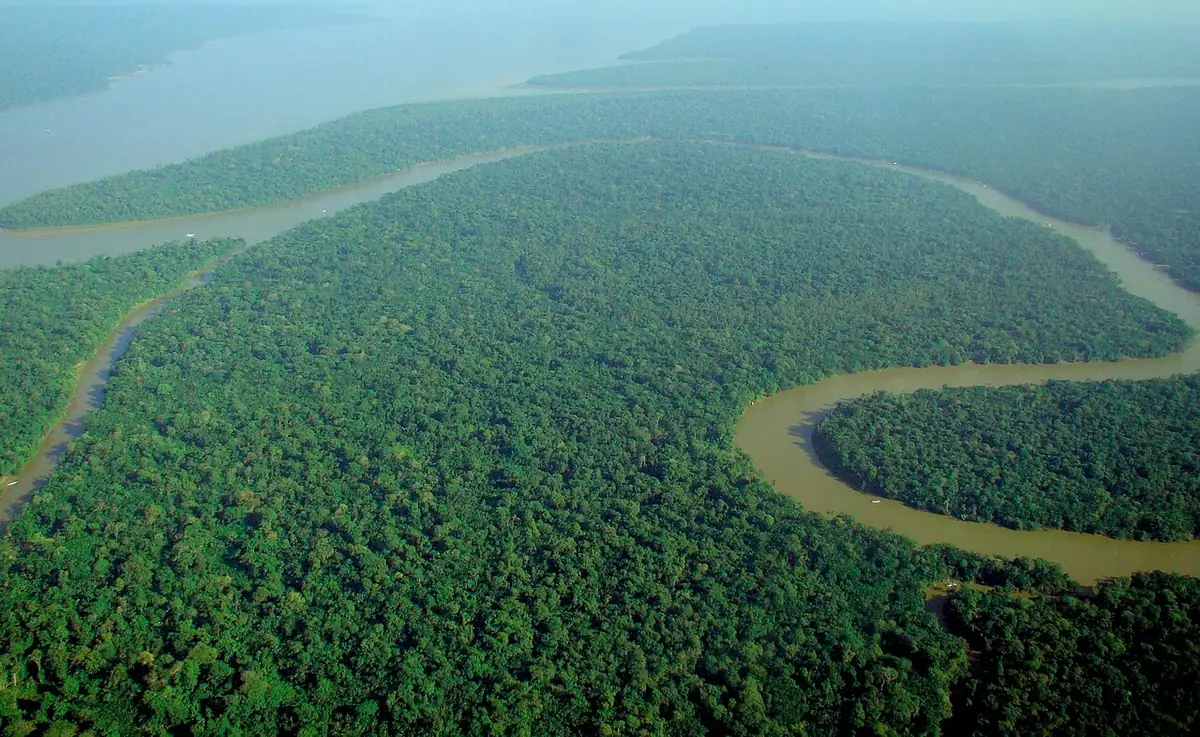
The named rainforest
The specification requires sustainable use and management of a rainforest in a named region. This course uses the Brazilian Amazon — the portion of the Amazon rainforest and associated biomeA large ecological region characterised by its climate and dominant vegetation, with associated animal communities. that lies inside Brazil, covering a large share of the whole Amazon Basin (which also extends into Peru, Colombia and other countries). It is the world’s largest tropical rainforestA dense, layered evergreen forest biome found in warm regions with high rainfall throughout the year., with exceptional biodiversityThe variety of living organisms, including differences within species, between species and among ecosystems., a huge carbon storeA part of a system in which water or other material is held for a period of time., and a major influence on regional rainfall. Millions of people live in the Legal Amazon, including indigenous peoples, traditional extractive communities, urban residents of cities such as Manaus and Belém, and farmers and ranchers along the eastern and southern “arc of deforestationThe clearance of forest so that land is converted to another use.”.
sustainableDescribes meeting present needs while protecting the capacity of future generations to meet their own needs. management here means using the forest and its land in ways that keep enough forest standing to maintain biodiversity, carbon and water functions, while still allowing people to make a living. It is not a demand that nobody ever farms, and it is not achieved by a single national park sticker on a map.
Protection, people and the law
protected areaA designated place managed to conserve habitats, species or landscapes through limits on damaging activities. and indigenous territoryLand recognised as belonging to or being managed by an indigenous community, often supporting local resource stewardship. are among the most effective brakes on clearance when they are actually demarcated and defended. Many maps of Brazilian deforestationThe clearance of forest so that land is converted to another use. show sharper forest edges inside those boundaries than outside them. Indigenous management is not “leaving land empty”; it is active presence, knowledge and legal title. Where titles are weak or invasions are tolerated, the paper boundary fails.
Law enforcement matters. Brazil’s environmental agency IBAMA, and related police and prosecutor actions, have at times fined illegal clearers, seized cattle and halted mills. Satellite monitoring (including INPE’s PRODES and DETER systems) makes large clearances visible quickly, which is a management technology as well as a science project. Enforcement has not been constant: it strengthened in the period when Brazil’s official deforestation rates fell sharply from a mid-2000s peak, and it weakened in some later years when political support and budgets fell and rates rose again. That rise-and-fall is your evaluation backbone — do not invent a single smooth success story.
Market rules and economic alternatives
Because cattle and soy are major drivers, rules in the supply chain can cut deforestationThe clearance of forest so that land is converted to another use. without every hectare needing a ranger. The Amazon soy moratorium (agreed in 2006 by major traders after campaign pressure) committed those companies not to buy soy grown on Amazon forest cleared after a cut-off date, and it is widely credited with helping to decouple soy expansion from new Amazon clearance, even as soy continued on already-cleared land. Similar efforts around cattle have been harder, because the herd is larger and animals are harder to trace. certificationIndependent verification that a product or activity meets defined environmental or social standards. schemes for some timber (for example FSC) try to reward legal, less damaging extraction.
extractive reserveA protected forest area where local communities can harvest products such as nuts and rubber without clearing the forest. and related approaches, associated with the legacy of Chico Mendes and rubber-tapper movements, allow residents to harvest rubber, nuts, oils or other non-timber products while keeping the canopy. agroforestryThe deliberate combination of trees with crops or livestock on the same land. mixes crops and trees so that a plot remains partly forested and soils are protected. ecotourismTourism designed to conserve environments and benefit local communities while limiting damage. can work near accessible wilderness and research stations but will not employ a whole frontier. payments for ecosystem servicesFinancial incentives for people to manage land in ways that maintain benefits such as clean water or carbon storage. and REDD+An international framework rewarding reductions in forest-related emissions alongside conservation, sustainable forest management and increased forest carbon stocks.-style carbon finance aim to make standing forest worth more than felled forest; they depend on trustworthy measurement and on money actually reaching the people who protect the trees.
What still gets in the way
Roads and damA barrier across a river that holds back water and regulates downstream flow. continue to open land. Illegal gold mining has damaged some territories and rivers. Global beef and soy demand still pays for pasture. corruptionThe misuse of entrusted power for private benefit, potentially diverting resources away from development and public services. and violence over land undermine the law. If the national government signals that enforcement is a low priority, opportunistic clearance rises quickly — evidence that Amazon management is political, not only technical. Fires in dry years can destroy forest that was not intentionally clear-felled, especially where the climateThe average weather conditions and their variability in a place over a long period, usually at least 30 years. fringe is already drier. sustainableDescribes meeting present needs while protecting the capacity of future generations to meet their own needs. use therefore has to include fire control and climate policy, not only reserve outlines.
Judging “how sustainable”
A balanced judgement: Brazil has shown that a mix of indigenous rights, parks, satellite-backed enforcement and market moratoria *can* reduce Amazon deforestationThe clearance of forest so that land is converted to another use. substantially below its mid-2000s peak; it has also shown that those gains are reversible. Some reserved forests are well protected; the arc of deforestation remains active; some communities still lack viable incomes from standing forest. sustainableDescribes meeting present needs while protecting the capacity of future generations to meet their own needs. management is a direction of travel, not a stamp on the whole basin.
Exam workshop — writing the named-region case
First sentence: name the Brazilian Amazon. Locate it. Then explain at least three approaches in depth (for example indigenous territoryLand recognised as belonging to or being managed by an indigenous community, often supporting local resource stewardship., IBAMA/satellite enforcement, and the soy moratorium), each with a mechanism. Then evaluate using the fall and later rise in clearance rates, and using the idea that cattle tracing is harder than soy tracing. If the insert gives a hectare graph, describe it; prefer those numbers to memory.
Worked example: a map shows low loss inside a labelled indigenous territory and high fishbone loss outside, along a highway. Describe the contrast. Explain legal title plus presence versus road-enabled ranching. Evaluate: the territory works *if* invasions are opposed; a new road around its edge could still raise future pressure.
Misconception check: “the Amazon is uninhabited and should just be fenced” erases millions of residents and misses the evidence that indigenous territories are themselves a management tool. “sustainableDescribes meeting present needs while protecting the capacity of future generations to meet their own needs. management has solved deforestationThe clearance of forest so that land is converted to another use.” is equally false.
Exam craft for this page (f09, note 1). Return to the figure before you add another memorised sentence. Describe the pattern or the calculation that is actually printed, name the process this lesson taught, and only then evaluate what the evidence cannot show. A controlled paragraph of that kind is worth more than a longer paragraph that could have been written without looking at the insert. If the command word is compare, give one shared feature and one difference; if it is explain, give a because clause; if it is assess, end with a judgement that uses a criterion such as sustainability, equity or uncertainty. Practise saying the named specification terms out loud so they appear naturally under time pressure rather than as a panicked list at the end. Teachers can see the difference because your last sentence will answer the question that was asked, not a neighbouring question from revision notes.
Exam craft for this page (f09, note 2). Return to the figure before you add another memorised sentence. Describe the pattern or the calculation that is actually printed, name the process this lesson taught, and only then evaluate what the evidence cannot show. A controlled paragraph of that kind is worth more than a longer paragraph that could have been written without looking at the insert. If the command word is compare, give one shared feature and one difference; if it is explain, give a because clause; if it is assess, end with a judgement that uses a criterion such as sustainability, equity or uncertainty. Practise saying the named specification terms out loud so they appear naturally under time pressure rather than as a panicked list at the end. Teachers can see the difference because your last sentence will answer the question that was asked, not a neighbouring question from revision notes.
Exam craft for this page (f09, note 3). Return to the figure before you add another memorised sentence. Describe the pattern or the calculation that is actually printed, name the process this lesson taught, and only then evaluate what the evidence cannot show. A controlled paragraph of that kind is worth more than a longer paragraph that could have been written without looking at the insert. If the command word is compare, give one shared feature and one difference; if it is explain, give a because clause; if it is assess, end with a judgement that uses a criterion such as sustainability, equity or uncertainty. Practise saying the named specification terms out loud so they appear naturally under time pressure rather than as a panicked list at the end. Teachers can see the difference because your last sentence will answer the question that was asked, not a neighbouring question from revision notes.
Exam craft for this page (f09, note 4). Return to the figure before you add another memorised sentence. Describe the pattern or the calculation that is actually printed, name the process this lesson taught, and only then evaluate what the evidence cannot show. A controlled paragraph of that kind is worth more than a longer paragraph that could have been written without looking at the insert. If the command word is compare, give one shared feature and one difference; if it is explain, give a because clause; if it is assess, end with a judgement that uses a criterion such as sustainability, equity or uncertainty. Practise saying the named specification terms out loud so they appear naturally under time pressure rather than as a panicked list at the end. Teachers can see the difference because your last sentence will answer the question that was asked, not a neighbouring question from revision notes.
Exam craft for this page (f09, note 5). Return to the figure before you add another memorised sentence. Describe the pattern or the calculation that is actually printed, name the process this lesson taught, and only then evaluate what the evidence cannot show. A controlled paragraph of that kind is worth more than a longer paragraph that could have been written without looking at the insert. If the command word is compare, give one shared feature and one difference; if it is explain, give a because clause; if it is assess, end with a judgement that uses a criterion such as sustainability, equity or uncertainty. Practise saying the named specification terms out loud so they appear naturally under time pressure rather than as a panicked list at the end. Teachers can see the difference because your last sentence will answer the question that was asked, not a neighbouring question from revision notes.
Exam craft for this page (f09, note 6). Return to the figure before you add another memorised sentence. Describe the pattern or the calculation that is actually printed, name the process this lesson taught, and only then evaluate what the evidence cannot show. A controlled paragraph of that kind is worth more than a longer paragraph that could have been written without looking at the insert. If the command word is compare, give one shared feature and one difference; if it is explain, give a because clause; if it is assess, end with a judgement that uses a criterion such as sustainability, equity or uncertainty. Practise saying the named specification terms out loud so they appear naturally under time pressure rather than as a panicked list at the end. Teachers can see the difference because your last sentence will answer the question that was asked, not a neighbouring question from revision notes.
Exam craft for this page (f09, note 7). Return to the figure before you add another memorised sentence. Describe the pattern or the calculation that is actually printed, name the process this lesson taught, and only then evaluate what the evidence cannot show. A controlled paragraph of that kind is worth more than a longer paragraph that could have been written without looking at the insert. If the command word is compare, give one shared feature and one difference; if it is explain, give a because clause; if it is assess, end with a judgement that uses a criterion such as sustainability, equity or uncertainty. Practise saying the named specification terms out loud so they appear naturally under time pressure rather than as a panicked list at the end. Teachers can see the difference because your last sentence will answer the question that was asked, not a neighbouring question from revision notes.
Common misconceptions
Not quite: The Amazon rainforest lies only in Brazil.
Instead: Brazil contains the largest share, but the basin extends into several neighbouring countries.
Not quite: Sustainable management means nobody lives in or uses the forest.
Instead: Extractive reserves, indigenous territories and agroforestry are forms of use that can keep forest standing.
Not quite: A soy or beef moratorium automatically covers every hectare.
Instead: It applies to signatories and to what they can trace. Leakage onto unsold or informal markets remains a risk, especially for cattle.
Exam tips
Name the region in sentence one
{The Brazilian Amazon} is the named rainforest for this course — say so immediately.
Explain mechanisms
Parks, indigenous title, fines, satellite alerts and buyer rules each {change the cost or reward of clearance} in a different way.
Evaluate with reversibility
Brazil’s deforestation decline after the mid-2000s {can be, and in some years has been, reversed} when politics and prices shift.