By the end of this lesson
- Describe a range of technologies used to store, save, find or reuse water in drylands.
- Explain how those technologies can reduce water shortages — and how poorly chosen ones can worsen desertification.
- Evaluate intermediate and high-tech options against cost, energy, maintenance and equity.
Technology is more than a shiny pump
The specification asks how technology can resolve water-resource shortages in fragile environmentAn environment easily damaged by change or pressure and often slow to recover. under threat from desertificationThe degradation of land in dry regions through climatic variations and human activities, reducing its biological productivity.. Technology here includes high-tech options (desalinationThe removal of dissolved salts from seawater or saline water to produce usable fresh water., deep boreholeA narrow drilled shaft used to reach groundwater for abstraction or monitoring., remote sensingThe collection of information about Earth's surface from a distance, usually by satellites or aircraft., drip systems with timers) and lower-cost, often local techniques (stone lineA row of stones placed along a slope contour to slow runoff, trap sediment and improve infiltration., planting pits, small earth damA barrier across a river that holds back water and regulates downstream flow., clay-lined ponds, fog netA mesh structure that captures airborne water droplets from fog for collection and use. in a few coastal desertA biome with very low precipitation and sparse vegetation adapted to water shortage.). A good answer names several, explains the water process each uses, and evaluates. “Build wells” as a complete essay will not do, because we have already seen wells concentrate grazing pressure.
The aim is reliable water for people, animals and crops without destroying the vegetation that holds the dryland together. That is a management problem as much as an engineering one.
Finding and storing water
boreholeA narrow drilled shaft used to reach groundwater for abstraction or monitoring. tap groundwaterWater stored below the water table in saturated rock and sediment.. They can transform a village’s health and keep herds alive through a failed rainy season. riskThe combination of the likelihood of harm and the seriousness of its consequences. include falling water tables if extraction exceeds recharge, high pumping costs when diesel or solar gear fails, and the bare rings of overgrazingThe removal of vegetation by livestock faster than it can regrow, exposing soil to erosion. described earlier. Successful projects often combine a well with agreed rules about herd numbers and rest days for surrounding pasture.
Small dams, bunds and ponds hold surface water from the short wet season. They are visible, repairable with local labour, and can recharge nearby wells. They silt up, evaporate, and can breed mosquitoes if poorly designed. Larger reservoirs storeA part of a system in which water or other material is held for a period of time. more but lose more to evaporationThe change of liquid water into water vapour at a surface, using energy from the surroundings. in hot drylands and may be socially contested.
In a few places, fog netA mesh structure that captures airborne water droplets from fog for collection and use. or dew collectors tease water from air on cool, foggy coasts (parts of the Atacama-facing Andes or Namib are textbook illustrations). They are niche, not a Sahel-wide solution — say so if you use them. Remote sensing and seasonal forecasts are information technologies: they do not create water, but they help people move herds, plant later, or request assistance before a crisis peaks.
Using less water to grow more
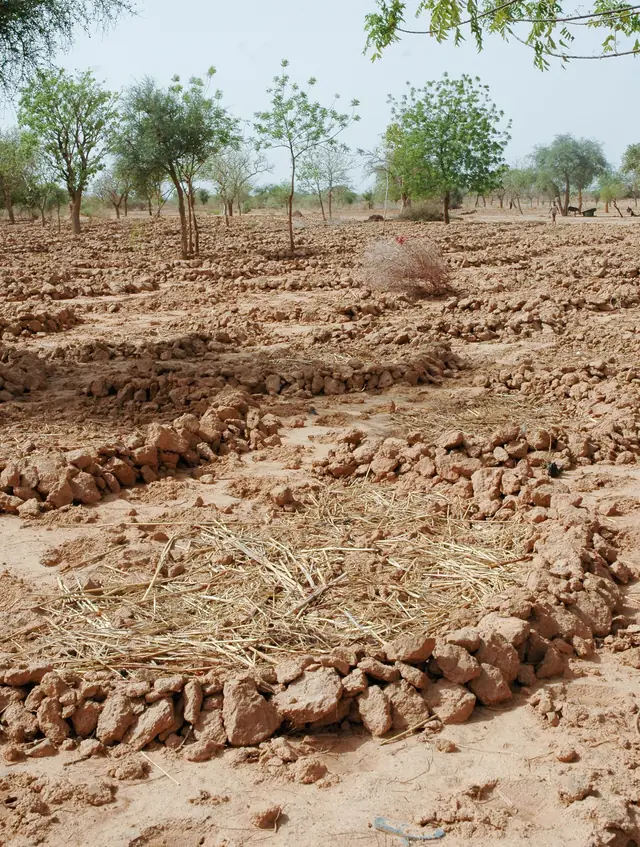
drip irrigationA watering method delivering small amounts directly to plant roots to reduce evaporation and water waste. delivers water to the root zone through pipes and emitters, cutting the waste of flood irrigation in hot, windy air. It can make commercialDescribes farming whose main purpose is to produce goods for sale. fruit or vegetable production possible in dry areas and reduce salinisation if it avoids waterlogging. It needs capital, filters (because emitters clog), and a reliable pump. Drought-resistant or shorter-cycle varieties, including some conventionally bred millet and sorghum and, more controversially, some GM cropsCrops whose genetic material has been altered using biotechnology to introduce selected characteristics., are biological technologies that reduce the water needed for a harvest. Mulching and zai / tassa planting pits, and stone lineA row of stones placed along a slope contour to slow runoff, trap sediment and improve infiltration. laid along contourA line on a map joining points of equal height above sea level. (widely associated with farmers in parts of Burkina Faso and neighbouring countries, sometimes called “magic stones” in older school texts), slow runoff so that scarce rain infiltrates. These are technologies even though they are made of earth and stone: they change the path of water on purpose.
recycling wastewaterThe treatment and reuse of previously used water for purposes such as irrigation or industrial supply. and treating grey water for trees or some crops stretches an urban or oasis supply. desalinationThe removal of dissolved salts from seawater or saline water to produce usable fresh water. turns seawater or brackish water into drinking water, which can rescue a coastal city, but it is energy-hungry, expensive, and produces a salty brine that must go somewhere. For an inland Sahelian village it is usually the wrong scale.
Matching the fix to the place
Evaluate every option against four tests: does it increase useful water, can local people maintain it, who can afford it, and does it protect vegetation? Solar pumps score well on running-cost and carbon compared with diesel, but they can over-extract if they run all day without rules. A stone lineA row of stones placed along a slope contour to slow runoff, trap sediment and improve infiltration. scores well on maintenance and soil protection but will not supply a town. desalinationThe removal of dissolved salts from seawater or saline water to produce usable fresh water. scores well on volume for a rich coastal state and poorly on equity for a landlocked farmer.
Worked example: a project installs a solar boreholeA narrow drilled shaft used to reach groundwater for abstraction or monitoring. in a pastoralDescribes farming that rears livestock for products such as meat, milk or wool. area without a grazing plan. Short-term impact: women walk less for water, child health improves, herds survive a dry year. Medium-term riskThe combination of the likelihood of harm and the seriousness of its consequences.: livestock numbers grow, the pasture ring dies, some households become more dependent on a single point that fails when a panel or pump breaks. The evaluation is not “solar is bad”; it is “water technology without land management can deepen desertificationThe degradation of land in dry regions through climatic variations and human activities, reducing its biological productivity.”.
Technology plus social rules
The most durable dryland successes combine kit with institutions: water-user committees, maintained stone lineA row of stones placed along a slope contour to slow runoff, trap sediment and improve infiltration., agreed rest rotations, and national support for spare parts. non-governmental organisationAn organisation independent of government that works towards aims such as humanitarian relief, development or environmental protection. and governments have promoted farmer-to-farmer training so that pits and bunds spread without each village waiting for an imported engineer. That still counts as technology transfer. Mentioning only imported machines underestimates what dryland farmers already invent.
Exam workshop — named techniques and honest limits
A typical question: “Explain how technology can be used to manage water shortages in a fragile environmentAn environment easily damaged by change or pressure and often slow to recover..” Name at least three techniques at different scales (for example stone lineA row of stones placed along a slope contour to slow runoff, trap sediment and improve infiltration. or zai pits, a managed boreholeA narrow drilled shaft used to reach groundwater for abstraction or monitoring., drip irrigationA watering method delivering small amounts directly to plant roots to reduce evaporation and water waste. or desalinationThe removal of dissolved salts from seawater or saline water to produce usable fresh water.), locate them in a dryland type, and evaluate one. If the insert shows a photo of contourA line on a map joining points of equal height above sea level. stone lines, describe how they pond rain and trap sediment, then explain the crop-yield gain, then add a limit (labour to build them, they do not help if rain fails completely).
Misconception check: technology cannot “resolve” droughtA prolonged period of unusually low precipitation that creates water deficits for ecosystems and people. in the sense of making rainfall reliable. It can storeA part of a system in which water or other material is held for a period of time., save, find and share what water there is, and it can reduce the damage drought does. Over-claiming invites a sharp examiner.
Exam craft for this page (f08, note 1). Return to the figure before you add another memorised sentence. Describe the pattern or the calculation that is actually printed, name the process this lesson taught, and only then evaluate what the evidence cannot show. A controlled paragraph of that kind is worth more than a longer paragraph that could have been written without looking at the insert. If the command word is compare, give one shared feature and one difference; if it is explain, give a because clause; if it is assess, end with a judgement that uses a criterion such as sustainability, equity or uncertainty. Practise saying the named specification terms out loud so they appear naturally under time pressure rather than as a panicked list at the end. Teachers can see the difference because your last sentence will answer the question that was asked, not a neighbouring question from revision notes.
Exam craft for this page (f08, note 2). Return to the figure before you add another memorised sentence. Describe the pattern or the calculation that is actually printed, name the process this lesson taught, and only then evaluate what the evidence cannot show. A controlled paragraph of that kind is worth more than a longer paragraph that could have been written without looking at the insert. If the command word is compare, give one shared feature and one difference; if it is explain, give a because clause; if it is assess, end with a judgement that uses a criterion such as sustainability, equity or uncertainty. Practise saying the named specification terms out loud so they appear naturally under time pressure rather than as a panicked list at the end. Teachers can see the difference because your last sentence will answer the question that was asked, not a neighbouring question from revision notes.
Exam craft for this page (f08, note 3). Return to the figure before you add another memorised sentence. Describe the pattern or the calculation that is actually printed, name the process this lesson taught, and only then evaluate what the evidence cannot show. A controlled paragraph of that kind is worth more than a longer paragraph that could have been written without looking at the insert. If the command word is compare, give one shared feature and one difference; if it is explain, give a because clause; if it is assess, end with a judgement that uses a criterion such as sustainability, equity or uncertainty. Practise saying the named specification terms out loud so they appear naturally under time pressure rather than as a panicked list at the end. Teachers can see the difference because your last sentence will answer the question that was asked, not a neighbouring question from revision notes.
Exam craft for this page (f08, note 4). Return to the figure before you add another memorised sentence. Describe the pattern or the calculation that is actually printed, name the process this lesson taught, and only then evaluate what the evidence cannot show. A controlled paragraph of that kind is worth more than a longer paragraph that could have been written without looking at the insert. If the command word is compare, give one shared feature and one difference; if it is explain, give a because clause; if it is assess, end with a judgement that uses a criterion such as sustainability, equity or uncertainty. Practise saying the named specification terms out loud so they appear naturally under time pressure rather than as a panicked list at the end. Teachers can see the difference because your last sentence will answer the question that was asked, not a neighbouring question from revision notes.
Exam craft for this page (f08, note 5). Return to the figure before you add another memorised sentence. Describe the pattern or the calculation that is actually printed, name the process this lesson taught, and only then evaluate what the evidence cannot show. A controlled paragraph of that kind is worth more than a longer paragraph that could have been written without looking at the insert. If the command word is compare, give one shared feature and one difference; if it is explain, give a because clause; if it is assess, end with a judgement that uses a criterion such as sustainability, equity or uncertainty. Practise saying the named specification terms out loud so they appear naturally under time pressure rather than as a panicked list at the end. Teachers can see the difference because your last sentence will answer the question that was asked, not a neighbouring question from revision notes.
Exam craft for this page (f08, note 6). Return to the figure before you add another memorised sentence. Describe the pattern or the calculation that is actually printed, name the process this lesson taught, and only then evaluate what the evidence cannot show. A controlled paragraph of that kind is worth more than a longer paragraph that could have been written without looking at the insert. If the command word is compare, give one shared feature and one difference; if it is explain, give a because clause; if it is assess, end with a judgement that uses a criterion such as sustainability, equity or uncertainty. Practise saying the named specification terms out loud so they appear naturally under time pressure rather than as a panicked list at the end. Teachers can see the difference because your last sentence will answer the question that was asked, not a neighbouring question from revision notes.
Exam craft for this page (f08, note 7). Return to the figure before you add another memorised sentence. Describe the pattern or the calculation that is actually printed, name the process this lesson taught, and only then evaluate what the evidence cannot show. A controlled paragraph of that kind is worth more than a longer paragraph that could have been written without looking at the insert. If the command word is compare, give one shared feature and one difference; if it is explain, give a because clause; if it is assess, end with a judgement that uses a criterion such as sustainability, equity or uncertainty. Practise saying the named specification terms out loud so they appear naturally under time pressure rather than as a panicked list at the end. Teachers can see the difference because your last sentence will answer the question that was asked, not a neighbouring question from revision notes.
Common misconceptions
Not quite: The only real water technology is a deep modern borehole.
Instead: Earth bunds, stone lines, planting pits and small ponds are technologies too, and often easier to maintain.
Not quite: Desalination can solve dryland shortages everywhere.
Instead: It is costly and energy-intensive, and it is tied to a saline water source — usually a coast.
Not quite: More water always means less desertification.
Instead: Extra water can raise herd sizes and expand cultivation onto land that cannot sustain them.
Exam tips
Name techniques at more than one scale
Combine a {field-scale} idea such as stone lines or drip with a {community-scale} store or well.
Evaluate with four tests
{Water gained, maintainability, who pays, what happens to vegetation}.
Remember the overgrazing ring
A well that ignores pasture rules can {increase} desertification while fixing a drinking-water shortage.